Chicago After Dark – Part 8: When the Music Made You Move
May 13, 2026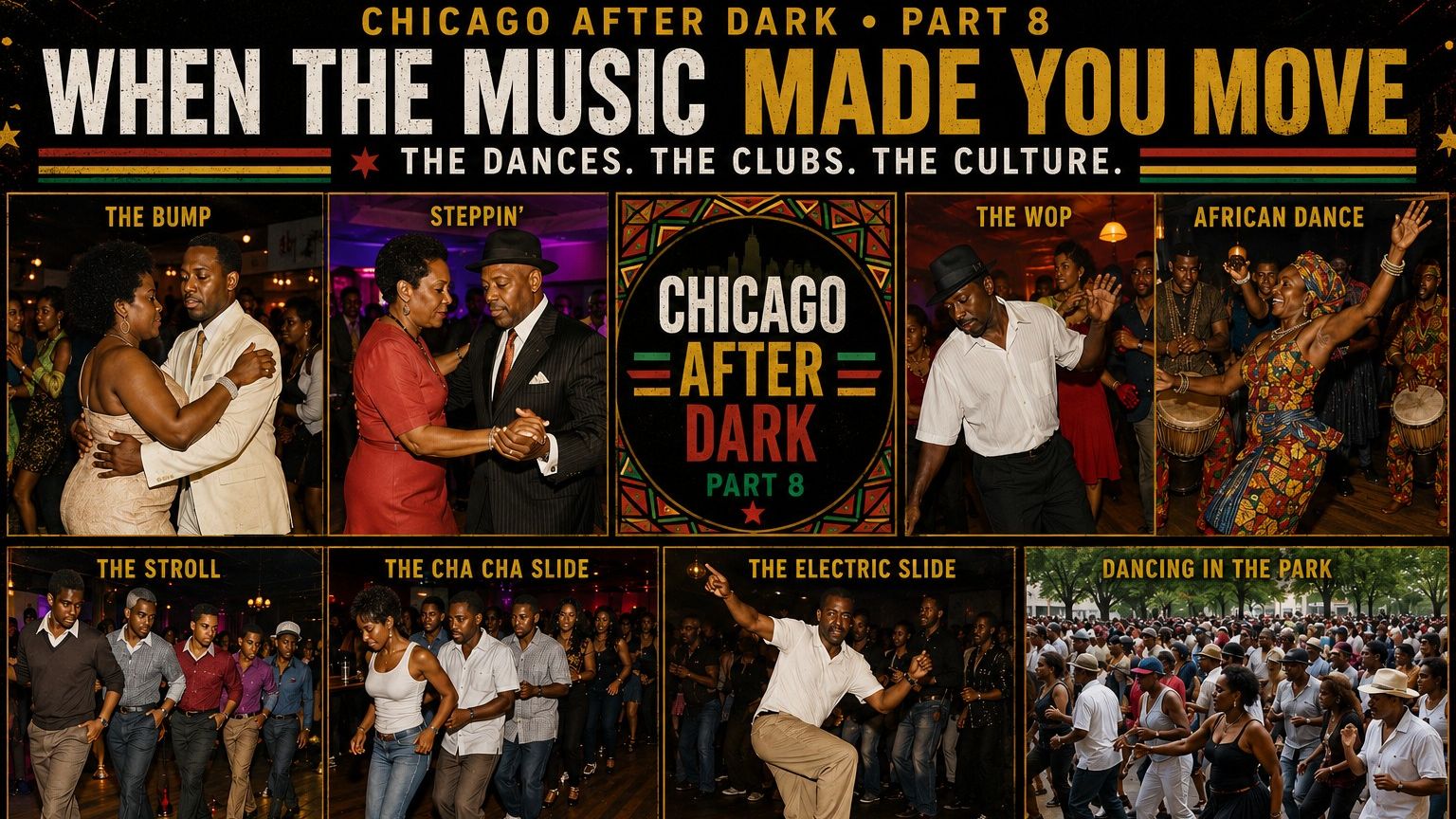
From the Charleston to Jacking — A Century of Black Dance, Black Chicago, and the Body as a Form of Resistance
We have spent seven parts of this series talking about the rooms. The clubs, the supper lounges, the record stores, the radio stations, the warehouse floors. We've talked about the DJs and the bandleaders, the promoters and the producers, the men and women who built Black Chicago's nightlife from the ground up — through Prohibition, through the Depression, through redlining and urban renewal and everything else the city threw at them.
But we haven't talked about what happened in the middle of all those rooms. We haven't talked about the dancing.
And that is a serious oversight. Because in Black Chicago — in Black America — dance has never been just entertainment. It has been language. It has been defiance. It has been memory passed from body to body when other forms of transmission were denied. When you couldn't own property in certain neighborhoods, when you couldn't vote without fear, when your music was called noise and your culture was called nothing — you could still move. And the way Black Americans moved, decade after decade, told a story that no one could take away.
This is that story. Seven eras. Seven sets of dances. One continuous conversation between a people and their music, their history, and each other.
Part 1 Connection: The Jazz Age — The Charleston and the Lindy Hop (1920s)
"Jazz and the blues are a way of asserting yourself. You could say the Charleston was the same thing."
When Prohibition arrived in 1920, it didn't stop Black Chicago from having a good time. It just moved the party underground — into the basement clubs and basement bars, the speakeasies that dotted the South Side's State Street corridor and spilled into the side streets off Bronzeville. And in those rooms, in defiance of everything that said Black people should be invisible and quiet, people danced.
The Charleston was the dance of the 1920s — arms swinging, knees knocking inward, feet kicking out to the side in a move that looked joyful and loose and free. It had roots in African American communities in South Carolina and traveled north with the Great Migration, arriving in Chicago and New York at roughly the same time. When white flappers picked it up and made it the symbol of the Roaring Twenties, most of the country forgot where it came from. But Black Chicago knew. The Charleston was theirs first.
The flapper era brought its own visual drama: dropped waists, fringe skirts that shimmied when you moved, headbands and feathers, long beads that swung in time with the music. For Black women in that era, the silhouette was slightly different — more color, more layering, the influence of African and Southern aesthetics woven into the fashion. These were women who were working domestic jobs by day and dancing free by night, and the way they dressed for that dance was itself an act of reclamation.
But the dance that truly defined the era — and that Black Chicago could claim without argument — was the Lindy Hop.
Named for Charles Lindbergh's 1927 transatlantic flight (someone at Harlem's Savoy Ballroom, asked what the dancers were doing, said they were "hopping like Lindy"), the Lindy Hop was acrobatic, improvisational, and built on a partnership between two people who trusted each other completely. It had air steps — lifts and flips and throws — that required real athleticism. It was developed by Black dancers at the Savoy in Harlem, but it traveled quickly. By the late 1920s it was in Chicago, on the South Side, in the ballrooms and the clubs and the basement speakeasies where jazz was playing and no one was going home early.
The Lindy Hop was not a polite dance. It was a full-body, full-commitment, everything-you-have kind of dance. And that was the point.
👉 Watch: Lindy Hop and Charleston — The Dances That Started It All — Watch what this actually looked like. The athleticism alone will stop you cold.
Part 2 Connection: The Stroll Era — Swing, the Jitterbug, and the Big Apple (1930s–40s)
"The Stroll wasn't just a street. It was a stage, and everybody on it was performing."
By the 1930s, swing music had arrived, and with it came a new set of dances built for big bands, big ballrooms, and big feeling. The Jitterbug was the Lindy Hop's wilder cousin — faster, looser, with even more room for improvisation. You didn't have to know the steps in advance. You had to know your partner and trust the music.
The Big Apple was a circle dance with a caller — someone in the middle who would shout out moves and the whole group would execute them together. It was communal and theatrical and could go on for as long as the music held. There was something deeply African in its structure — the circle, the caller, the collective response — that made it feel familiar even to people who couldn't have told you why.
And then there was the dance that didn't have a formal name but that everyone on the South Side understood: the slow drag. Blues music played low, two people close together, moving through the room like they had nowhere else to be and all the time in the world to get there. The slow drag was intimacy made visible. It was also, in a world where so much of Black private life was surveilled and judged, a quiet insistence on tenderness.
Chicago's Savoy Ballroom (not Harlem's — Chicago had its own, at 47th and South Parkway) was where a lot of this happened at scale. Thousands of people, dressed in their best, moving through the room together. These were not people who were supposed to be there — not according to the city's redlining maps, not according to the housing policies that tried to hem them in. But they were there, dressed impeccably, dancing like it mattered. Because it did.
👉 Watch: Jitterbug and Swing — The Dances of the Big Band Era — Pay attention to the footwork. This took practice. This took commitment.
Part 3 Connection: Dressed Up and Stepping Out — Mambo, Cha-Cha, and Early R&B (Late 1940s–50s)
"You didn't just show up. You showed out."
The late 1940s and 1950s brought a new sophistication to Black Chicago's dance floors. The supper clubs and show lounges that we described in Part 3 — the ones where people dressed to the nines before they ever set foot in the door — demanded a different kind of dancing. Still expressive. Still rooted. But polished now. Partnered. Precise.
Latin rhythms swept through Black America in this period. Mambo — invented in Cuba and popularized by Tito Puente and Pérez Prado — hit Chicago's dance floors like a weather event. It was fast, syncopated, built around a pause on the first beat that made the dancer look like they were about to explode before they finally did. You had to be able to hold tension and release it, hold it and release it, again and again. Black Chicagoans took to it immediately. The rhythm was different but the instinct was the same.
Cha-Cha followed — slightly slower, slightly more playful, with that characteristic triple step that sounded like the words themselves when the music played: cha-cha-cha. It was a couples dance, intimate but not slow, technical but not cold. It was the kind of dance you could do in a room full of people and still feel like you and your partner were the only two there.
And then there was what was emerging from the R&B records coming out of the late 1940s — something harder to name because it didn't have a name yet. It was Black social dancing loosening up from the formality of the swing era, becoming more individual, more improvised, more rooted in the blues feeling of the music itself. People were starting to move differently — more from the hips, more from their own interior rhythm rather than a shared set of steps. It was the beginning of something that would define the next twenty years.
👉 Watch: Mambo and Latin Rhythms on the Black Dance Floor — Watch how the body holds and releases. That tension is the dance.
Part 4 Connection: The Supper Club Floor — The Stroll, the Hand Jive, and the Twist (Late 1950s–Early 60s)
"Chubby Checker put it on TV, but Black folks had been doing it. We always had been."
By the late 1950s, something was shifting on dance floors across Black America. The big band era was winding down. Rock and roll was arriving. And with it came dances that were, to the older generation, scandalous — and to everyone under thirty, absolutely necessary.
The Stroll was a line dance that became nationally popular after appearing on Dick Clark's American Bandstand in 1957. Two lines facing each other, couples taking turns dancing down the middle while the rest kept the groove going. It looked social and organized. It was also deeply communal — the kind of dance that made you feel part of something larger than yourself. Black teens had been doing variations of this for years before it went national.
Then came The Twist.
Chubby Checker performed it on American Bandstand in 1960 and the country lost its mind. White parents were horrified. White teenagers were obsessed. But Black people — particularly Black Chicagoans who had been going to house parties and basement dances and neighborhood clubs for years — recognized The Twist as something that had been in circulation long before Checker made it famous. The original recording was by Hank Ballard, a Black R&B artist who had been performing it since 1958.
What made The Twist culturally significant wasn't just the move itself — though the move (hips rotating, arms pumping, feet planted) was genuinely freeing. What made it significant was what it represented: dancing without a partner. For the first time in mainstream popular culture, you didn't need someone else to dance. You just needed yourself, your body, and the music. That shift was enormous. It opened the door for everything that came after.
The Hand Jive — popularized around the same time — was its own kind of revolution. You could do it sitting down. You could do it without moving your feet. It was rhythm expressed through hands and arms, a dance built for spaces too crowded to move in, for people who were going to find a way to move regardless of the circumstances. That is a very Black American instinct.
👉 Watch: Chubby Checker and The Twist — Watch the move that changed everything. Notice how nobody needs a partner.
👉 Watch: How to Do the Hand Jive — Rhythm expressed through hands and arms, for every room too crowded to move in.
Part 5 Connection: The Price of the Party — The Boogaloo, the Funky Chicken, and Soul Train (Late 1960s–70s)
"Soul Train didn't just show you the dances. It showed you that Black people were beautiful. Every Saturday morning, it said that out loud."
The late 1960s were a reckoning. The Civil Rights Movement was in the streets. The assassination of Dr. King shook the country. Black Power was asserting itself as both philosophy and aesthetic. And Black American dance responded — became more Afrocentric, more deliberate, more rooted in an identity that refused to be diminished.
The Boogaloo — sometimes spelled Bugaloo — arrived in the mid-1960s and was pure improvisation. It had no set steps. You moved your whole body independently: head going one way, hips going another, shoulders doing something else entirely. It was a dance of self-expression, almost defiant in its refusal to be standardized. In the same era came the Funky Chicken — arms flapping, knees pumping, completely ridiculous in the best possible way. These dances asked nothing of you except that you commit completely and not care how you looked.
And then, in 1971, Don Cornelius launched Soul Train in Chicago before taking it national, and everything changed.
Soul Train was the first nationally syndicated television program hosted by and for Black Americans. Every Saturday morning, it broadcast from a studio in Chicago (and later Los Angeles) with the best Black artists of the era performing while real young people danced in the aisles. The Soul Train line — two rows of dancers facing each other while a couple danced down the middle — became one of the most iconic images in American television history. It was the Stroll evolved, grown up, and given a national stage.
What Soul Train did culturally cannot be overstated. It told Black young people every Saturday that they were stylish, beautiful, talented, and worth watching. It standardized and circulated dances that might otherwise have stayed regional. And it made Black Chicago — the city where it was born — part of that story permanently.
The Hustle arrived in the mid-1970s with disco, bringing partnered dancing back after a decade of solo improvisation. Disco itself was, like house music would be after it, born in Black and Latino and gay communities — a music of people who needed somewhere to belong. The Hustle was its signature dance: smooth, syncopated, with specific patterns that you had to learn but that rewarded the learning with a feeling of elegance and mastery. When Saturday Night Fever came out in 1977 and John Travolta did the Hustle on screen, the country called it a "new" dance. It wasn't new. It had been in the clubs for years.
👉 Search YouTube: "Soul Train line 1970s" — This is required viewing. Block out fifteen minutes. You will not regret it.
Part 6 Connection: The Nightclub Circuit — Hip Hop, Breaking, and Popping and Locking (Late 1970s–80s)
"Break dancing wasn't just a dance. It was a battle. And the floor was the arena."
By the late 1970s, something new was being born in the Bronx. Hip hop — the culture, not just the music — arrived with its own vocabulary, its own aesthetics, and its own dances. And like every Black American cultural movement before it, it traveled. Chicago received it and added to it.
Breaking — what the media called "break dancing" — was a physically demanding art form that took the athletic energy of the Lindy Hop and pushed it somewhere entirely new. B-boys and B-girls competed on the floor: freezes and footwork, head spins and windmills, toprock and downrock, all of it done in response to the breakbeats that DJs like Kool Herc were isolating and extending in New York. Chicago's breakers added their own flavor. The city had always had dancers — the South Side produced some of the most technically gifted — and they brought that legacy to the new form.
Popping and Locking came from the West Coast — from the Electric Boogaloos in Fresno, California — but spread nationally through Soul Train. Popping involved a rapid muscle contraction that made the dancer's body appear to pop or jerk at specific points, timed to the beat. Locking was its own distinct style: sudden, sharp freezes interspersed with fluid motion. Together they formed the aesthetic of a body that understood its own mechanics at a level most people never reached. The robot. The wave. The moonwalk — which Michael Jackson popularized in 1983 but which had roots in popping and locking circles years earlier.
Michael Jackson himself is worth stopping for. He grew up in Gary, Indiana — twenty-five miles from Chicago's South Side — and his entire visual language was built on the foundation of Black social dance that had been developing for fifty years before he arrived. The moonwalk. The slide. The kick. The spin. These were not invented from nothing. They came from a lineage.
By the mid-1980s, hip hop dance had moved beyond breaking and popping into a broader set of moves that varied by city, by neighborhood, by crew. The Running Man, the Cabbage Patch, the Smurf, the Wop — these were dances that spread through high schools and house parties and block parties, passed from person to person the same way dances had always been passed: through watching, through imitation, through the body learning from other bodies.
👉 Search YouTube: "1980s breaking battle South Side Chicago" and Search YouTube: "popping locking Soul Train 1980s"
Part 7 Connection: House Music — Jacking, Footwork, and Chicago Stepping (1980s–Present)
"You didn't learn Jacking from anyone. You felt the music and your body figured it out. That's the whole point."
And then we arrive at the dances that belong to Chicago specifically. Not dances that came from somewhere else and landed here. Dances that were born here, on South Side dance floors, in West Loop warehouse clubs, in a musical culture that Chicago built from the ground up.
Jacking was what people did at the Warehouse and the Music Box and the Power Plant. It is almost impossible to describe in words, which is appropriate — it was never meant to be described. It was the body's response to house music: a forward and backward rocking motion from the torso, the chest pumping in and out, the whole upper body becoming a kind of wave. You didn't do it to impress anyone. You did it because the music made you do it. Frankie Knuckles once said that the feeling on that floor was like church. Jacking was the response to the sermon — involuntary, full-body, honest.
Chicago Footwork — sometimes called Juke or Footworking — grew from the house music tradition and became something entirely its own. Developed on the South Side in the late 1980s and 1990s, footwork is technically extraordinary: feet moving at speeds that seem impossible, legs crossing and uncrossing and sliding in patterns that have their own internal logic. It has been studied by musicians and choreographers from around the world. It has its own competition circuit. The late DJ Rashad and DJ Spinn brought it to international attention before Rashad's death in 2014. It is one of the most distinctive and original American art forms of the last forty years, and it was born right here.
Chicago Stepping is something different again — an African American couples dance with roots in the Midwest that has its own dedicated community in Chicago. Smooth, precise, built around a six-count rhythm, Stepping has its own competitions, its own instructors, its own culture of transmission. It is the tradition of partnered social dancing carried into the present day, sophisticated and communal and unmistakably Chicago.
👉 Search YouTube: "Chicago Footwork Juke dancing" — Watch this before you read another word. Then come back.
👉 Search YouTube: "Chicago Stepping couples dance"
A Note on Now: The Dance Goes Digital
Before we close, we have to say something about where dance lives today.
The most popular dances in the country right now are not being transmitted through clubs or television programs. They are being transmitted through 15-second videos on TikTok and Instagram Reels — created by young people, many of them Black, and often appropriated by the wider culture within days of being posted, sometimes without credit and without compensation.
The Renegade was created by Jalaiah Harmon, a 14-year-old Black girl from Atlanta, in 2019. By early 2020, it was the most famous dance on TikTok — performed by tens of millions of people worldwide, credited to almost none of them, and certainly not to her. When the mainstream finally noticed who had actually created it, it became a national conversation about the way Black creativity is consumed and rarely compensated.
This is not a new story. It is the same story this series has been telling for eight parts. The Charleston. The Twist. The Hustle. Breaking. Jacking. And now the Renegade. Black people create. The culture absorbs. History frequently forgets the origin. Knowing where it comes from is not just an act of historical correction. It is an act of respect.
What the Dances Said
Looking back across a century of Black Chicago dance — from the Charleston in the speakeasies of Bronzeville to footwork on the South Side stages today — one thing is consistent: the body was always saying something that words alone couldn't carry.
In the 1920s, when Black Chicagoans were packed into a narrow strip of the South Side by racially restrictive covenants, the dance said: we are still here, and we are still joyful.
In the 1950s, when the supper clubs gave people somewhere to be fully themselves for a few hours before the world started again, the dance said: we are beautiful, and we know it.
In the 1970s, when Soul Train put Black dancing on national television every Saturday morning, the dance said: we are worth watching.
In the 1980s, when house music built a sanctuary for people who had nowhere else to belong, the dance said: you are free in this room.
And today, when a fourteen-year-old Black girl creates a dance in her bedroom and the whole world learns it, the dance says — as it has always said: this started with us.
Chicago knows. The South Side knows. And now, so do you.
Catch the full Chicago After Dark series at Bronzecomm Hub: Introduction | Part 1 | Part 2 | Part 3 | Part 4 | Part 5 | Part 6 | Part 7
Stay connected with news and updates!
Join our mailing list to receive the latest news and updates from our team.
Don't worry, your information will not be shared.
We hate SPAM. We will never sell your information, for any reason.
