
Chicago After Dark – Part 6: The Nightclub Circuit
Apr 29, 2026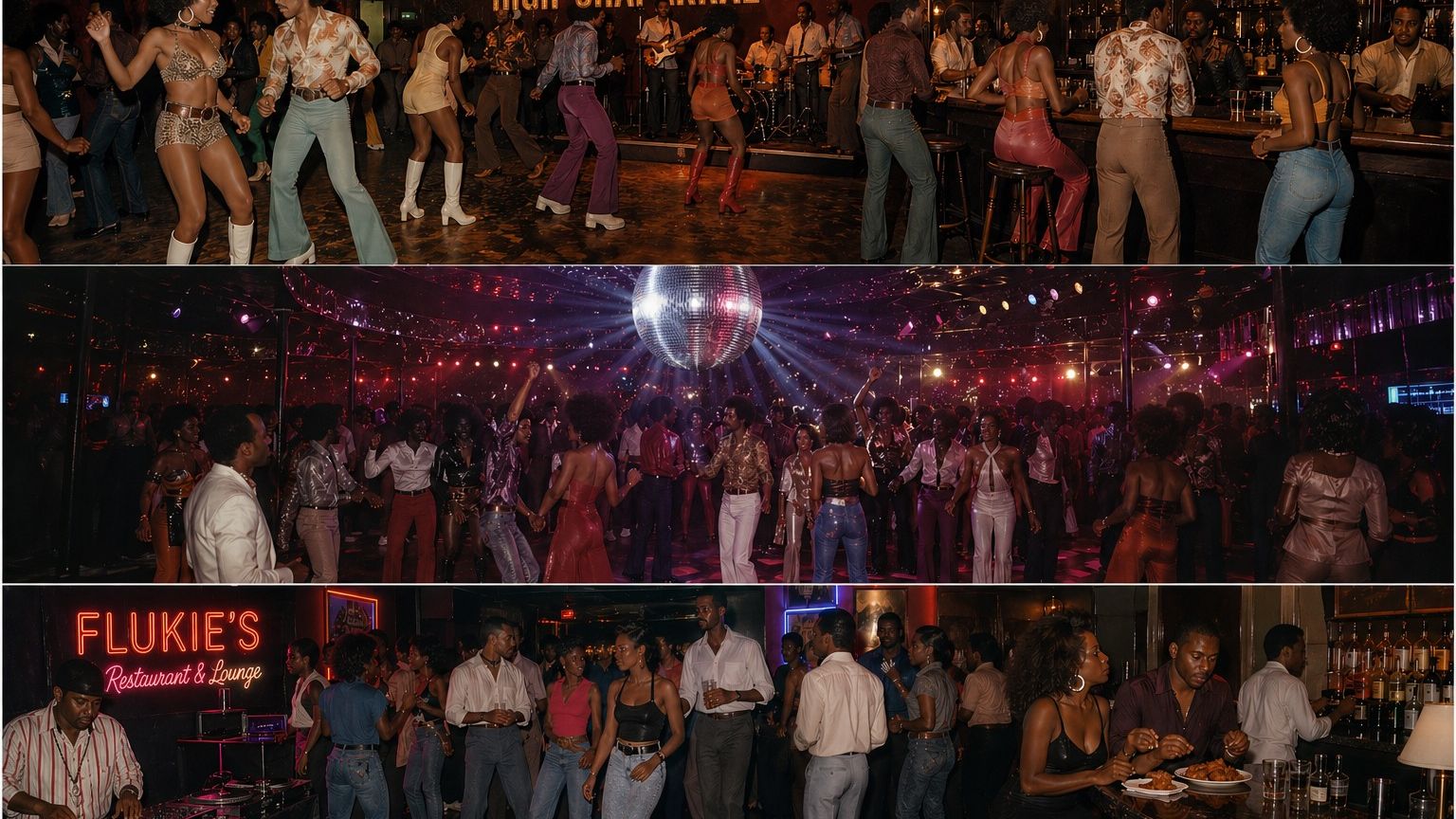
The Clubs That Built a World on the South Side — From Civil Rights to Disco and Beyond
Something changed in the 1960s. You could feel it in the air before you could name it.
Jim Crow wasn't dead yet — not by a long shot — but it was cracking. The Civil Rights Movement had put a different kind of fire in people's spirits. A restlessness. A refusal. A determination to live out loud, fully, on their own terms. And nowhere did that energy show up more vividly, more joyfully, more defiantly than on a Friday or Saturday night on the South Side of Chicago.
The supper clubs and show lounges that had defined an earlier generation — the places we talked about in Parts 3, 4, and 5, where Black Chicago dressed in their finest and navigated Jim Crow's daily insults with silk stockings and patent leather and sheer, unyielding dignity — those rooms didn't disappear overnight. But something new was growing up beside them. Something louder, looser, and alive in a different way.
The Nightclub Circuit was born.
What the Nightclub Circuit Was
It wasn't a formal thing. Nobody drew a map and called it by that name. But ask anyone who came of age on the South Side in the '60s, '70s, or '80s, and they knew exactly what it was: a collection of clubs, lounges, and neighborhood bars — some large enough to hold a thousand people, some small enough that you knew the bartender's mother — that formed a living, breathing network of community.
On the right night, you might start at one club, feel the pull of the music or spot a familiar face in the crowd, and end up down the street at another before the night was done. That was the Nightclub Circuit. You moved through it, and it moved through you.
People had their spots. Their tables. Their bartenders who knew what they drank without being asked. The same faces showed up week after week — not because there was nowhere else to go, but because those rooms were theirs. They were home. The Nightclub Circuit was where you went to meet someone new, reconnect with someone old, let off steam from a hard week, and remind yourself that life was good — or at least, for the next few hours, that it could feel that way.
Dress Changed With the Times
The generation that built the supper club era had come of age under Jim Crow, and they dressed accordingly — with a kind of precision and formality that was partly style and partly armor. Mink stoles, tailored suits, silk gloves. Looking flawless was a form of resistance when the outside world spent so much energy trying to diminish you.
But by the mid-1960s, something else was moving through the culture. The Civil Rights Movement wasn't just changing laws — it was changing how Black people saw themselves and how they wanted to show up in the world. The natural hairstyle — the Afro, worn full and proud — moved from political statement to everyday expression of identity. A woman with a perfectly shaped Afro walking into a South Side club in 1968 wasn't making a compromise. She was making a declaration.
The clothes followed. Miniskirts that stopped mid-thigh. Bell bottoms wide enough to sweep the floor in every color the fabric could hold. Halter tops and hot pants. Go-go boots clicking across dance floors. Platform shoes adding four inches and several degrees of drama to every entrance. This wasn't sophistication giving way to chaos — it was sophistication giving way to joy. The rules had changed, and the way people dressed told you exactly that.
The Big Rooms
At the center of the Nightclub Circuit were a handful of clubs large enough to host full concerts — places where you bought your ticket, dressed up, and settled in for a real show.
The High Chaparral, at 7740 Stony Island Avenue, was the crown jewel. It could hold close to a thousand people — tables ringing a square stage on the main floor, a big bar room when you first walked in. If you wanted to see who's who in national talent on the South Side, the High Chaparral was your destination. B.B. King played here. Tyrone Davis. The O'Jays. The Stylistics. Sam and Dave. Bobby Bland was a regular. Go-go dancers Vickie and Joy kept the floor alive between sets. The High Chaparral wasn't just a club. It was an institution. And on a good Friday night, there was no better room on the South Side of Chicago.
The Burning Spear, at 55th and State Street, came with a backstory that most people who drank and danced there probably didn't know in full — but it is one for the ages. The building had previously housed the legendary Club DeLisa, which we wrote about in earlier installments of this series. In 1965, two of the biggest names in Black Chicago radio — Pervis Spann and E. Rodney Jones, both stars of the original WVON "Good Guys" lineup — purchased the space and renamed it the Burning Spear. Pervis Spann, known across the city as "The Blues Man," was one of the most important entertainment entrepreneurs Black Chicago has ever produced. He played the blues on WVON after midnight when nobody else would touch it. He managed B.B. King. He was the first person to crown Aretha Franklin "the Queen of Soul" — from a stage at the Regal Theater. And at the Burning Spear, he hosted a young group of brothers from Gary, Indiana, who came in and won a major talent show. Their name was the Jackson 5. It was their first Chicago performance. That is the kind of room the Burning Spear was.
Flukie's Restaurant, at 8211 S. Cottage Grove, was a South Side institution that older Chicagoans remember with real warmth. What set Flukie's apart from a straight-up nightclub was that it was a full restaurant — an elegant dining establishment that became an entertainment destination after dark, with live music and a loyal following. People who grew up on the South Side remember Flukie's as the kind of place where you could bring your family for Sunday dinner and come back on a Friday night for something entirely different. Flukie's run came to an end when a tornado tore down Cottage Grove Avenue and stripped the fronts off buildings, taking Flukie's along with it. Some losses in a neighborhood aren't just buildings. They're eras.
The Neighborhood Rooms
But the Nightclub Circuit wasn't only the big rooms. Some of the most important clubs were the smaller, more intimate neighborhood spots — places you might not have known about unless someone took you there, but once you found them, you never forgot them.
The Red Pepper Lounge, on 87th Street, is still there today. That alone tells you something. A neighborhood establishment doesn't survive decades without doing something right — without earning the kind of loyalty that passes from one generation to the next. Back in the day, the Red Pepper was exactly the kind of place the Nightclub Circuit was built on: good drinks, a kitchen in the back turning out fried chicken, catfish, and whatever else the cook felt like making that night, and a room full of regulars who had claimed their spot at the bar or their usual table and weren't going anywhere until the night was through.
Mr. Ricky's, on East Garfield Boulevard — 55th Street — near King Drive, was a cut above the average neighborhood lounge. The owner had a taste for class, and it showed. Mr. Ricky's drew a crowd that expected something a little more refined — live entertainment on select nights, a room that was put together with care. When the same owner later opened Chic Rick's at 2201 S. Michigan Avenue in the early 1980s, he took that same sensibility downtown into the South Loop — one of the first Black nightclub owners to plant a flag in that part of the city when it was still largely undeveloped. The Chicago Defender noted years later that Chic Rick's and the Cotton Club were pioneers of Black-owned nightlife in the South Loop, long before the neighborhood became what it is today.
The Dating Game was another neighborhood fixture — the kind of club whose name alone tells you what the vibe was. People went there to see and be seen, to meet someone new, reconnect with old friends, to dance and laugh and let a Friday be a Friday. You didn't need a famous headliner. You needed the right people, the right music, and a bartender who kept things moving.
The Checkerboard Lounge, at 423 E. 43rd Street in Bronzeville, was the home of the blues in a way that few rooms anywhere in the world have ever matched. Founded in 1972 by bluesman Buddy Guy and his business partner L.C. Thurman — the two had met while working at Pepper's Lounge on 43rd Street — the Checkerboard was small, brick-walled, and completely uncompromising. It held maybe 200 people. The cover charge was a dollar. On off nights, you fed the jukebox. On good nights, you might walk in and find Muddy Waters on the stage, or Junior Wells, or Magic Slim, with Buddy Guy sitting in unannounced. On one particular night in November of 1981, a week's advance notice went out that the Rolling Stones — in town for a tour — wanted to come to the South Side and play with Muddy Waters at the Checkerboard Lounge. L.C. Thurman got $500 cash from the Stones' manager just to confirm it was real. What followed was one of the most legendary nights in the history of Chicago music: Mick Jagger, Keith Richards, Ronnie Wood, Muddy Waters, Buddy Guy, and Junior Wells on that small brick stage. The set was recorded and released as a live album. Buddy Guy left the partnership in 1985 to open his own club. Thurman kept the Checkerboard going until his death in 2015, when the doors finally closed.
And then there were the rooms that South Siders remember by name and feeling even when the records didn't always keep up with the history: The Other Place Lounge. The Checkmate Lounge. The Safari Lounge. The Ebony Lounge. The Blue Note Lounge. The Palms Lounge. These were the neighborhood rooms where regulars had their tables before they sat down, where the bartender started mixing your drink when you walked through the door, where the cook in the back knew you liked your catfish fried a certain way. The Nightclub Circuit ran on rooms like these. They were the connective tissue between the big shows and the everyday life of the South Side.
The Cotton Club — Then and Now
The name Cotton Club carries a complicated history in America — the original Harlem room in the 1920s was famous for presenting Black talent to an all-white audience while keeping Black patrons out. What Black Chicago did with that name was something entirely different.
The first Cotton Club on the South Side, at 6249 S. Cottage Grove, was a neighborhood establishment from the earlier era where Chicago blues was played and a who's who of South Side musicians came through — a room that belonged to the community it served, not the other way around.
Then in 1987, a second Cotton Club opened at 1710 S. Michigan Avenue in the South Loop — and the story of its owner is one that deserves to be told. Dr. Yvon Nazon, known to everyone as "Doc," came to Chicago from Haiti. He built a career as a successful gynecologist, practicing at Advocate Trinity Hospital, and even invented Nazon's Solution — a medical innovation that helped women recover more quickly from surgery. He also founded the Cojeunaze Nursing Center, the first nursing home owned by a person of color in Chicago. And then Doc Nazon opened a nightclub. His Cotton Club had a live music room in the front — the Cab Calloway Room — and a DJ room in the back called the Gray Room. It ran from 1987 to 2008, drawing music industry figures, radio programmers, and a clientele that understood the difference between a good club and a great one. Dr. Yvon Nazon was a healer, a businessman, a community builder, and a nightclub owner. The South Side has always been full of people like that — people who refused to be just one thing.
Special Nights
The clubs knew their audience, and they worked for their loyalty.
Ladies Night was a staple — usually a weeknight when women got in free or drinks were discounted, bringing in a crowd that brought everybody else. The women in the room set the tone. Always had.
Bid Whist Night was its own particular institution. Bid whist is a card game — a partnership trick-taking game with deep roots in African American social life, played at kitchen tables and church basements and social clubs for generations. On bid whist nights, tables were set up, partners were claimed, and the serious business of the game unfolded alongside the music and the drinks. It was competitive, communal, and joyful all at once.
Blues Night. Jazz Night. Some clubs rotated the genre with the day of the week. You knew what you were walking into before you got there, and you came when the music matched your mood.
What Made You Come Back
Here's what people don't always talk about when they talk about the clubs: it wasn't just the music that brought you back every weekend. It was the people.
The Nightclub Circuit ran on regulars. Folks who had their crew — the same eight or ten people they'd been rolling with since high school or the plant or the choir — who gathered every Friday or Saturday at the same spot without anyone having to plan it. It was understood. You showed up. They showed up. The night began.
In an era before cell phones and social media, the club was how you stayed connected. You heard the news. You passed along the news. You met your cousin's best friend who turned out to be somebody worth knowing. You watched your neighbor's son ask a girl to dance for the first time and saw his whole future in that moment. The bartender knew your drink. The cook in the back knew you liked your chicken well done. The DJ knew that if you walked in the room, he'd better drop something that got you on your feet.
That kind of familiarity — that sense of being known in a place — that was the real draw. The music was the reason to go. The people were the reason to stay.
The Music Changed With the Times
In the early 1960s, the soundtrack of the South Side clubs was R&B and Soul — the music of the Great Migration's children, raised in Chicago but carrying the South in their bones. And underneath all of it, woven into the fabric of even the dance songs, was the Civil Rights Movement. Curtis Mayfield's "Keep On Pushing" was more than a love song. Sam Cooke's "A Change Is Gonna Come" didn't need any explanation. The music said what needed to be said, and the people in those rooms understood every word.
As the decade turned and the '70s arrived, the sound shifted. Funk crept in — James Brown's rhythms, the tight horn arrangements of Earth, Wind & Fire, the groove of the Ohio Players. The music got more physical, more insistent. And then, in the middle of the decade, disco arrived.
Picture it: a mirrored ball spinning from the ceiling of the High Chaparral, throwing light off every wall, off every sequin in the room, off the silver hoops in someone's ears and the rhinestone buckle on someone else's platform shoes. The floor filling up with people who had been sitting all week and were not sitting anymore.
This was the era of the big dance floors and the big sound systems. The lights flashing, the music faster and brighter, the DJ becoming a figure of real authority — not just someone spinning records, but a curator, a crowd psychologist, a performer in his own right. The great South Side DJs were celebrities in their communities. Known by name. Requested. A DJ who knew his room could hold a crowd for hours, reading the energy, knowing exactly when to slow it down and when to bring it roaring back.
The Strip
On certain blocks of the South Side, the clubs were close enough together that the night could be one long, uninterrupted experience with a few changes of scenery. Stony Island Avenue was the axis of much of it — the High Chaparral anchoring that stretch, the surrounding blocks filled with their own supporting cast of bars and lounges. 63rd Street had its energy. 79th Street. 87th Street. Garfield Boulevard. These were not quiet residential blocks on a Friday night. They were alive — the sound spilling out of doorways, the smell of cigarette smoke and perfume and whatever was cooking in the back kitchen, the low rumble of conversation and laughter that you could feel before you could hear it.
You might park a few blocks away and walk, because parking was its own negotiation. You might stop on the sidewalk and talk to someone you knew for twenty minutes before you even got inside. You might never make it to the second club you had in mind because the first one was just too good to leave.
What the Clubs Meant
It's worth pausing and saying directly what the Nightclub Circuit represented — not just as entertainment, but as something larger.
These clubs existed in a world that was still, in many ways, actively hostile to the people who filled them. Housing discrimination. Employment discrimination. Police harassment. The daily accumulation of a society that had never fully decided that Black Americans belonged in it, fully and freely. The Civil Rights Movement was winning real victories — but legislation doesn't immediately change the texture of daily life. The grinding reality didn't vanish with the stroke of a pen.
So what did a Friday night at the Burning Spear mean? What did it mean to walk into the High Chaparral in your bell bottoms and your platform heels, with your Afro perfectly shaped and your people by your side?
It meant that for these hours, in this room, none of that outside world could reach you. It meant joy that was wholly yours — not borrowed, not performed for anyone else's approval, not justified or defended. Just real, living, breathing, dancing, laughing, human joy.
That's what the Nightclub Circuit was. And nobody who was part of it ever forgot it.
The Shift
By the late 1970s and into the 1980s, things began to change. The Black middle class that had built the Nightclub Circuit was moving — following the American pattern, heading south into the suburbs, to Dolton and Harvey and Country Club Hills and beyond. The steel mills were cutting back. The stockyards had long since closed. The economic foundation that had kept the South Side humming was shifting under everyone's feet.
Some clubs lost their audiences. Some lost their leases. Urban renewal — which Black Chicago had long since renamed "urban removal" — was eating through neighborhoods. Buildings came down. The landscape was changing.
But the music kept going. And in a set of rooms across the South Side and beyond, a new sound was already beginning to stir — something that would start small, in a single club, with a single DJ behind the turntables, and end up changing popular music around the entire world.
But that's Part 7.
Coming Up Next: The Birth of House Music
Next week, we tell the story of the last great music genre Chicago invented. It started in the early 1980s in a club called the Warehouse — with a DJ named Frankie Knuckles — and it spread from the South Side to Detroit to New York to London to Ibiza and every dance floor on the planet that was paying attention.
Chicago made house music. We'll tell you the whole story.
Check back next week for Part 7. And if you're just joining us, catch up on the full series — Introduction, Part 1, Part 2, Part 3, Part 4. and Part 5 are all waiting for you at Bronzecomm Hub.
Stay connected with news and updates!
Join our mailing list to receive the latest news and updates from our team.
Don't worry, your information will not be shared.
We hate SPAM. We will never sell your information, for any reason.
