
The Real Work Happens Behind the Chair
Apr 23, 2026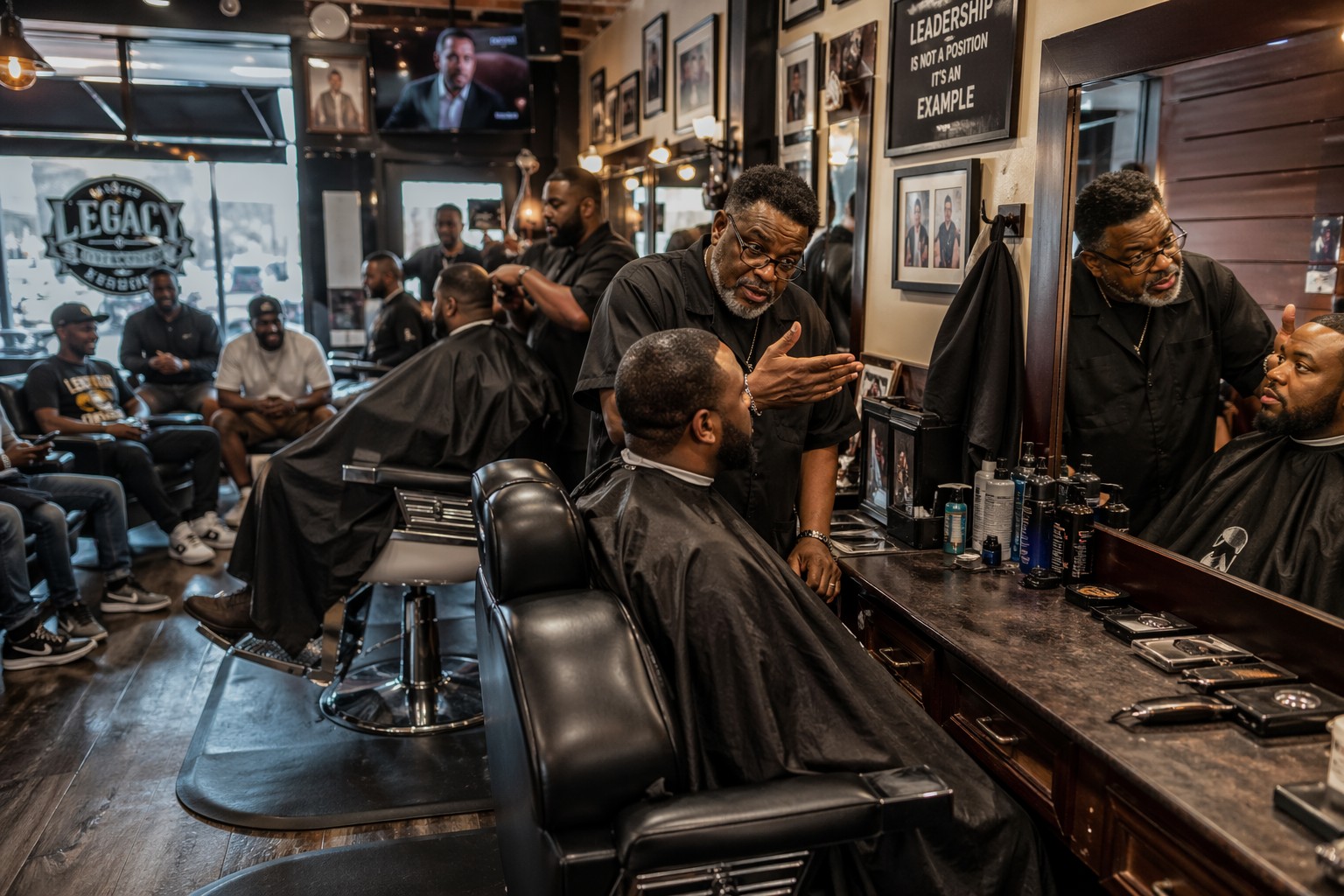
BEFORE THERE WERE THERAPISTS, THERE WERE BARBERS
Part 3 of 4
By Kiné Corder | Bronzecomm Hub
Last week we talked about the gap in barber education. Thirteen hundred years of history, three waves of formal training, and not one hour dedicated to what happens in the mind of the man in the chair or the man behind it. New programs are emerging to change that, and they are doing important work. But there is still a piece missing. And it is the piece that determines whether any of this is sustainable.
To understand it, you have to start at the beginning. Not 1893. The beginning of a barber’s career.
If a barber isn’t taught to grow, clients will drain him. Training barbers to support their clients without supporting the barber first is like filling everyone else’s cup until yours is empty.
What school teaches and what it leaves out
When a barber goes through school, the curriculum is thorough in the areas it covers. Anatomy. Sanitation. Hair cutting theory. Scalp conditions. State law. By the time a barber passes his boards and picks up his license, he knows how to take care of the person in his chair from the neck up. Physically.
What no barber school in the country teaches is how to manage what walks in with that person. The stress. The grief. The financial anxiety. The relationship problems. The weight of being a man who has been taught that asking for help is weakness. None of that is in the curriculum. And yet every single one of those things ends up in the chair.
Shakespeare wrote in Henry IV, “uneasy lies the head that wears the crown.”
The barbershop is one of the few places where Black men actually talk about this. Not because barbers are trained to facilitate that conversation, because the environment makes it natural. The chair is comfortable. The barber is familiar. The conversation starts about the haircut and ends up somewhere else entirely. That has always been true. What is new is that we are finally paying attention to it.
The mental health training programs now emerging are a direct response to that reality. They are training barbers to recognize when a client is struggling, to listen well, and to point people toward professional resources. That is genuinely valuable. But here is what almost none of them address: the barber is also struggling. And nobody is pointing him anywhere.
The weight the barber doesn’t talk about
Barbering is physical and emotional labor. A barber absorbs the energy of every person who sits in his chair, all day, back to back, sometimes ten or twelve clients deep. He hears about divorces, job losses, sick parents, financial stress, and everything in between. He listens, he responds, he steadies the room. And then the next client sits down and it starts again.
That is the work. And most barbers do it well. But nobody taught them how to do it without it costing them something. Nobody taught them how to process what they carry home at the end of the day. Nobody told them that the exhaustion they feel is not just physical. Nobody gave them a system.
And on top of the emotional weight, there is the financial reality. Many barbers are giving away some of their most valuable work for free. The conversation that steadies a man before a job interview. The advice that helps a client think through a business decision. The check-in that catches someone before they fall. That work has real impact. It also pays nothing. The haircut gets charged. Everything else goes on the house.
Barbers are some of the wisest people in the room and some of the most underpaid for what they actually do. Not the cut. The conversation.
That combination, absorbing without releasing, giving without receiving, builds up over time. And eventually it becomes burnout. Not the kind where you hate the work. The kind where the work you love starts to feel impossible to sustain.
I know because I lived it
I became one of the first well-known female barbers in Chicago and New York in the late 1990s. I loved the work. I was good at it. And somewhere along the way I started to feel the weight of it in a way I could not explain. I was carrying my problems and everyone else’s too, and I had no system for any of it.
One afternoon it caught up with me. I had too much on my plate, too many people pulling on me, and I was running on fumes. I called my next client and asked if we could adjust the time. Then I did something I rarely did. I stepped away.
I went for a walk. Ended up in a shoe store. Picked out a pair I liked and got in line to pay. That is when I saw him. A man I recognized from the shop, not my client, but someone who had sat in my chair once a long time ago. He had five pairs of shoes in his arms and a look on his face like money was the last thing on his mind.
He saw me and came over. Told me to put my shoes with his. I tried to decline. He insisted. Then he reminded me of a conversation we had had years earlier, the kind I had forgotten about completely, where I said something that shifted his thinking about a financial decision he was struggling with. He had been in a rough patch. I was just starting to study finance at the time, curious about money and how people related to it. We talked. He left feeling clearer. He made a different decision than he would have made otherwise. It worked out.
He bought my shoes that day without hesitation out of genuine gratitude for something I had given him that I never thought to charge for.
I walked back to the shop that afternoon feeling something I had not felt in a while. I felt better, yes. But I also felt different. I felt clear. Reminded of what I offer. Reminded that what happens in that chair goes far beyond the cut, and that the person doing it deserves to be compensated, supported, and sustained for the full scope of what they bring.
That day did not change my career immediately, but it planted something. I eventually stepped away from the chair entirely to get more training; my financial licenses, my mental health credentials, and my hypnotherapy certification. I thought leaving barbering was the only way to get paid for the deeper work. I spent years in finance, then therapy, then private practice, then working with clients on retreats across seven countries.
And then I came back. Because barbering was never just a job for me. It was a calling. And when you leave a calling, you feel the absence of it even when everything else is going well.
I was not the only one who left
In the years since, I have talked to enough barbers to know my story is not unusual. Many of the best ones, the ones who are not just cutting hair but genuinely changing the rooms they work in, hit a wall at some point. The emotional weight builds. The income does not reflect the full value of what they do. The industry does not offer them anywhere to turn. So they start looking for the exit.
Some leave. Some stay and suffer. Some keep going out of pure stubbornness and love for the craft but carry a low-grade exhaustion that never fully goes away. And almost all of them say the same thing when you ask what they need: not more technical training. Not another certification in hair. Someone who can do for them what they do for everyone else. Someone who can be for them what they are to so many others.
However, they don’t even know if that exists. That is the part the industry has not built yet. The support system for the barber himself. He’s not going to talk to another barber because he’s his competition and more importantly he knows the barber that he would go talk to has enough weight on his shoulder. Why add more?
What I am building
I did not come back to the barber industry to cut hair. I came back because I spent thirty years learning everything the chair was already doing, and I finally have the tools to make it sustainable. What I am building is a system that does two things at once: it gives barbers a way to get compensated for the deeper work they are already doing, and it gives them someone in their corner while they do it.
Not a motivational program. Not a social media strategy. A real system. One that starts with the barber’s own mental and financial health before it ever reaches a client. Because the barber who is taken care of is the barber who can take care of others.
I thought I had to leave the industry to get paid for listening to people work through their problems. I was wrong. Barbers do not have to leave. They just need a different menu and someone who has done both sides of this work standing with them while they build it.
Part 4 is the last post in this series. It is about what this looks like when it works at scale. What a city full of barbers who are financially stable, mentally supported, and trained to have intelligent conversations about money and wellbeing actually builds for the communities around them. That is the vision. And it starts with one barber deciding he is ready.
If you know a barber who is tired but not done, share this with him. He is exactly who this series is for.
FOR BARBERS
If you are a barber reading this and something in it felt familiar, I built something for you. Not a course. Not a pdf to download and forget. Something that starts a real conversation about where you are and where this could go. You will know what it is when you get there.
See what I built: selfsync.vegas/barber-income-growth
FOLLOW THE CONVERSATION
Kiné Corder is a Financial Hypnotherapist, nationally certified mental health counselor, and the creator of the SelfSync System. She trains barbers at the intersection of mental health and money. Follow her on Instagram for the final post in this series and everything being built in real time.
Follow Kiné on Instagram: instagram.com/kinecorder
Also read Part 1 and Part 2.
Stay connected with news and updates!
Join our mailing list to receive the latest news and updates from our team.
Don't worry, your information will not be shared.
We hate SPAM. We will never sell your information, for any reason.
