Chicago Started the Barber School. Here Is What Comes Next.
Apr 16, 2026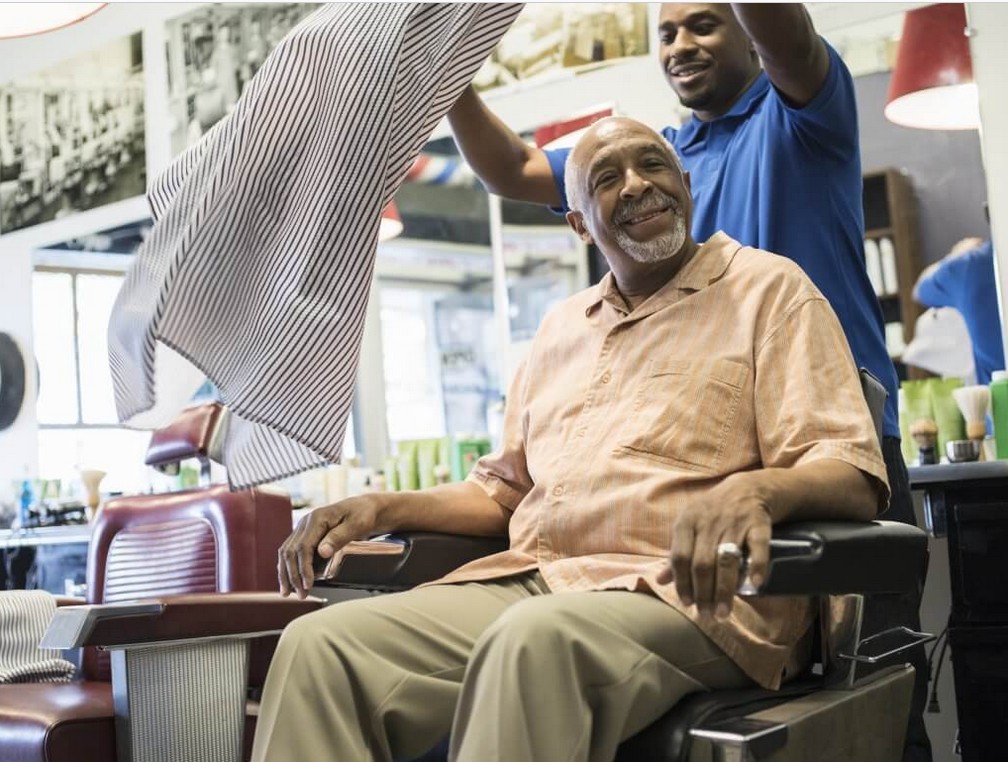
BEFORE THERE WERE THERAPISTS, THERE WERE BARBERS
Part 2 of 4
By Kiné Corder | Bronzecomm Hub
Barber education has evolved three times in 130 years. The fourth evolution is already in motion.
Like Chicago historian Dilla always says, everything dope in America started in Chicago. In 1893, a man named A.B. Moler walked into a building on Wabash Avenue in downtown Chicago and opened the first barber school in the United States.
He also sat down and wrote the first textbook on barbering ever published. Before that year, there was no formal training, no standard curriculum, no way to measure whether the man holding the razor knew what he was doing. Moler changed all of that from Chicago.
The Molar Barber School on Chicago’s west side, was named in the tradition of that legacy. So when we talk about what barber education is becoming, it is worth knowing where it started. And it started here.
What barber school has always taught
When Moler opened his school, the profession had a basic but urgent problem. Barbers were spreading disease. Unsterilized razors were passing fungal infections from client to client. The first wave of formal barber education was about sanitation, hygiene, and basic anatomy. How to keep a clean shop. How not to harm the man in your chair.
By 1897, Minnesota passed the first barber licensing law in the country, and within a few decades most states had followed. The education system expanded. Technical skills were added. Hair cutting theory. Scalp conditions. Product knowledge. State law. Today a barber in Illinois completes at least 1,500 hours of training before working in a barbershop professionally. That education is thorough, but it is also entirely focused on what happens to the hair and the skin.
But what about what’s happening underneath the hair and scalp. Nothing in that curriculum addresses what happens in the mind. That didn’t mean barbers weren’t doing their best to help their clients deal with mental and emotional pressure.
The relationship no classroom can manufacture
Think about what a barber actually builds over a career. A barber can give a boy his first haircut. He can cut that same young man’s hair before prom seventeen years later. And then even on his wedding day. He has watched that boy become a man, heard his family stories, his school problems, his first job, his first heartbreak. The barber is not just a service provider. He is one of the most trusted adults in that young man’s world.
That kind of trust is not in any textbook. It is built one appointment at a time over years. And it means that when a barber speaks, people listen. Not because he has a credential on the wall. Because he has shown up, reliably, for a long time.
A man will take financial and mental guidance from his barber long before he walks into a therapist’s office or a financial advisor’s building. The relationship is already there. The training has not caught up.
The third wave: mental health
In the last several years, organizations across the country have recognized what barbers have always known about themselves. As I mentioned in last week’s blog, a movement has started. The Confess Project of America has trained over 6,000 barbers as mental health advocates across 35 states. The Arthur Ashe Institute for Urban Health has partnered with more than 170 barbershops in New York. Cities in Arizona, Michigan, Oregon, Florida, and the United Kingdom have launched their own certification programs. New York State introduced legislation in 2025 that would make mental health first aid training mandatory for every licensed barber in the state.
This is the third wave of barber education. The profession learned to protect the body. Then it learned to perfect the craft. Now it is learning to hold the conversation. That is real progress and it deserves recognition.
But there is a fourth wave coming. And the third wave, as important as it is, does not get there on its own.
What every program is still missing
Here is what the research shows. Every barber mental health program currently operating trains barbers to do three things: recognize when a client is struggling, listen without judgment, and refer them to professional help. That is a solid foundation. It is also incomplete.
Money is the number one source of stress for not just Americans, but for people all over the world. Not health. Not relationships. Money. It has held that position in survey after survey for over a decade. And here is what that means in a practical sense: the majority of the men sitting in barber chairs right now, talking about their anxiety, their sleep problems, their relationship tension, their sense of being stuck, are experiencing symptoms that have a financial root.
They are not just stressed. They are financially stressed, and it is showing up in their bodies, their minds, and their conversations. None of the current programs give barbers a framework for that conversation. They train barbers to hear the symptoms of stress, but even if the client is referred to a therapist the financial stress won’t be addressed.
What if barbers not only had mental health first aid training but also financial systems training.
And there is a second gap that is just as important. While every program focuses on what the barber can do for his client, almost none of them address what the barber is carrying himself. The barber absorbs the emotional weight of every person in the chair, all day, every day, often without any support system of his own. You cannot pour from an empty chair. A barber who is financially stressed, mentally overloaded, and running a business with no retirement plan is not positioned to mentally support anyone else.
That’s why barber’s tools must extend beyond clippers, shears, and towels. Barbers need new tools.
Where this is going
The programs doing this work are doing great things. What comes next is the next evolution of barber education. It adds the financial layer, addresses the barber's own mental health first, and gives the profession a complete system.
I’ve created that system through years of research, training, and my own experience behind the chair. A few years ago, on a day when the weight of everyone else's problems had caught up with me, I stepped away from my chair for a few hours of “selfcare” (before we called it that) and had a chance encounter that reminded me exactly how much value a barber carries, and exactly how much goes unrecognized and unrewarded.
I came back to work that afternoon with a clearer sense of purpose than I had left with. I’m taking what I learned that day and everyday since and put it into a system. I’ll tell you more about that story and a little about the system too.
That story is Part 3. And the point of it is: before a barber can add anything to a clients life, one has to decide to add something to their own first.
If you know a barber who has been playing the role of counselor, financial advisor, and community anchor without a single tool or resource to support him in that role, share this series with him. The conversation is just getting started. He needs to read what comes next.
FOR BARBERS
If you are a barber who already knows you are the wisest guy in the room and still feels behind in business, this is where you start. The Wise Barber Network is a free community built specifically for barbers who are ready to use the chair differently. When you join, you get the five questions every barber should be asking, plus a bonus resource that goes deeper. No cost. No pressure. Just tools that work.
Join free: Click here
FOLLOW THE CONVERSATION
Kiné Corder is a Financial Hypnotherapist, nationally certified mental health counselor, and the creator of the SelfSync System. She trains barbers at the intersection of mental health and money. Follow her on Instagram for updates on the SelfSync program, the Wise Barber Network, and this series as it continues.
Follow Kiné on Instagram: instagram.com/kinecorder
Stay connected with news and updates!
Join our mailing list to receive the latest news and updates from our team.
Don't worry, your information will not be shared.
We hate SPAM. We will never sell your information, for any reason.
