
When Silence Became a Weapon: The 1917 Silent Protest Parade
Feb 18, 2026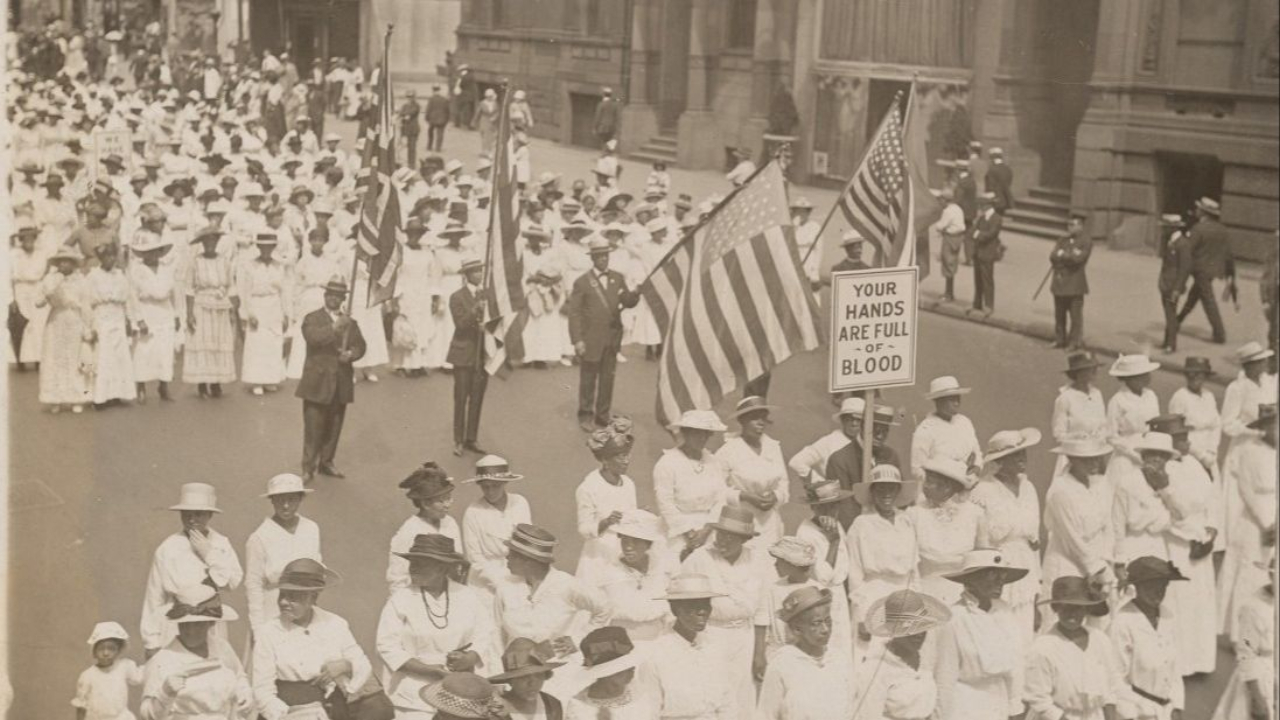
On July 28, 1917, ten thousand Black men, women, and children stepped onto Fifth Avenue in New York City and did something radical.
They said nothing. No chants. No shouting. No fiery speeches.Just the low beat of muffled drums and the steady sound of footsteps moving in disciplined rows past stunned onlookers.
This was the Silent Protest Parade, organized primarily by the National Association for the Advancement of Colored People. And it was one of the earliest large-scale civil rights demonstrations in American history.
But to understand why they marched in silence, you have to understand what America was doing to them.
The Spark: Blood in East St. Louis
Weeks before the march, white mobs in East St. Louis attacked Black residents in one of the most violent racial massacres of the early 20th century. Estimates of the dead range from 50 to more than 200. Homes were burned. Families fled for their lives. Thousands were left homeless.
And East St. Louis was not an isolated tragedy. Organizers referenced other atrocities—Waco, Memphis, and countless lynchings across the South. Black bodies were being terrorized in public, often without consequence.
The message from much of white America was silence. So Black America answered with its own.
The Organizers: Strategic, Not Spontaneous
This was not an emotional outburst. It was deliberate.
The NAACP’s field secretary at the time, James Weldon Johnson, played a central role in conceptualizing the silent format. The idea was powerful: remove every excuse. No disorder. No confrontation. No spectacle that could be twisted into fear.
Children would lead the procession, dressed in white. Women would follow, also in white. Men would march behind them in dark suits. The symbolism was unmistakable. Innocence. Mourning. Dignity.
Among those marching was W. E. B. Du Bois, one of the nation’s most influential Black intellectuals. But this wasn’t just a gathering of elite thinkers. It was laborers, teachers, mothers, church members—ordinary Black citizens refusing to be quiet about injustice.
They gathered between 55th and 59th Streets and moved south down Fifth Avenue to Madison Square. Ten thousand people. In complete silence. Let that sink in.
“We March…”
The signs they carried did the speaking. “We march because we deem it a crime to be silent in the face of such barbaric acts.” They marched against lynching. Against Jim Crow segregation. Against disfranchisement. Against racial terror being normalized. They marched so their children could live in a better land.
And here is the part we have to say plainly: they marched while Black men were fighting in World War I overseas. They were demanding democracy at home while America claimed to be defending it abroad. That contradiction was not lost on them.
The Delegation to Power
After the parade, an eleven-member committee including John E. Nail, James Weldon Johnson, Everard W. Daniel, George Frazier Miller, Fred R. Moore, A. B. Cosey, D. Ivison Hoage, Isaac B. Allen, Maria C. Lawton, Madam C. J. Walker, and Frederick A. Cullen (chairman), traveled to Washington to present a petition to President Woodrow Wilson.
They were not received. They were told he was too busy. That detail matters because it reminds us that protest does not always produce immediate justice. Sometimes power ignores you. Sometimes it slams the door in your face but that does not mean the action failed.
So Was It Effective?
If effectiveness means immediate legislation, then no. Lynching did not end in 1917. Federal anti-lynching laws would stall for decades. But if effectiveness means shifting consciousness, building organized resistance, and proving that disciplined mass protest was possible, then yes—this march changed the trajectory of the movement.
It strengthened the NAACP as a national force. It showed that Black communities could mobilize thousands peacefully and strategically. It established a model of protest rooted in dignity and moral clarity that would echo decades later in Montgomery, Birmingham, Selma, and beyond.
The Silent Protest Parade demonstrated something powerful: protest does not have to be loud to be disruptive. Sometimes silence is more unsettling than shouting.
Why This Still Matters
Every generation hears the same thing: “Protests don’t work.” “That was then. This is different.”
“Just move on.” But in 1917, when racial terror was openly defended, Black Americans organized ten thousand people and marched in silence down the most visible avenue in the country. They documented their demands. They built institutions. They forced the nation to look at itself. They understood something we still need to understand: Silence in the face of injustice is complicity. Silence used strategically is power.
Stay connected with news and updates!
Join our mailing list to receive the latest news and updates from our team.
Don't worry, your information will not be shared.
We hate SPAM. We will never sell your information, for any reason.
