
When Black America Owned $1 Billion in Real Estate
Sep 16, 2026By the African and Black History African Archives
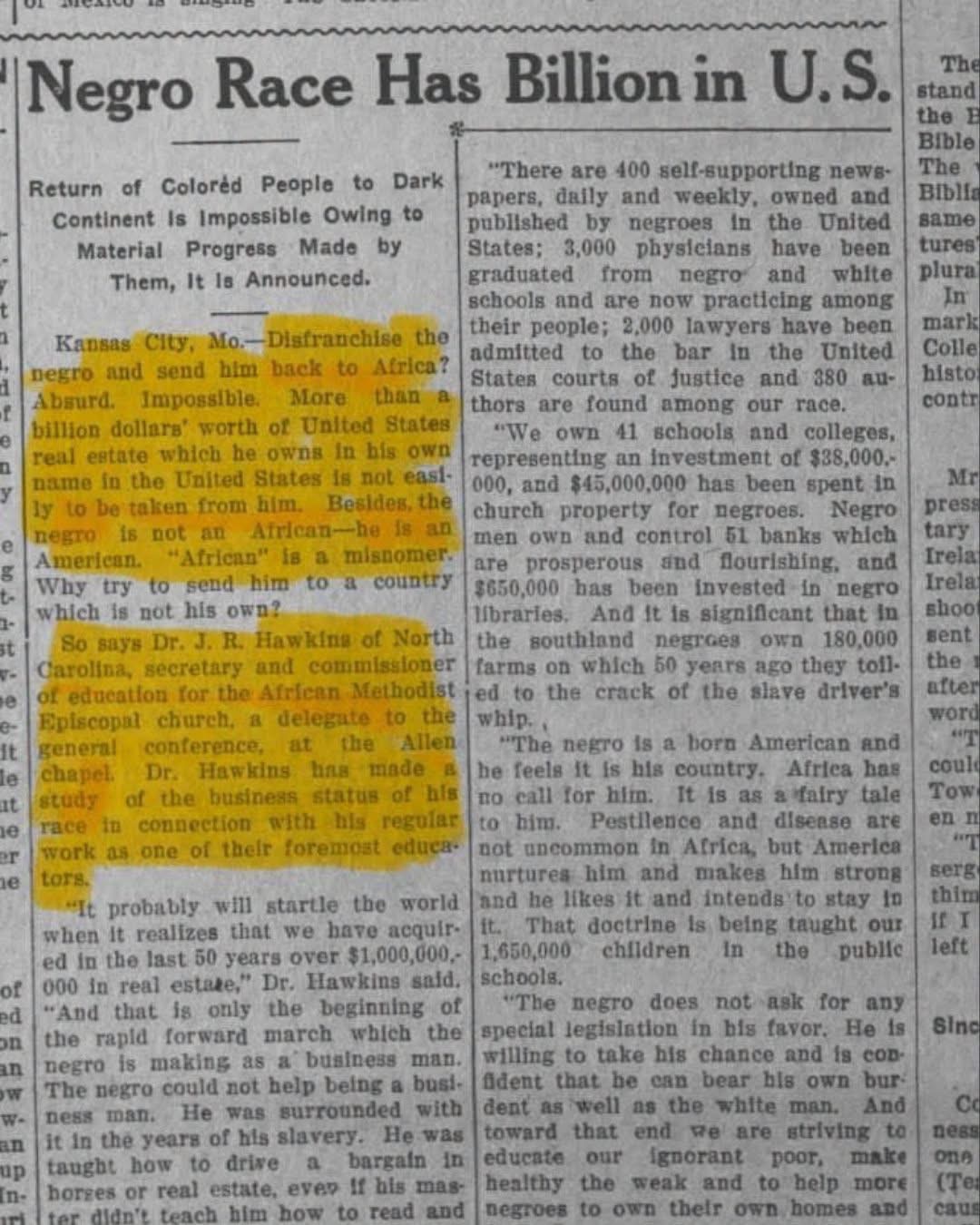
More than a century ago, Black Americans were already building an economic foundation that challenged some of the most racist assumptions of the era. This newspaper article, headlined “Negro Race Has Billion in U.S.,” reported that Black Americans collectively owned more than $1 billion in real estate at a time when segregation and racial discrimination severely restricted where they could live, work, study and conduct business.
The article quotes Dr. J. R. Hawkins of the African Methodist Episcopal Church arguing against the idea that Black Americans should simply be sent “back to Africa.” His response was strikingly direct: Black Americans had built lives, families, businesses and property in the United States and were Americans. “Why try to send him to a country which is not his own?” the article records him asking.
What makes the piece especially interesting is the picture it gives of Black economic life during the early 20th century. It claims there were around 400 Black-owned newspapers, thousands of Black physicians and lawyers, 41 schools and colleges representing millions of dollars in investment, millions more invested in churches and libraries, and 51 banks owned and controlled by Black Americans. It also reported that Black farmers in the South owned roughly 180,000 farms.
Those achievements existed within an extremely hostile economic system. Jim Crow segregation was firmly established across much of the country, while Black Americans faced disenfranchisement, racial violence and discrimination in employment, housing and finance. The article itself points out the extraordinary historical transition involved. Many of the people creating businesses and acquiring property at the time had been born during slavery, or were only one generation removed from it.
Black economic progress during this period also produced thriving business districts and institutions in communities across the country. Places such as Greenwood in Tulsa, Oklahoma, later remembered as “Black Wall Street,” became famous examples, but they were part of a much broader tradition of Black entrepreneurship, mutual aid, banking, newspapers, churches and professional networks that developed despite segregation.
Stay connected with news and updates!
Join our mailing list to receive the latest news and updates from our team.
Don't worry, your information will not be shared.
We hate SPAM. We will never sell your information, for any reason.
