
What is the SAVE America Act?
Mar 18, 2026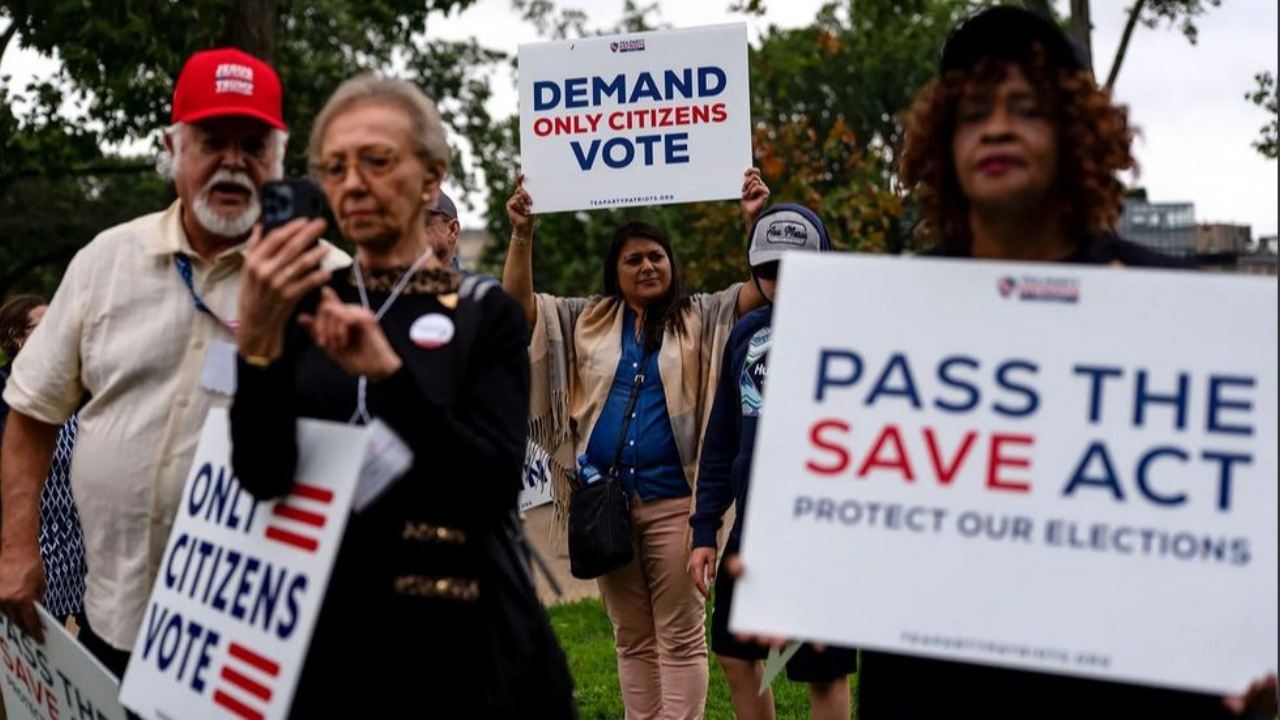
Attendees listen to Sen. Mike Lee speaking at a rally on passing the SAVE Act outside the Capitol on September 10, 2025 in Washington, D.C. The legislation has since been reintroduced as the SAVE America Act, a revised version of the bill that seeks to further restrict voter registration to prevent non-citizen voting, which is already rare and illegal. (Kent Nishimura/Getty Images)
The 19th explains the bill that would require voters to provide documents — such as U.S. passports or birth certificates — proving their citizenship.
This week, the Senate will take up the SAVE America Act, the second version of an extensive elections bill that seeks to increase the restrictions on registering to vote in hopes of cutting down on non-citizen voting — already a rare and illegal occurrence.
Critics say the bill’s structure would add burdens for some people, especially women and others who have changed their legal names because of marriage, assimilation or to better align with their gender identity. GOP proponents of the legislation insist that there are workarounds and categorize concerns about the potential impact on the millions of people who have differing identifying documents as “ridiculous.”
While Republicans are anxious to pass the legislation ahead of the midterms, many senators are still on the fence, making it highly unlikely the bill gets past the 60-vote threshold needed to land on President Donald Trump’s desk. The president also recently proposed adding more restrictions that would not make its passage any easier, saying he would “not sign other bills until this is passed, and not the watered down version — go for the gold.”
Here’s what’s currently in the bill, why it’s facing trouble in the Senate despite easily passing in the House, and what could come next.
Key details: What is currently in the legislation?
The SAVE America Act would require voters to provide documents proving their citizenship at the time of registration. One accepted document would be a U.S. passport — something approximately half of Americans do not have. Otherwise, a registrant would need to use a driver’s license paired with proof like a birth certificate or adoption paperwork. These documents would have to be verified in person at an election office.
Much of the criticism of the bill stems from concern that married women and trans people who have changed their legal names, among others, would bear an unnecessary burden in proving their identities by requiring even more documentation.
Republicans argue this process should not be difficult in practice.
“We’ve made special accommodation for those who don’t have documentation, for those who can’t find their birth certificate — maybe their house burned down, maybe their dog ate it, whatever it is,” said Sen. Mike Lee, a firebrand Utah Republican who is one of the upper chamber’s main proponents of the bill. He explained that states would be allowed to accept sworn statements establishing citizenship, and it would be up to local officials to follow up later and determine its authenticity.
The bill also requires a photo ID with visible expiration dates to vote in federal elections, including driver’s licenses, military IDs and tribal identification cards. Currently, many states do not require voters to present photo ID before casting an in-person ballot, and others accept documents like college student IDs or utility bills.
Mail-in voters would need to start submitting copies of their identification as well.
If the law passes, these provisions would go into effect immediately, likely causing confusion and difficulty as states shift the rules in the months leading up to the November midterm elections.
Voter ID requirements are popular among Americans across the political spectrum, but under the proposed law, 9 percent of eligible voters would not have access to the necessary identification.
What does Trump want to add?
Trump has said he wants to add even more provisions, including a ban on mail-in ballots, with exceptions. He also wants to include unrelated elements related to trans women’s participation in sports and gender-affirming care for trans youth, though he has not given additional details about how that would combine with the voting legislation.
Trump said the proposed inclusions are massively popular with voters and represent the “best” of his policy positions. But to include those in the bill, the House would have to pass a third version. Republicans in the lower chamber acknowledged that adding culture-war issues would further hurt its chances in the Senate.
“We can’t be the party that starts doing a bunch of multiple-issue bills, leveraging this to get this,” Utah Rep. Blake Moore told Deseret News.
Democrats called Trump’s requests to include anti-trans provisions “desperate,” saying the president was trying to divert attention from a struggling economy and rising prices — though many have stopped short of condemning the specific use of trans issues as a sticking point.
Why is there a new version called the ‘SAVE America Act?’ And why is the Senate having trouble passing it?
The House’s first pass at this voting overhaul legislation, the SAVE Act, was not taken up by the Senate in 2025 because intense opposition from Democrats meant it would not get the 60 votes it needed to pass through the upper chamber. Currently, seven Democrats or independents would have to join 53 Republicans to pass the bill.
So the House revised the original legislation this year and reintroduced it under a new name, and fellow GOP lawmakers and political influencers launched an intense online pressure campaign to prompt Senate action. Some of the bill’s co-sponsors have considered attaching the legislation to other vehicles as another tactic to force a vote.
Trump also ramped up support for the bill in recent weeks, dangling an endorsement in the Texas Senate race as an incentive and refusing to sign bills that make it onto his desk.
“It’s hard to believe we’re having a hard time. I think anybody that votes against it shouldn’t be allowed to run for office, to tell the truth,” Trump said during a Women’s History Month event last week ahead of the vote.
What does the filibuster have to do with this?
The filibuster is a legislative tool to delay or block votes with debates until the 60-vote threshold is hit.
Senators from both parties have debated changing filibuster rules while in the majority, ultimately deciding against the move in fear of losing leverage when they lose control of the chamber. Senate Majority Leader John Thune of South Dakota has said repeatedly this month that there is plenty of reason not to employ the “talking filibuster,” in which senators physically hold the floor to prevent action from the opposing party, because the math isn’t on Republicans’ side this time around.
Outgoing Sen. Thom Tillis, a North Carolina Republican who both co-sponsored the original legislation and has been more critical of the Trump administration in his final year in office, is among GOP lawmakers who criticize employing a filibuster to pass the SAVE America Act.
“People on my side of the aisle and people at the far right of the political spectrum are trying to swing for the fences, and they’re not going to succeed,” he said. “In the process, we are setting up vulnerable Republicans for a more difficult environment than they already have.”
What could happen this week?
Regardless of the division among senators on supporting the current version or adding more provisions at Trump’s behest, Thune had to bring the bill to the floor at some point during primary season as pressure ramped up within his party. Several Republicans said they’re “done” with the relentless pile-on from prominent MAGA figures pushing to pass the bill.
The Senate kicked off the debate process Tuesday afternoon, and Republicans could spend much of the week peddling the legislation on the floor in a series of marathon sessions. Democrats will make their concerns known, particularly on the stricter registration document requirements.
Teeing up a vote will calm some of the fervor among Republicans and force those on the fence to make public their hesitations and concerns. However, any additions the president wants to make to the legislative text would likely have to be part of a new House version altogether, which would further delay an upper chamber vote on the issue.
Stay connected with news and updates!
Join our mailing list to receive the latest news and updates from our team.
Don't worry, your information will not be shared.
We hate SPAM. We will never sell your information, for any reason.
