West Lawn: The Neighborhood That Sits on Top of History
Apr 01, 2026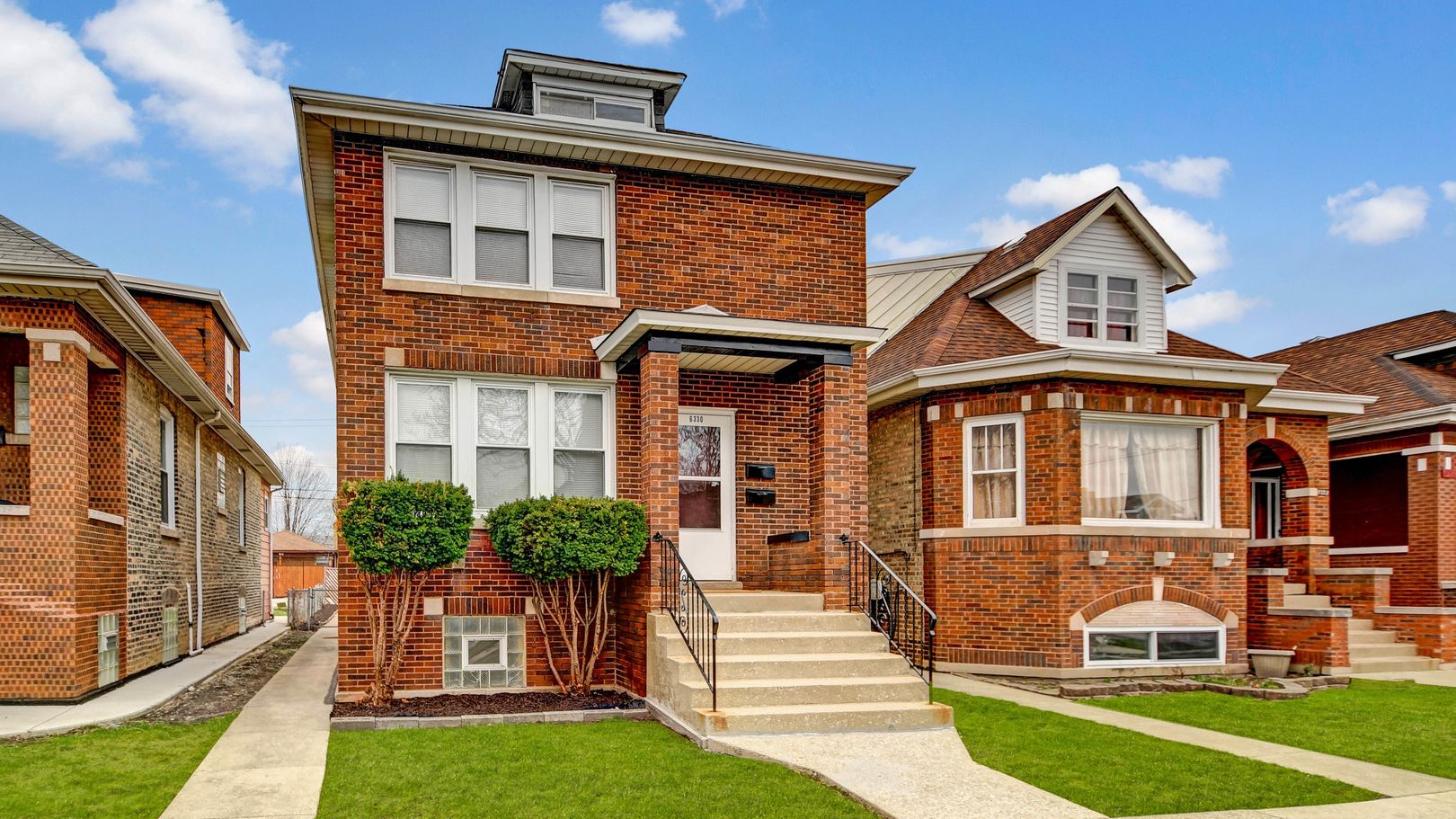
West Lawn occupies Chicago's Southwest Side about nine miles from the Loop. It is bounded by 59th Street to the north, Marquette Road and 71st Street to the south, Pulaski Road to the east, and Cicero Avenue to the west. The Grand Trunk Railroad tracks, running roughly north to south, divide it from its neighbor Chicago Lawn to the east — a seam of iron that has shaped the neighborhood's development since the nineteenth century. West Lawn is a neighborhood of bungalows and two-flats, of parish schools and corner taquerias, of long-term residents and new arrivals — and, beneath Ford City Mall at 76th and Cicero, a labyrinth of tunnels built for a wartime factory that was once the largest building on earth.
Trivia Question
A massive defense plant built in West Lawn during World War II was, at the time of its construction, the largest building in the world. After the war, it briefly became the factory for one of the most famous failed automobiles in American history, before eventually being converted into a shopping mall that still operates today. What was the wartime plant called, what car was made there after the war, and what is the site known as now?
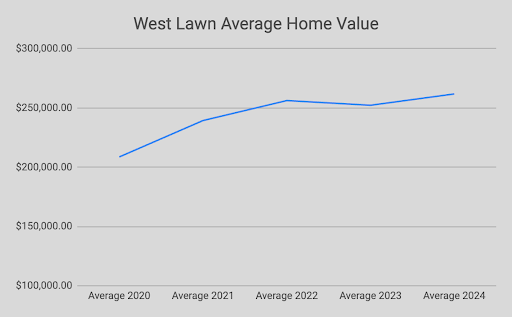
West Lawn by the Numbers
Marsh, Rail, and the Slow Arrival of Settlement
For much of the nineteenth century, West Lawn was simply too wet to build on. While neighboring Chicago Lawn developed with relative speed to the east, the land west of the Grand Trunk Railroad tracks sat as stubborn marsh and prairie, deemed unsuitable by developers who preferred drier ground. Speculators had subdivided portions of the land as early as the 1870s as part of broader Chicago Lawn promotions, but buyers were scarce and actual settlement was minimal.
Three railroads, the Grand Trunk, the Belt Line, and the Santa Fe encircled and crossed the area by the 1880s, and Chicago annexed the land in 1889. But rail access and city jurisdiction alone could not drain a swamp. It was not until the industrial sector in neighboring Clearing began expanding around 1915, generating jobs and demand for housing, that horse-drawn streetcars began running toward West Lawn and workers began looking for places to live within reach of those jobs. The first modest homes rose in that decade, and a genuine community of German, Irish, Czech, Italian, Polish, and Lithuanian slowly took shape.
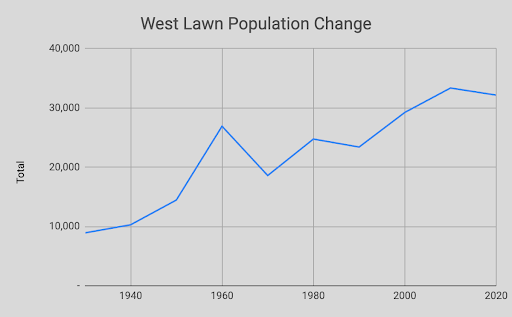
Even then, progress was uneven. Some housing went up in the 1920s, but much of the land remained marshy and underdeveloped into the 1930s. The population climbed slowly, reaching about 14,460 by 1950. It would nearly double in the two decades that followed, driven by forces that had nothing to do with drainage and everything to do with war.
The Largest Building in the World
In 1942, the federal government selected a site in West Lawn at Cicero Avenue and 72nd Street for one of the most ambitious industrial projects in American history. The Dodge Chicago Aircraft Engine Plant, designed by renowned factory architect Albert Kahn, broke ground that year and was completed by early 1944. The main building alone covered 82 acres (30 city blocks) and the full complex stretched 6.3 million square feet across 19 structures. At the time, it was the largest building in the world.
The plant's mission was singular and urgent: produce the Wright R-3350 Cyclone radial engines that powered the B-29 Superfortress, the most sophisticated long-range bomber the United States had ever built. The B-29 played a decisive role in the Pacific theater, including the missions that ended the war with Japan. The Dodge Chicago plant ultimately produced more than 18,000 of those engines, roughly five for every four-engine B-29 that ever flew. At peak production, the factory ran around the clock, employed more than 10,000 workers per shift, and served 35,000 meals a day across fifteen cafeterias.
Kahn engineered an extraordinary building to support that output. Air conditioning was installed throughout the main assembly floor — an engineering feat in itself at the time because the engines required precision tolerances measured in millionths of an inch. To move workers and materials efficiently across the vast footprint, Kahn dug an underground network of tunnels running in a grid pattern beneath the plant. Those tunnels still exist today, used by Tootsie Roll Industries — which has occupied a portion of the former plant since 1967 — for storage and utility access, and by Ford City Mall for a strip of boutique retail along its lower level.
Notably, 75 percent of the plant's line workers were women, and the facility set an early standard for racial and ethnic integration on the factory floor. In a city and an era defined by rigid segregation, the Dodge Chicago plant was an imperfect but genuine experiment in cooperation.
Tucker, Ford, and the Mall That Replaced a Factory
When the war ended, the Dodge Chicago plant fell suddenly silent and then became the backdrop for one of the stranger stories in American industrial history. In 1947, Preston Tucker, a charismatic entrepreneur with grand ambitions and an unfinished car, leased half the massive building to manufacture what he called the "Car of Tomorrow." The Tucker 48 was genuinely innovative for its era: a rear-mounted engine, a padded dashboard, a windshield designed to pop out on impact, and three headlights — including a center one that turned with the steering wheel.
Tucker held a splashy debut in the cavernous factory in 1947, but the company quickly became mired in SEC investigations, dealer lawsuits, and accusations of fraud. Tucker was ultimately acquitted of all charges, but by 1949 the company had collapsed after producing only 51 cars. The "Tin Goose" as the Tucker 48 was sometimes called, became a symbol of American ingenuity derailed, real or imagined, by entrenched industrial interests. Forty-seven of the original 51 Tucker automobiles survive today and are considered collector's treasures.
The U.S. Air Force took over the shuttered plant during the Korean War, contracting with Ford's aircraft division to manufacture Cold War jet engines. Ford eventually closed the facility in 1959. Two years later, the federal government sold the site to private developers who envisioned something entirely different. They tore down portions of the southern section of the complex, paved over the engine test floors, and opened Ford City Mall in 1965 — named for the Ford aircraft division that had last operated there. It remains the largest enclosed mall in Chicago outside of downtown.
The Postwar Bungalow Boom and the Making of a Community
The wartime industrial surge that transformed West Lawn's southern edge also transformed the neighborhood itself. The tens of thousands of workers who streamed into the Dodge plant and other nearby facilities needed somewhere to live, and West Lawn's remaining open land filled rapidly with modest brick bungalows, workers' cottages, and two-flats built for the postwar housing market. The population grew from 14,460 in 1950 to 27,644 by 1970 — a near-doubling in twenty years.
The commercial corridors at 63rd Street and Pulaski Road became the neighborhood's social and economic center, drawing grocery stores, bakeries, pharmacies, and the kinds of neighborhood businesses that require enough foot traffic to survive. Catholic parishes anchoring a community where national identity and religious affiliation were often inseparable, organized daily life for the predominantly Eastern European population. Lithuanian families, in particular, put deep roots into West Lawn, making the neighborhood one of the most significant Lithuanian-American communities in the country.
The intersection of 63rd and Pulaski developed a character all its own. One of its most enduring landmarks is the Capitol Cigar Store, whose oversized wooden Native American statue — a traditional tobacconist's sign — stood out front for decades and was famously featured in the 1992 film Wayne's World. The statue remains a neighborhood touchstone, one of those improbable local icons that define a block more than any official marker.
The Balzekas Museum and the Lithuanian Legacy
Of all the ethnic communities that shaped West Lawn, none left a more singular institutional mark than the Lithuanians. Chicago is home to the largest Lithuanian community outside Lithuania itself — a distinction earned over generations of immigration, first from the oppression of Tsarist Russia and later from Soviet occupation. Many of those immigrants settled on the Southwest Side, and West Lawn became one of their primary anchors.
The community's most visible legacy is the Balzekas Museum of Lithuanian Culture, located at 6500 South Pulaski Road. Founded in 1966 by Stanley Balzekas Jr., a decorated World War II veteran, successful automobile dealer, and son of Lithuanian immigrants, the museum was established during the Cold War specifically because Lithuania had been absorbed into the Soviet Union and cut off from the outside world. Balzekas and other community leaders feared that Lithuanian culture, language, and history would be lost or erased. They built the museum as, in their words, a "cultural home away from the homeland."
The museum moved to its current West Lawn location in 1986, occupying the former Von Solbrig Hospital on Pulaski Road after extensive renovation. Today it holds the distinction of being the largest museum in the United States dedicated to Lithuania — its permanent collection spans folk art, amber, rare maps, medieval armor, and twentieth-century Lithuanian art and photography. It serves as a research library, a community gathering space, and a living record of what Lithuanian-Americans built on the Southwest Side of Chicago when their homeland was beyond reach.
West Lawn Today
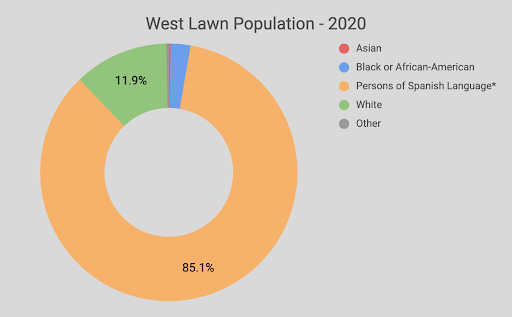
The demographic story of West Lawn over the last four decades mirrors that of the broader Southwest Side. The white ethnic community that dominated the neighborhood through the 1970s has given way to a majority-Latino population, predominantly Mexican-American, that began arriving in the 1970s and grew steadily through the 1980s and 1990s. Arab families, many following the commercial corridor westward from Chicago Lawn, also established a presence along 63rd Street. Today, West Lawn is one of Chicago's more diverse Southwest Side communities — a neighborhood that has absorbed successive waves of newcomers while retaining the physical character its earlier residents built.
The bungalows are the same. The two-flats are the same. The commercial strips at 63rd and Pulaski still draw foot traffic, though the businesses have changed with the population — taquerias and panaderías now share the block with the old-guard institutions that have held on. Huck Finn Restaurant, a breakfast and diner institution that has been in the neighborhood for decades, still draws lines. Paco's Tacos has become a neighborhood staple in its own right.
West Lawn Park, a 15-acre green space on the neighborhood's eastern edge, offers baseball diamonds, a fieldhouse, and open lawn that serves as a gathering point across the community's generational and ethnic boundaries. The Kedzie station on the CTA Orange Line connects residents to the Loop, and Midway Airport — its flight paths arcing directly overhead — remains the neighborhood's loudest and most constant neighbor.
Drive south on Cicero Avenue today and you'll pass Ford City Mall without necessarily thinking much about what came before it. But beneath those floors and in those tunnels is the ghost of the world's largest building — a place that once ran around the clock to fuel the Pacific War, then briefly sheltered an American automotive dream that never quite came true, and now sells sneakers and churros to Southwest Side families on a Saturday afternoon. West Lawn has a habit of building the next thing on top of the last one and moving on.
Trivia Answer
The plant was the Dodge Chicago Aircraft Engine Plant, built in 1942–1944 and at the time the largest building in the world. It produced the Wright R-3350 Cyclone engines that powered the B-29 Superfortress bomber. After the war, entrepreneur Preston Tucker leased the facility to manufacture the Tucker 48 — an innovative but ill-fated automobile of which only 51 were ever built before the company collapsed in 1949. The U.S. Air Force then contracted with Ford's aircraft division to produce Cold War-era jet engines there through 1959. The site was later converted into Ford City Mall, which opened in 1965 and remains the largest enclosed mall in Chicago outside of downtown. Tootsie Roll Industries has occupied a portion of the original plant since 1967, and the underground tunnels Albert Kahn built for wartime logistics are still in use today.
Stay connected with news and updates!
Join our mailing list to receive the latest news and updates from our team.
Don't worry, your information will not be shared.
We hate SPAM. We will never sell your information, for any reason.
