
West Englewood: How Rail Lines, Industry, and Migration Shaped a Chicago Neighborhood
Feb 10, 2026
West Englewood occupies a unique place in Chicago’s neighborhood history. Often mentioned alongside Englewood but shaped by different forces, West Englewood developed as its own community with distinct boundaries, institutions, and identity. Its story is rooted in transportation corridors, industrial growth, and the waves of people who built lives on its residential blocks.
West Englewood is one of Chicago’s 77 officially designated community areas. It sits directly west of Englewood and is bordered by West 59th Street to the North, West 79th to the South, South Ashland Ave to the East, and South Western Ave to the West. These boundaries matter because they reflect physical and economic separations that shaped how the neighborhood evolved. Ashland Avenue, in particular, became a dividing line between Englewood and West Englewood, reinforced by rail infrastructure and industrial zoning that limited east/ west residential continuity.
Understanding West Englewood requires looking closely at how Chicago grew on its South Side, how railroads and factories structured daily life, and how official neighborhood lines hardened into real social boundaries over time.
Trivia Question:
What year was West Englewood officially designated as a separate Chicago community area from Englewood?
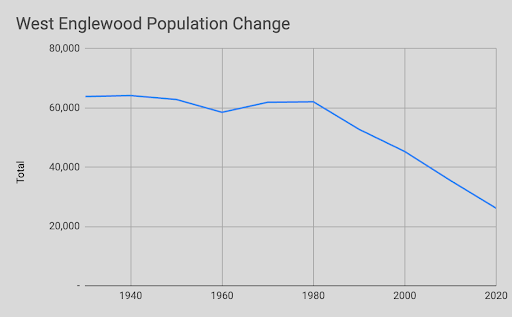
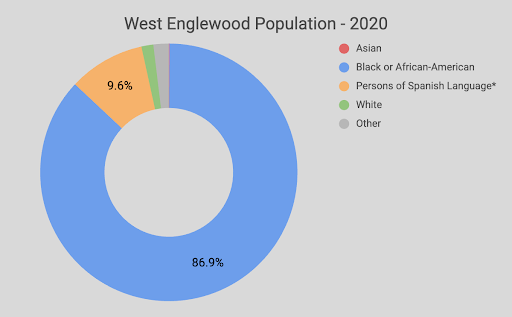
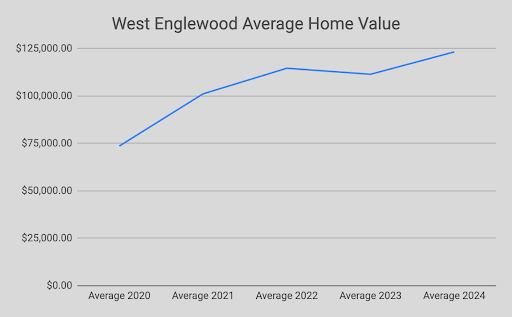
West Englewood by the Numbers
Early Land and Settlement
Before it became part of the city of Chicago, the land that would become West Englewood was prairie and farmland. In the mid-nineteenth century, the area was sparsely populated and used primarily for agriculture. Early settlers were largely European immigrants, including Irish and German families, who were drawn to the area by affordable land and proximity to emerging transportation routes.
Chicago’s annexation of surrounding townships in the late 1800s brought this area into the city, setting the stage for more intensive development. What truly accelerated growth, however, was rail.
The Role of Railroads and Industry
Rail lines played a central role in defining West Englewood’s trajectory. Multiple railroad corridors ran through or along the neighborhood, especially near its eastern edge. These lines supported freight movement and industrial operations rather than passenger travel.
As a result, large portions of West Englewood developed alongside factories, warehouses, and rail yards. This industrial character contrasted with parts of Englewood to the east, which developed more robust commercial corridors and entertainment districts along streets like 63rd.
The presence of rail infrastructure did more than shape land use. It physically separated neighborhoods. Tracks and industrial zones created barriers that discouraged residential overlap and reinforced Ashland Avenue as a dividing line. Over time, residents on either side experienced different daily rhythms, job patterns, and economic opportunities.
Becoming Distinct from Englewood
West Englewood was officially designated as its own community area in the early twentieth century, when Chicago formalized neighborhood boundaries for planning and statistical purposes. While Englewood and West Englewood share historical roots, several factors drove their separation.
First, industrial concentration mattered. West Englewood had a higher density of manufacturing and rail related employment, which influenced housing types and population patterns.
Second, commercial development diverged. Englewood became known for major shopping districts and theaters, while West Englewood’s commercial activity was more dispersed and often tied to local services rather than regional draw.
Third, transportation corridors acted as borders. Ashland Avenue and the adjacent rail lines were not just lines on a map. They shaped how people moved, where businesses located, and how residents identified their neighborhood.
By the time community area boundaries were finalized, West Englewood functioned differently enough that it made sense to treat it as a separate place.
Population Growth and Change
During the early twentieth century, West Englewood grew rapidly. Modest single family homes, two flats, and small apartment buildings filled in residential blocks. Many residents worked in nearby factories, stockyards, or rail related jobs.
The Great Migration brought significant change. African Americans moving north from the South began settling in West Englewood in increasing numbers after World War II, particularly as housing options elsewhere were restricted by segregation and discriminatory practices.
By the mid-twentieth century, West Englewood had become a predominantly Black neighborhood, with strong community institutions including churches, social clubs, and locally owned businesses. These institutions played a critical role in neighborhood stability during periods of economic transition.
Housing and Urban Form
West Englewood’s housing stock reflects its working class roots. Brick bungalows, greystones, and frame houses dominate many blocks. The neighborhood lacks the large mansions found in Kenwood or Hyde Park, but it offers a cohesive residential fabric that supported multigenerational families.
Zoning decisions placed heavier industry near the eastern and southern edges of the neighborhood, while interior blocks remained residential. This mix created both opportunity and tension, as industrial decline later left vacant land and environmental challenges.
Community Institutions and Landmarks
West Englewood has long been anchored by churches, schools, and parks that serve as gathering places.
- Lindblom Math and Science Academy, located on the western edge of the neighborhood, has roots as a historic Chicago public high school and remains a major educational institution.
- West Englewood Park provides recreational space and has hosted community programming for decades.
- Numerous long standing churches reflect the neighborhood’s role as a center of Black religious and civic life on the South Side.
While West Englewood does not have the same concentration of landmark buildings as some other neighborhoods, its institutions are deeply woven into residents’ daily lives.
Economic Shifts and Disinvestment
Like many industrial neighborhoods, West Englewood faced major challenges in the second half of the twentieth century. Factory closures, job losses, and population decline strained local businesses and housing markets.
Public policy decisions, including disinvestment and uneven infrastructure spending, compounded these issues. Vacant lots and underused industrial parcels became more common, altering the physical landscape of the neighborhood.
Despite these challenges, residents continued to organize around block clubs, faith-based groups, and community organizations to stabilize their blocks and advocate for resources.
West Englewood Today
Today, West Englewood is a neighborhood shaped by both history and ongoing change. Community led development efforts focus on housing rehabilitation, green space, and local en ship.
The neighborhood’s location offers access to major arterial streets and transit, and large tracts of vacant land present opportunities for thoughtful redevelopment. Residents and local leaders continue to emphasize investment that serves existing families while building long term economic stability.
West Englewood’s story is not simply one of loss or decline. It is a story of how structural forces shaped a neighborhood and how people adapted, stayed, and built community through change.
West Englewood reminds us that neighborhood boundaries are not arbitrary. They reflect decisions about land use, transportation, and investment that have lasting consequences. By understanding how West Englewood became distinct from Englewood, we gain a clearer picture of how Chicago itself was built.
Trivia Answer:
West Englewood became distinct from Englewood in the early 1870s, following the Great Chicago Fire of 1871, which prompted a building boom in the area. While both areas were part of the Town of Lake and annexed by Chicago in 1889, West Englewood established its own identity as a separate residential area during this rapid development phase.
Stay connected with news and updates!
Join our mailing list to receive the latest news and updates from our team.
Don't worry, your information will not be shared.
We hate SPAM. We will never sell your information, for any reason.
