
They Started It. The History Books Buried It.
May 28, 2026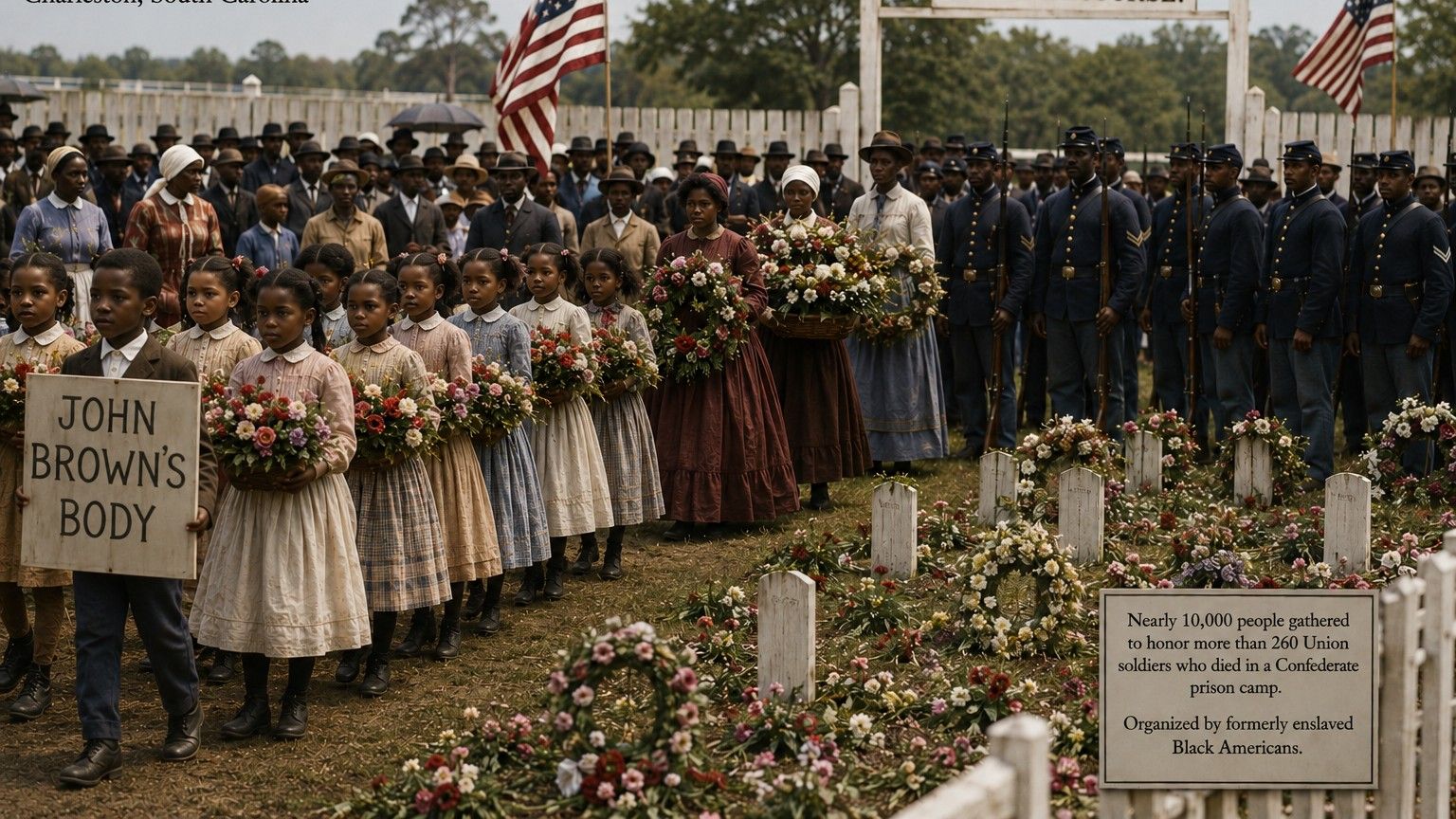
Every year, Americans observe Memorial Day with flags and parades, barbecues and beach trips, a solemn moment at Arlington and a long weekend that marks the unofficial start of summer. Most people know the broad strokes: it began after the Civil War, it was called Decoration Day, soldiers’ graves were decorated with flowers.
What most people do not know — because the story was deliberately buried — is who actually started it.
It was not a government proclamation. It was not a general’s order. It was formerly enslaved Black people in Charleston, South Carolina, who organized the first mass Memorial Day observance in American history. They did it on May 1, 1865. They did it with flowers and songs and 10,000 people. And then white Charleston made sure the country forgot it happened.
This is that story.
The Racetrack That Became a Prison
The Washington Race Course and Jockey Club was once one of the most elegant venues in Antebellum Charleston — a posh country club where the planter class came to bet on horses and display their wealth. By the final year of the Civil War, the Confederate army had stripped it of its elegance entirely. They converted it into an open-air prison camp for captured Union soldiers.
More than 260 Union soldiers died there — of disease, of exposure, of the brutal indifference of their captors. The Confederates buried them hastily in a mass grave behind the grandstands. No markers. No ceremony. No recognition. They were dumped in the ground and left.
When Charleston fell in February 1865 and Confederate troops evacuated the city, most of the white population left with them. The people who remained were Black — mostly formerly enslaved men and women who had survived the war in the city they had been held captive in for their entire lives.
One of the first things they did with their freedom was go back to that racetrack.
Two Weeks of Work Before a Single Flower Was Laid
In the approximately ten days leading up to May 1, roughly two dozen Black volunteers went to the Washington Race Course and did something extraordinary. They exhumed the bodies from the mass grave, one by one, and gave each man a proper individual burial. Then they built a ten-foot whitewashed fence around the new cemetery. Above the entrance, they placed a hand-painted sign that read:
“Martyrs of the Race Course.”
Think about what that took. These were people who had just been freed from bondage less than a month before. They had no resources, no institutional support, no mandate from any government. They chose, as one of their first acts as free people, to do the dignified, backbreaking labor of honoring the men who had died helping to free them.
The work was completed before the ceremony. The ceremony was what came next.
May 1, 1865: Nearly 10,000 People Show Up
On May 1, 1865, nearly 10,000 people gathered at the Washington Racecourse for what historian David Blight would later call the first Memorial Day in American history.
The procession was led by 3,000 Black schoolchildren — newly enrolled in Freedmen’s schools that had only recently opened to them — marching while singing “John Brown’s Body” and carrying armfuls of roses. Behind them came hundreds of Black women bearing baskets of flowers, wreaths, and crosses. Behind them came Black ministers, mutual aid societies, white northern missionaries, and a full brigade of Union infantry — including the famous 54th Massachusetts and the 34th and 104th United States Colored Troops, who performed a special double-columned march around the gravesite.
Prayers were offered. Speeches were made. The graves were decorated. The men buried in that ground were publicly named, publicly grieved, publicly honored.
The New York Tribune covered it. The Charleston Daily Courier covered it. The event was documented. It happened.
“This was the first Memorial Day. African Americans invented Memorial Day in Charleston, South Carolina. What you have there is Black Americans recently freed from slavery announcing to the world with their flowers, their feet, and their songs what the war had been about. What they basically were creating was the Independence Day of a Second American Revolution.” — David Blight, Yale University historian
How the Story Got Buried
The memory of May 1, 1865, did not fade on its own. It was pushed.
From 1876 onward, as white Democrats retook control of South Carolina politics and the “Lost Cause” mythology began reshaping how the South — and eventually the nation — remembered the Civil War, the story of the Charleston freedmen was quietly erased. White Charlestonians built their own version of Decoration Day, one that did not center Black people, Black grief, or the meaning of emancipation.
Decades later, when the United Daughters of the Confederacy asked the Ladies Memorial Association of Charleston whether the May 1, 1865, ceremony had actually occurred, they received a reply from a woman named S.C. Beckwith: “I regret that I was unable to gather any official information in answer to this.”
Whether Beckwith knew and chose silence, or the erasure was already so complete she genuinely could not find the record, the effect was the same. The story disappeared. A 1937 history book further muddled it by attributing the ceremony to a single white organizer and giving it the wrong date.
The graves themselves were eventually removed. The Union Cemetery became a zoo in 1932. It became Hampton Park in 1975. The oval track is still there if you know to look for it.
The Rediscovery, a Hundred and Thirty Years Later
In 1996, Yale historian David Blight was digging through two boxes of unsorted veterans’ papers in the Houghton Library at Harvard — material a curator had pointed him toward almost by accident — when he found a clipping from the New York Herald Tribune. The file was labeled, in someone’s handwriting: “First Decoration Day.”
“I was quite surprised,” Blight later said. “I was like: ‘Praise God. I hope this is true.’ One thing led to another. I kept digging and digging — and there it was.”
He called the Avery Institute of Afro-American History and Culture at the College of Charleston to see what they knew. Their answer: “I’ve never heard of it. This never happened.”
But it had. The newspaper coverage proved it. The Library of Congress held photographs. Blight’s subsequent research produced a 2001 book, Race and Reunion: The Civil War in American Memory, which put the Charleston ceremony back into the historical record where it belongs.
“This was a story that had really been suppressed both in the local memory and certainly the national memory,” Blight said. “But nobody who had witnessed it could ever have forgotten it.”
How We Got from There to Here
In 1868, three years after the Charleston ceremony, Major General John A. Logan — leader of the Grand Army of the Republic, an organization of Union veterans — issued General Orders No. 11, designating May 30 as a national Decoration Day. His proclamation called for the graves of Union soldiers to be decorated with flowers across the country. On May 30, 1868, more than 5,000 people gathered at Arlington National Cemetery, where General James Garfield gave a speech and participants decorated the graves of more than 20,000 soldiers buried there.
That 1868 ceremony is often cited as the official beginning of Memorial Day. But it came three years after Charleston. And Logan himself acknowledged he was building on a tradition that had already been established by the communities — Black communities in particular — who had been honoring their dead since the war ended.
New York became the first state to officially recognize Decoration Day in 1873. By 1890, every northern state had followed. The South refused for decades, honoring Confederate dead in separate ceremonies on separate dates. After World War I, the holiday expanded to honor veterans of all wars, not only the Civil War.
In 1966, President Lyndon B. Johnson declared Waterloo, New York the official birthplace of Memorial Day — because Waterloo had held an annual, community-wide observance beginning in May 1866. The federal government’s choice of Waterloo over Charleston was not incidental. It was a continuation of the same pattern of erasure.
In 1968, Congress passed the Uniform Monday Holiday Act, moving Memorial Day from May 30 to the last Monday in May to create a three-day weekend. In 1971, it became an official federal holiday. The National Moment of Remembrance — a minute of silence at 3 p.m. local time — was added in 2000.
Today, a historical marker stands at Hampton Park in Charleston, recognizing the 1865 ceremony as one of the earliest Memorial Day observances in the country. It took more than 130 years to get that marker placed.
What This Means
Memorial Day, as most Americans understand it, is a day to honor the military dead. That framing is not wrong. But it is incomplete.
The people who started this tradition were not soldiers. They were not politicians. They were not generals issuing orders. They were formerly enslaved people who had just been freed, standing on the grounds of a slaveholders’ pleasure club that had been turned into a prison, decorating the graves of men who had died to end the system that had owned them.
They were not performing patriotism. They were claiming it. They were saying: we know what this war was for. We know who these men were. We know what their deaths meant. And we will not let it be forgotten.
That act — flowers on graves, songs in the open air, 10,000 people on a May morning in Charleston — is the foundation this holiday is built on. It deserves to be remembered as such. Remember who built the tradition of honoring America’s war dead. Remember whose history got buried so somebody else could claim the credit.
And remember the name of that fence: Martyrs of the Racecourse.
Sources: David Blight, Race and Reunion (2001); HISTORY.com; TIME Magazine; Black Press USA; African American Registry; National Cemetery Administration; National Park Service
Stay connected with news and updates!
Join our mailing list to receive the latest news and updates from our team.
Don't worry, your information will not be shared.
We hate SPAM. We will never sell your information, for any reason.
