The Story of the Chicago-Style Hot Dog
Sep 02, 2026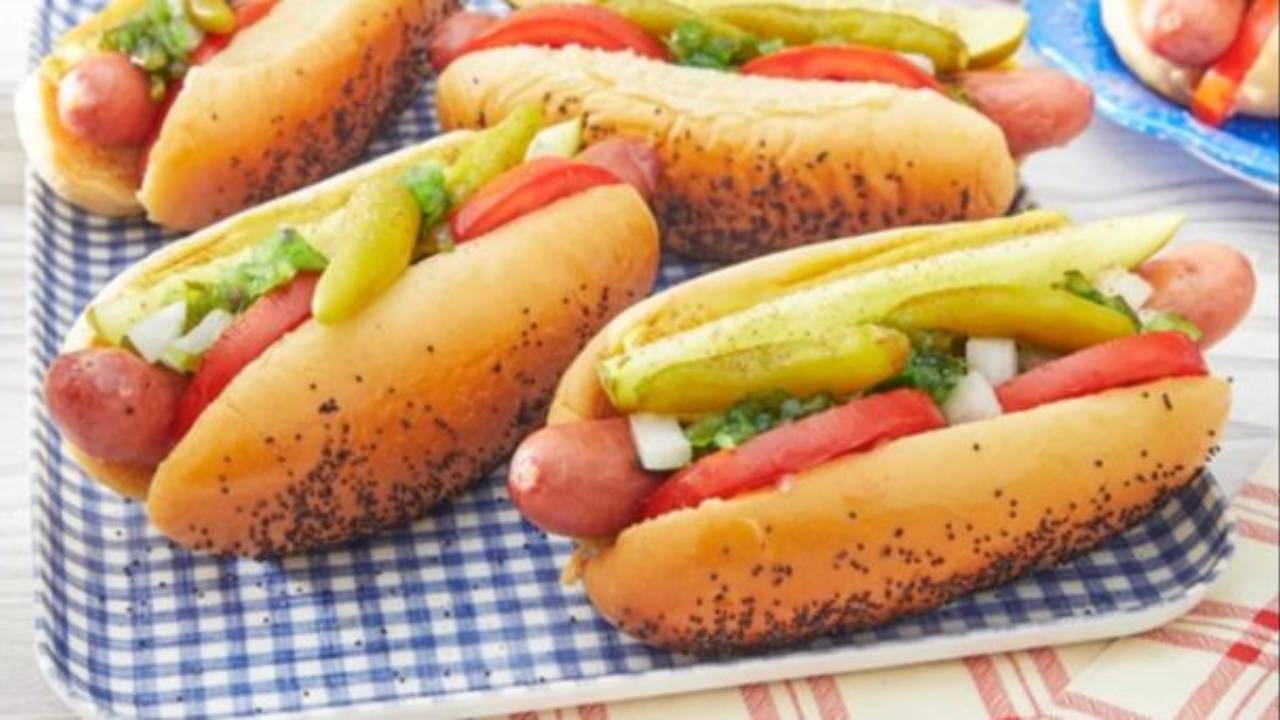
If you want to start an argument in this city, there are two reliable ways to do it. Bring up the Bears' quarterback situation, or put ketchup on a hot dog in front of someone. We're going to focus on the second one today.
Born Broke, Not Broke Down
Though the concept of a sausage in a bun was already being sold in places like Coney Island years earlier, the classic Chicago-style hot dog made its major debut at the 1893 Chicago World's Fair. At the Fair, Austrian-Hungarian immigrants Emil Reichel and Samuel Ladany sold spiced beef sausages with mustard and onions at the "Old Vienna" exhibit.
By the late 1920s, hot dogs were already a cheap, portable lunch for Chicago's working class. Then the Great Depression hit, and "cheap" needed to also mean "filling." Vendors started piling vegetables onto the dog, not for flavor first, but because a hot dog buried in onions, tomato, pickle, and relish looked and felt like an actual meal. You could eat lunch and dinner off one sandwich if you had to, and a lot of people did.
That combination of hustle and hunger is really the whole origin story. Nobody sat down and designed the Chicago dog. The city built it out of necessity, one cart at a time.
The First Known Sighting
The name most tied to this story is Abe "Fluky" Drexler, who in 1929 turned his father's old vegetable cart at Maxwell and Halsted into a hot dog stand. His five cent creation, which he called the "Depression Sandwich," came topped with mustard, relish, onions, a dill pickle, hot peppers, lettuce, and tomato. If you didn't have the nickel, Fluky's reportedly fed you anyway. There was even a meatless version for two cents, served as a "Garden on a Bun." That could be where the “dragged through the garden” saying came from; Do you say that phrase, that seems to be debated.
His nickname "Fluky" reportedly originated during a school initiation where classmates dragged him up stairs with a rope around his neck; after he survived, they joked that it was just a "fluke" that he lived.
Fluky's spent decades claiming they invented the Chicago dog outright. Food historians today are more careful about that claim. Bruce Kraig, a Chicago food historian, has pointed out there isn't hard evidence Fluky's was first, and that the dog we know today came together gradually between the 1920s and 1950s, shaped by German, Eastern European, Puerto Rican, and Mexican vendors and customers all working the same stretch of Maxwell Street. It's less a single invention and more a neighborhood consensus that slowly hardened into a rulebook.
Either way, Fluky's stuck around long enough to become the standard bearer. Fluky's expanded to four locations by 1936. World War II meat rationing forced three locations to close, and the last remaining store closed in 1955. Drexler reopened Fluky's in 1964 on Western Avenue, transforming it into a modern glass-enclosed restaurant that became one of Chicago's premier hot dog establishments. The last freestanding location closed in 2006, but the brand still exists inside a Walmart in Niles.
The Rules Nobody Wrote Down, But Everyone Follows
The finished product, sometimes called the Chicago Seven, is specific enough that Chicagoans can spot a fake from across the room. An all-beef dog, steamed and snapped into a poppy seed bun, topped with yellow mustard, chopped white onion, neon green relish, a dill pickle spear, tomato wedges, sport peppers, and a shake of celery salt. Order it "dragged through the garden" and you're getting all of it.
And no ketchup. Ever. The reasoning traces back to old-school hot dog vendors who saw ketchup as something you used to mask cheap, low-quality meat. If your beef was good, you didn't need to cover it up. That logic calcified into a citywide rule that Chicagoans now treat as closer to law than preference. When Heinz tried to rebrand ketchup as "Chicago Dog Sauce" in 2017, it went about as well as you'd expect.
A Few Facts Most People Don't Know
- The neon relish is neon on purpose, and not for taste. Vienna Beef's own team has said the bright green dye was added decades ago because plain relish photographed poorly and looked unappetizing in ads. The color stuck, and now it's non-negotiable.
- Vienna Beef's story predates the Depression by 40 years. Two Austrian-Hungarian immigrants, Emil Reichel and Samuel Ladany, sold sausages at the 1893 World's Columbian Exposition and decided to stay in Chicago afterward. The company they built is still the dominant hot dog supplier in the city today.
- Sport peppers may have Mexican and Delta roots. Their exact path to the hot dog is debated, with some tracing them back to Mexican vendors at the 1893 fair and others to Southern migrants who brought pickled hot peppers north during the Great Migration.
- Celery salt is a leftover from Chicago's produce industry. The city was once a major celery growing hub, and celery salt found its way onto the dog as a local flavor that had nothing to do with sausages and everything to do with what was already sitting in Chicago pantries.
- The dill pickle and relish come from two different immigrant traditions. The pickle spear traces to Eastern European vendors around Maxwell Street, while the sweet relish has roots in British piccalilli traditions. The Chicago dog is basically a topping-by-topping map of who settled here.
So Who Has the Best One Today
This is the question you cannot win an argument about, and we're not going to pretend otherwise. Superdawg has the loyalists who grew up going to the drive-in. Gene & Jude's in River Grove has the purists, serving a stripped-down version with fries tucked right into the bun, no tomato, no lettuce, exactly the way old-school Depression-era stands did it. The Wiener's Circle has the people who want a little attitude with their lunch. Portillo's has everyone who wants consistency and doesn't mind a chain doing it well.
Ask five Chicagoans for the best hot dog in the city and you'll get six answers, one of them delivered with genuine anger. That disagreement is kind of the point. This sandwich was built by a hundred different vendors making their own calls with whatever they had, and a hundred years later, we're still doing the same thing, just with more opinions and stronger feelings about ketchup.
Where do you go to get your Chicago-style hot dog? Is there an agreed upon number one location on the south side? Reply to this email to give us your response.
Stay connected with news and updates!
Join our mailing list to receive the latest news and updates from our team.
Don't worry, your information will not be shared.
We hate SPAM. We will never sell your information, for any reason.
