
THE PEOPLE'S HOUSE, THE PRESIDENT'S BUNKER
Aug 26, 2026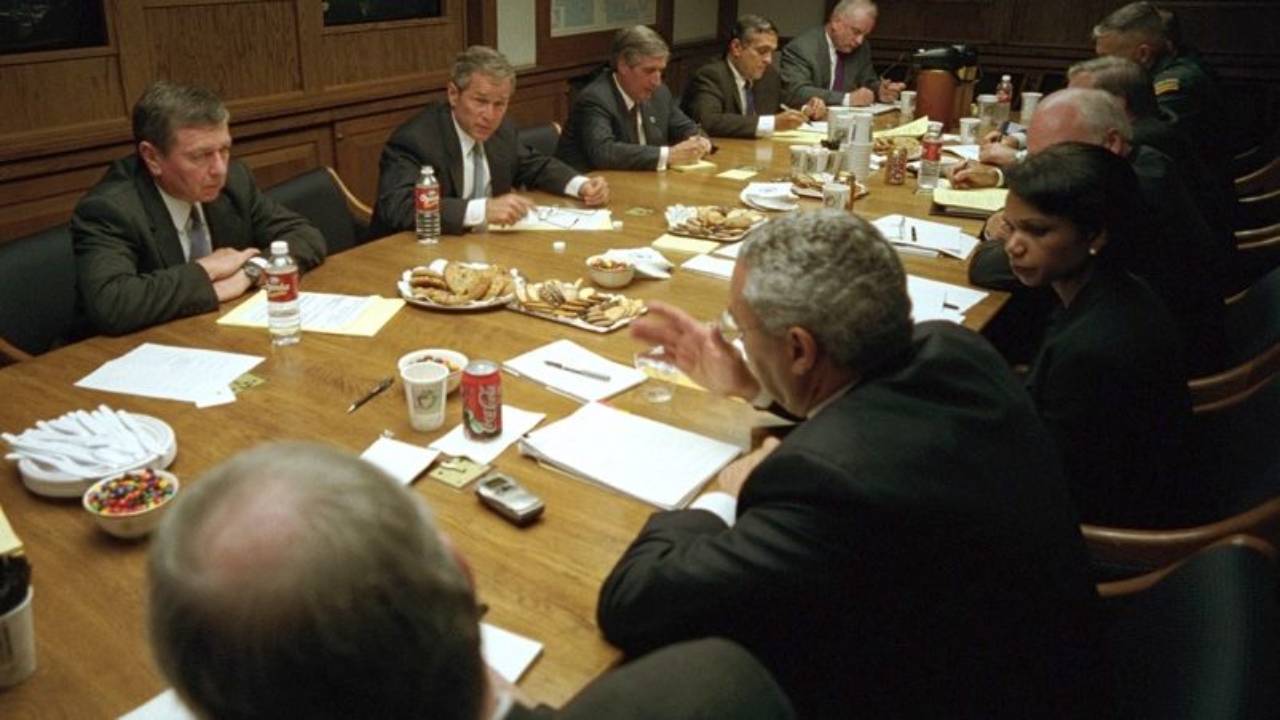
The one thing I know about Donald Trump is if he’s talking, he’s lying. Even when he’s talking about things that are true, he exaggerates or plain out lies about the truth. For example, the White House bunker he keeps talking about that’s under the yet to be constructed ballroom. He would lead you to believe that it is a new idea and it needs to be built and it’s an urgent matter that the bunker be built now for national security and he’ll be the President that made sure it was done having designed and built something to protect him and future presidents to come.
Well, of course that’s a truth based on a lie. Why? Because the bunker was already there. The East Wing was built in 1942 under President Franklin Delano Roosevelt to conceal an underground White House bomb shelter built in the aftermath of Pearl Harbor. The fortified subterranean bunker existed deep below the two-story East Wing of the White House, and during Truman’s administration the bunker was restructured to be strong enough to withstand a direct nuclear hit.
So, once again, here he is taking credit for building something that’s already there. Whatever amount of money he says is dedicated to this bunker that’s already built, he’s lying once again. He’s deceiving you. He’s taking advantage of the fact that most Americans don’t know about the bunker and don’t have enough curiosity to confirm what the president (known to lie) is saying. Nine times out of ten, he’s lying or exaggerating about whatever he’s talking about.
Inside the White House's Underground Emergency Bunker — From FDR's 1942 Air-Raid Shelter to the Massive New Complex Rising Beneath Trump's Ballroom
Most Americans know the White House by its public face — the North Portico, the Rose Garden, the press briefings on the lawn. Far fewer know that directly beneath the East Wing sits one of the most secretive structures in the federal government: the Presidential Emergency Operations Center, better known as the PEOC (pronounced "PEE-ock"), or simply, the White House bunker. Built to shelter the president from an attack severe enough to level the building above it, the PEOC has been rebuilt, expanded, and hardened across eight decades — and right now, in the summer of 2026, it's being torn out and replaced with something far bigger. Here's everything that's publicly known about it.
Born Out of Pearl Harbor
The story starts in December 1941. Weeks after the attack on Pearl Harbor, with fears running high that Japanese bombers could reach the U.S. mainland, President Franklin D. Roosevelt ordered an underground bomb shelter built beneath the White House. Construction began in 1942. To disguise what was happening below ground, the administration built a new above-ground structure to cover it — the East Wing itself, designed by White House architect Lorenzo Winslow. In other words, the East Wing that stood for the next 83 years wasn't just office space for First Ladies and their staff. It was, from day one, a lid over a bunker.
The government never officially acknowledged the shelter at the time. What went up was public. What went underground stayed classified.
From Air-Raid Shelter to Nuclear Command Post
The bunker didn't stay a simple World War II shelter for long. Between 1948 and 1952, President Harry Truman ordered a total gut renovation of the White House — the building's interior was so structurally unsound that the Trumans moved out entirely to Blair House while crews hollowed it out and rebuilt it from the inside. During that overhaul, engineers significantly expanded the underground shelter and added a tunnel connecting the West Wing to the East Wing, giving the president a direct, protected path to the bunker without ever stepping outside.
That expanded facility became what's now called the PEOC. As Cold War anxieties escalated through the 1950s, its mission shifted from "protect the president from bombs" to "protect the presidency itself from a nuclear strike." Starting in 1954, the federal government ran a recurring readiness drill called Operation Alert, in which officials rehearsed evacuating Washington leadership during a simulated nuclear attack — with the PEOC as part of that continuity-of-government machinery.
What's Actually Down There
The exact blueprints of the PEOC have never been made public, and the government has never officially confirmed its specifications. But between photographs, FOIA-released documents, and firsthand accounts from officials who've been inside, a reasonably clear picture has emerged over the years:
- A hardened, self-contained structure built to withstand a direct nuclear hit, with its own backup power, its own water supply, and its own separate air filtration system — meaning it can function independently even if the rest of the White House complex is destroyed or contaminated.
- Access through massive, vault-style blast doors that seal shut with an audible hiss once closed — reachable by elevator and by the underground tunnel connecting the West and East Wings.
- Multiple layers below ground, including a conference room with a long table and the presidential seal on the wall, a communications suite, a medical suite, sleeping quarters, and stores of shelf-stable food and water.
- Secure phone lines, television feeds, and — in later years — video conferencing and computer systems tying the room directly into military and intelligence networks.
- Round-the-clock staffing by U.S. Secret Service personnel and joint-service military officers and non-commissioned officers, even when no president is using the space.
Despite the upgrades, the bunker has never exactly been described as comfortable. When Secret Service agents suggested President George W. Bush and Laura Bush spend the night there after the September 11 attacks, the Bushes reportedly declined — put off by the dated furniture in the living quarters — and returned to the residence instead.
The PEOC Is Not the Situation Room
It's a common mix-up, but the two rooms serve very different purposes. The Situation Room, created by President Kennedy after the Bay of Pigs invasion, sits at ground level in the West Wing basement. It's built for monitoring and coordinating intelligence in real time — comfortable, wood-paneled, wired for video conferencing — but it offers little protection against an actual attack. The PEOC, by contrast, sits on the opposite side of the complex, is reached through hardened tunnels and doors, and is built to keep the president alive and in command if the White House itself comes under direct assault. In a real emergency, the Situation Room feeds information to the PEOC, not the other way around.
September 11, 2001: The Bunker's First Real Test
For nearly 60 years, the PEOC existed mostly as a contingency — a room built for a catastrophe that never came. That changed on the morning of September 11, 2001. As American Airlines Flight 77 turned back toward Washington, Secret Service agents physically pulled Vice President Dick Cheney from his chair and rushed him into the tunnel leading to the bunker. He, Lynne Cheney, National Security Advisor Condoleezza Rice, and later President Bush and First Lady Laura Bush all sheltered there that day. It was inside the PEOC's conference room, according to the 9/11 Commission's official report, that Cheney authorized U.S. fighter jets to engage United Flight 93 if necessary.
"...closed behind me with a loud hiss, forming an airtight seal." — Laura Bush, describing the steel doors of the PEOC on 9/11, in her 2010 memoir Spoken From the Heart
But 9/11 also exposed real problems. According to counterterrorism official Richard Clarke's memoir, Cheney complained bitterly that day that the communications equipment in the bunker was simply inadequate for a national crisis unfolding in real time. The room built to keep a Cold War presidency running through a nuclear exchange wasn't equipped for a 21st-century terrorist attack demanding instant, secure coordination with the Pentagon, the FAA, and fighter pilots in the air.
The Post-9/11 Rebuild
That failure triggered a quiet, expensive overhaul. In the years after the attacks, the government sought secret funding to replace the Roosevelt-era bunker with a new facility — dug deeper, more securely located, and built around modern communications technology. Much of that push came directly from Vice President Cheney, who had spent much of his career working on continuity-of-government planning and pressed for new communications systems and upgraded environmental controls for the space.
In 2010, a massive, unexplained construction project got underway under the North Lawn near the West Wing — a $376 million effort shielded from public view by large fences, with no visible changes once it was finished. It was widely believed to be an expanded successor to the PEOC, built with the latest computer and communications systems and environmental technology designed to let the president and staff operate for extended periods during a crisis without ever coming above ground.
2025–2026: The East Wing Comes Down
That brings us to now. In July 2025, the Trump administration announced plans for a large new White House ballroom — a formal event space intended to replace the tents historically pitched on the South Lawn for state dinners too large for the East Room's 200-person capacity. The administration initially said the project, expected to cost around $200 million, would sit near the existing East Wing without touching it.
That's not what happened. In October 2025, demolition crews tore down the East Wing in its entirety, including the East Colonnade connecting it to the main residence. The project's price tag climbed alongside its scope — first to $250 million, then $300 million, and by mid-2026 the combined cost of the ballroom and the underground work below it was reported at roughly $600 million, including $352 million in taxpayer funds redirected from other federal spending for what the administration has described as security upgrades.
As the demolition proceeded, it became clear the ballroom wasn't the only thing being built. According to reporting from The New York Times and CNN, the project also involves tearing out the WWII-era PEOC entirely and replacing it with a larger, deeper facility. President Trump confirmed as much himself in March 2026, telling reporters aboard Air Force One that the military was building a massive complex beneath the ballroom, and that the ballroom itself functions as a kind of shed covering what the military is constructing underneath, including protections against drones.
"The military is building a massive complex under the ballroom..." — President Trump, March 29, 2026
Sources familiar with the project told CNN that the new bunker will function as a self-contained unit with separate backup power, separate water backup, and separate air filtration — but that unlike the new construction around it, the aging systems it's replacing were still running on 1940s infrastructure. One source said the entire footprint of the old subterranean structures — including the PEOC and underground facilities used by the White House Military Office and the Secret Service Uniformed Division — appears to be gone.
A Legal Fight Over the Nation's Most Recognizable Address
The scale and secrecy of the project has drawn serious pushback. The National Trust for Historic Preservation sued in December 2025 to block the ballroom construction, arguing the administration bypassed the legal process that gives Congress — not the president alone — control over alterations to federal property, including the White House grounds. In January 2026, a judge ordered construction halted until Congress authorized the project, while carving out an exception allowing work tied to the safety and security of the president and his family to continue.
The fight escalated through the year. The National Capital Planning Commission approved a final design in April 2026. By August 2026, with a federal appeals panel ordering most above-ground work halted absent congressional approval, the administration told the Supreme Court the project was already 65 percent complete, with roughly 250 workers on site around the clock, and asked the justices to let construction continue rather than risk leaving the site — and, by the administration's account, the president's security — in limbo. The National Trust countered that the injunction never stopped work on the bunker or the president's safety in the first place; it only blocks construction of a ballroom without Congress's sign-off. As of this writing, the Supreme Court has allowed construction to proceed while the underlying legal case continues.
What This Means, Bottom Line
Strip away the politics of who's paying for it and who approved it, and the throughline is remarkable: for 83 years, whatever sat beneath the East Wing was rebuilt in secret every few decades to match the threats of its era — bombers in 1942, nuclear missiles in the 1950s, a communications failure exposed on 9/11, and now, according to the president's own words, drones and other modern threats in 2026. The public will likely never see blueprints, floor plans, or a tour. But the pattern across eight decades is consistent: whatever is being built under that ballroom right now won't be the last version of this bunker, either.
Sources: georgewbush-whitehouse.archives.gov; the 9/11 Commission Report; Laura Bush, Spoken From the Heart (2010); Richard Clarke memoir; Wikipedia (Presidential Emergency Operations Center; East Wing; White House State Ballroom); PBS NewsHour; CNN Politics; ABC News; Axios; NBC News; Mental Floss; Electrospaces.net; LegalClarity.
Stay connected with news and updates!
Join our mailing list to receive the latest news and updates from our team.
Don't worry, your information will not be shared.
We hate SPAM. We will never sell your information, for any reason.
