
The First HBCUs: Who They Were Built For, What They Survived, and How They’re Doing Now
Feb 04, 2026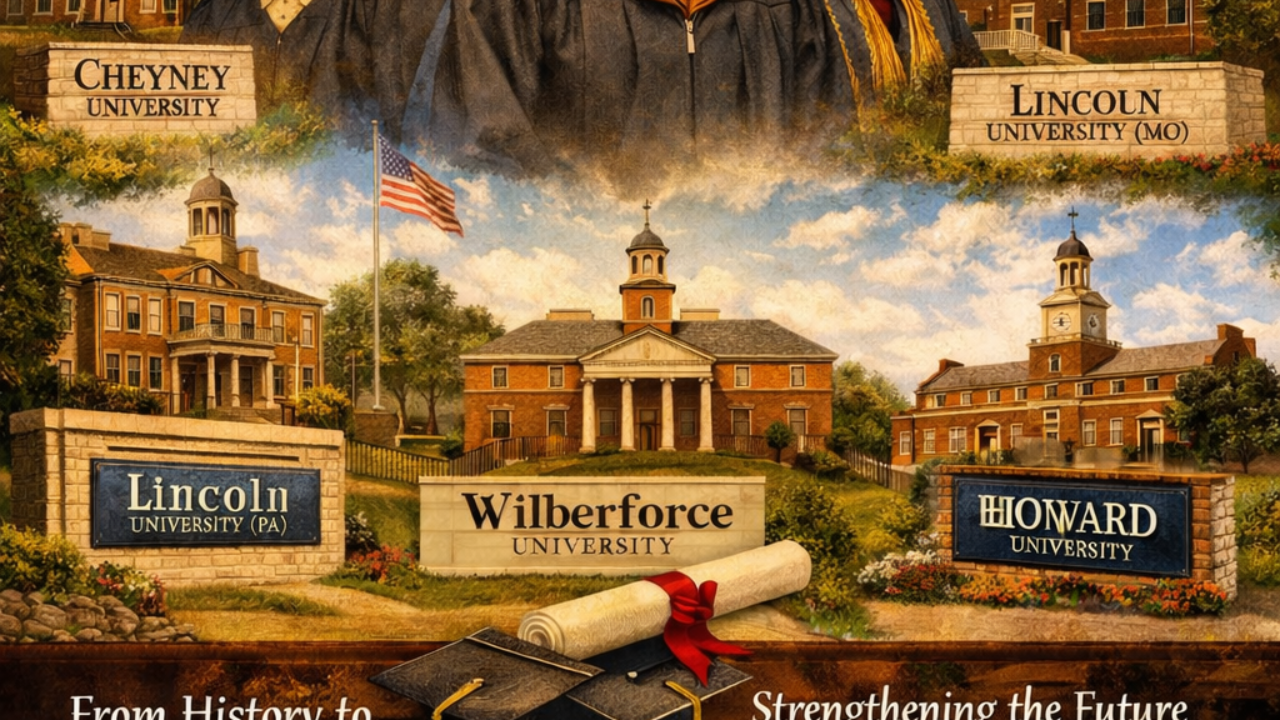
Every HBCU was born out of a simple, radical idea: Black people deserved education, safety, and opportunity—no matter what the law, the economy, or the culture said. These institutions weren’t created because it was convenient. They were created because it was necessary.
One quick note of truth before we dive in: the Instagram reel we reference groups these schools as “all before the Civil War,” but two of them were founded after the war—during Reconstruction, when newly freed Black communities were fighting to build institutions that could last. (That doesn’t make them less important. It makes them part of a different chapter of the same struggle.)
Below is a grounded look at the history of each school—and what “how they’re doing now” looks like today.
Cheyney University of Pennsylvania (1837)
America’s First HBCU
Historical Role
Cheyney was created specifically to train Black teachers at a time when educating Black people was considered a threat to the social order. It became a foundation for public education in Black communities throughout the Northeast and Mid-Atlantic.
Its early graduates staffed segregated schools, trained future leaders, and helped build Black professional life in Pennsylvania and beyond.
Academic Focus
Today, Cheyney emphasizes:
-
Business
-
Education
-
Criminal Justice
-
Liberal Arts
-
Social Sciences
Teacher preparation remains central to its identity.
Alumni Impact
Cheyney alumni have been especially influential in:
-
Public education
-
Civil service
-
Community leadership
-
Ministry
It has quietly shaped generations of Black professionals.
Current Reality
Cheyney has struggled financially for decades due to:
-
State funding gaps
-
Enrollment declines
-
Deferred maintenance
However, recent accreditation reaffirmation (2024) stabilized the school and opened doors to new grants and partnerships.
Outlook
Cheyney is rebuilding slowly, focusing on:
-
Enrollment growth
-
Infrastructure repair
-
Strategic partnerships
-
Restoring public confidence
It remains a symbol of survival and resilience.
Lincoln University of Pennsylvania (1854)
First Degree-Granting HBCU
Historical Role
Founded as Ashmun Institute, Lincoln (PA) trained Black ministers, teachers, and intellectuals when universities were closed to them.
It became one of the main pipelines for Black leadership in the 19th and early 20th centuries.
Academic Strengths
Lincoln is known for:
-
Natural sciences
-
Business
-
Social sciences
-
Education
-
Pre-law and pre-med tracks
It maintains a strong liberal arts tradition.
Legendary Alumni
Lincoln has produced:
-
Thurgood Marshall (U.S. Supreme Court Justice)
-
Langston Hughes (poet)
-
Kwame Nkrumah (Ghana’s first president)
Few universities—Black or white—can match that global impact.
Current Status
As a state-related institution, Lincoln receives public funding, which helps with stability. It has:
-
Modernized facilities
-
Expanded STEM programs
-
Increased out-of-state recruitment
Outlook
Lincoln (PA) is relatively stable among HBCUs and positioned for moderate growth, especially in health and science fields.
Wilberforce University (1856)
Oldest Private Black-Owned HBCU
Historical Role
Wilberforce was purchased and governed by the African Methodist Episcopal Church, making it one of the first institutions fully controlled by Black leadership.
It became a spiritual, political, and intellectual hub for Black America.
Academic Identity
Wilberforce focuses on:
-
Business
-
Communications
-
Computer Science
-
Social Work
-
STEM
-
Aviation (through partnerships)
It blends faith-based and secular education.
Cultural Influence
Wilberforce has long produced:
-
Pastors and bishops
-
Educators
-
Civil rights leaders
-
Community organizers
Its church connection remains central.
Recent Turnaround
After years of near-collapse, Wilberforce has:
-
Rebuilt enrollment
-
Reorganized finances
-
Invested in student housing
-
Strengthened governance
The 70% enrollment growth since 2022 is significant.
Outlook
Wilberforce is in recovery mode—but moving forward. If leadership remains steady, it could become a model for small HBCU revival.
Lincoln University of Missouri (1866)
Built by Black Soldiers
Historical Role
Lincoln (MO) is unique because it was founded by formerly enslaved Black Union soldiers. They literally financed freedom through education.
It represents self-determination in its purest form.
Academic Strengths
Lincoln (MO) offers:
-
Agriculture
-
Veterinary Science (partnerships)
-
Business
-
Education
-
Criminal Justice
-
Nursing
-
STEM
It is Missouri’s only public HBCU.
Research & Agriculture
Because it is a land-grant institution, Lincoln receives federal research funding, especially in:
-
Food systems
-
Environmental science
-
Rural development
-
Public health
This gives it an advantage many HBCUs lack.
Current Position
Enrollment growth and Carnegie “Research College” status have strengthened its profile. It has:
-
Expanded graduate programs
-
Increased grant funding
-
Built new labs
Outlook
Lincoln (MO) is one of the more structurally secure HBCUs and likely to grow as a regional research center.
Howard University (1867)
The Flagship HBCU
Historical Role
Howard was created to train Black doctors, lawyers, teachers, and administrators after emancipation. It became the intellectual engine of Black America.
Almost every major civil rights movement included Howard graduates.
Academic Power
Howard offers:
-
Law
-
Medicine
-
Pharmacy
-
Dentistry
-
Engineering
-
Communications
-
Public Policy
-
Fine Arts
It functions like a comprehensive research university.
Elite Alumni
Howard alumni include:
-
Kamala Harris
-
Thurgood Marshall
-
Toni Morrison
-
Chadwick Boseman
-
Zora Neale Hurston
Its influence is national and global.
Financial Strength
Howard has:
-
Billion-dollar endowment growth
-
Major corporate partnerships
-
Federal research contracts
-
Strong alumni giving
R1 status confirms its elite research standing.
Outlook
Howard is positioned as the “Harvard of HBCUs”—not symbolically, but structurally. It will likely continue expanding its national influence.
The Bigger Picture: What These Five Schools Represent
Together, these institutions show the full arc of Black higher education:
| Era | Institution | What It Represents |
|---|---|---|
| Pre-Civil War | Cheyney, Lincoln PA, Wilberforce | Survival under slavery |
| Reconstruction | Lincoln MO, Howard | Building after freedom |
| Modern Era | All | Fighting for sustainability |
They were built when:
-
Black literacy was illegal
-
Black colleges were attacked
-
Black professionals were blocked
They still exist because communities refused to let them die.
Check out the Instagram reel on the five HBCU's here.
Stay connected with news and updates!
Join our mailing list to receive the latest news and updates from our team.
Don't worry, your information will not be shared.
We hate SPAM. We will never sell your information, for any reason.
