
The Barbershop Was Always the Clinic. Now It’s Time to Staff It.
Apr 29, 2026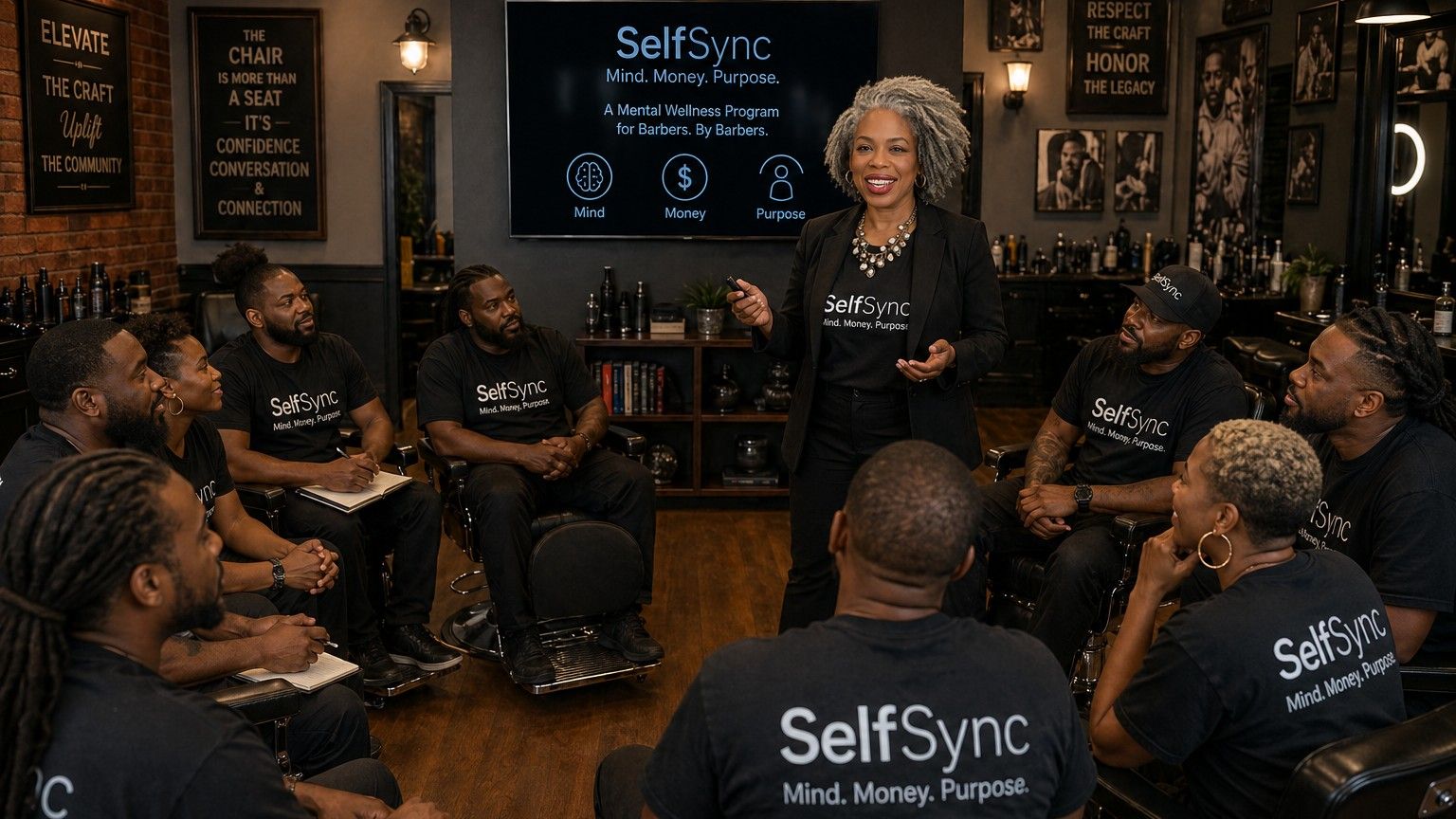
BEFORE THERE WERE THERAPISTS, THERE WERE BARBERS
Part 4 of 4 | Mental Health Awareness Month
By Kiné Corder | Bronzecomm Hub
What if the most important mental health conversation happening in America right now is not in a therapist’s office? What if that conversation is already happening in a chair you have been sitting in your whole life, with someone who has known you longer than most of your doctors? Maybe you should also ask him how he’s doing.
May is Mental Health Awareness Month and in most barbershops they’ll be talking about baseball season, basketball playoffs, or even the latest movie release. But the mental health conversation should also be happening in the barbershop. Now is a good time.
Consider this. In 2023, only 17 percent of American men saw a mental health professional. One in four men dealing with depression never received any counseling or therapy at all. Men make up nearly 80 percent of all suicides in the United States, at a rate four times higher than women.
And the part that could really hit a man hard is that the data shows the lower a man’s income, the higher his risk of depression, with the lowest-income Americans experiencing depression at nearly three times the rate of the highest earners. The data collected was based on Americans, but there are studies like this happening all over the world, including Europe and the UAE.
These are not numbers about weakness. They are numbers about access. About stigma. About a mental health system that was not designed with men in mind and has never figured out how to reach them where they actually are.
But someone else has. Someone who has been there for a thousand years.
We agree on the problem
Over the last three weeks we traced the history of barbers from ancient Egypt to the civil rights era to the streets of Chicago’s South and West Sides. We documented the programs now training barbers in mental health awareness across 35 states. We even named the gap that was being left out which data shows is clearly connected, money. The financial root of stress is something that must be addressed, but the current programs available are skipping over it.
Last week we got honest about what it costs a barber to carry everyone else’s weight without a system of his own. This week we need to continue that discussion and offer solutions. Not as a concept. As a real thing being built right now, in four cities, on three continents, by someone who has spent thirty years standing on all sides of this problem.
The problem is not local
Chicago gave the United States its first barber school in 1893 and as we said last week, before there were therapists, there were barbers. However, the barbers weren’t trained in school how to handle the mental health conversations that come their way. That’s why barbers, all over the world, must be equipped with more tools so they can guide the man who won’t think of going to therapy on his own.
But the problem these barbers are navigating is not a man problem. It is a human problem. And it is playing out the same way in every city where men are expected to be strong, providers, and silent about their struggles.
In Las Vegas, a city built on performance and illusion, men are working long hours in high-pressure environments with very little infrastructure for what happens when the performance stops. The financial stress there is acute. The conversations barbers are absorbing in those chairs are heavy.
In Dubai, one of the fastest-growing cities in the world and a hub for entrepreneurs, executives, and men who have relocated far from their support systems, the barbershop is often the only consistent community space these men have. Expats building new lives in a new country are carrying enormous pressure with almost no one to talk to. Locals meeting new people, getting used to the environment changing, and dealing with their generational values being questioned.
Their barber may be the most stable relationship they have.
Even in France and Monaco you'll find old money and new money problems co-existing. The stress is mounting. The old way of life when the south of France and Monaco expats spent more time on the beach and in yachts than they did on land or at work is the past. Business owners are worried about finding good help, navigating global markets, and remembering what time zone they are in. All new stress that most of the people in their families can’t understand.
Not to mention not even the savviest therapists can grasp what they are experiencing.
The geography changes. The weight on the barber does not.
Mental health pressure does not need a passport to travel. Neither does financial stress. The barbershop is the one institution that shows up everywhere men are, in every culture, in every income bracket, in every city on earth.
Why a global therapist sees this differently
I have spent the last four years working with clients on therapy retreats across seven countries. I have sat with men and women in Europe, the Middle East, Asia and across the United States who are dealing with the same core struggle: the intersection of money and mental health. The details change by city and by culture. The root stays the same.
What that experience taught me is that the mental health crisis among men is not a cultural problem or an American problem. It is a structural one. Men are not unwilling to get help in the same way that women do. They are unwilling to go to the places help has traditionally been offered. The therapist’s office. The support group. The hotline. These are not spaces that feel natural to most men, and the data bears that out.
So why are we making them suffer? Why hasn’t there been a solution?
The barbershop is different. It always has been. A man will walk into a barbershop without hesitation. He will sit in that chair every two to four weeks for years. He will talk. Not because someone told him to. Because the environment makes it natural and the person serving him has earned the right to be trusted. In some ways the man behind the chair feels like an equal, but in other ways he is the wisest man in the room.
A man who may not hold a degree, and quiet as kept, he may not even have a barber diploma. But he knows things, he’s seen things, he listens in a way that no other professional does, and he responds in a way that no other professional does. He’s professional, but he’s relatable. That’s what makes the men that sit in his chair go there. That’s what makes them tell him things they’ve never told anyone.
What is missing is not the relationship. What is missing is the training, the tools, and the financial framework that turns that relationship into something sustainable for both the barber and the client.
What a staffed clinic actually looks like
Imagine a veteran barber in Chicago who has been cutting hair for fifteen years. He knows his clients. He knows their families, their jobs, their patterns. He already notices when someone comes in carrying more than usual. He already asks the right questions by instinct. What he does not have is a system for what comes next.
Now give that barber training on how the brain processes stress, what financial anxiety actually does to decision-making, and how to move a conversation from venting to clarity without overstepping his role. Give him a community of other barbers going through the same development so he is not doing it alone. Show him a way to add that deeper service to his menu so the work he is already doing starts generating additional income instead of slowly draining him.
That barber does not become a therapist. He becomes something more precise than that. He becomes the most trusted, most accessible, most consistent mental wellness and financial conversation partner that his clients will ever have. And he does it from a chair they were already going to sit in anyway.
Now multiply that by every serious, veteran barber in Chicago. Then Las Vegas. Then Dubai. Then Monaco. Then every city where the barbershop is the room where men actually talk, freely and honestly. Going there gives him peace, because he can be himself.
It’s like a clinic, they just call it a barbshop. It has always existed. It just has not been staffed properly.
This is what I came back to build
I left the barber industry years ago thinking the only way to get paid for the deeper work was to leave it behind. I got my financial licenses. I got my master’s degree in mental health counseling. I trained in hypnotherapy. I worked in finance and private practice and therapy retreats across the world.
And then I came back. Because everything I learned points to the same place. The chair is where the work happens. The barber is who the work flows through. And the system that makes that sustainable, for the barber and for the clients who depend on him, is what nobody had built yet.
I built it. It is called SelfSync. And it starts not with the client but with the barber himself, his brain, his money, his health, his legacy. Because a barber who is taken care of is a barber who can take care of others. Not as a sacrifice. As a practice.
Chicago gave the world the first barber school. I would like to think this city also helps give the world the first generation of barbers who are fully equipped for everything the chair has always asked of them.
That work has started. And it is bigger than any one city. I’m the founder of the SelfSync System and a Chicago native. There’s work to do and I’m up for it. There are lots of programs for women, even programs that support therapists. This one is for the men, so they can commit to what they’ve already been willing to do.
If this series found you, it found you for a reason. Share it with someone who needs to read it. If you are a barber, the next step is waiting for you below.
FOR BARBERS
If you have read one or all four parts of this series and something in it felt like it was written for you, it was. I built something specific for where you are right now. No fluff. No pitch. Just a real conversation about what comes next. Before you leave the industry or try another side hustle, let’s talk.
Book your session: everyexpert.com/kine
FOLLOW THE CONVERSATION
Kiné Corder is a Financial Hypnotherapist, nationally certified mental health counselor, and creator of the SelfSync System. She works with barbers at the intersection of mental health and money from Las Vegas to Dubai. Follow her on Instagram as she builds this in real time.
Follow Kiné on Instagram and YouTube:
https://www.youtube.com/@prosperousbarber
Stay connected with news and updates!
Join our mailing list to receive the latest news and updates from our team.
Don't worry, your information will not be shared.
We hate SPAM. We will never sell your information, for any reason.
