
The Architects of Segregation
Oct 22, 2026By Erased Empires
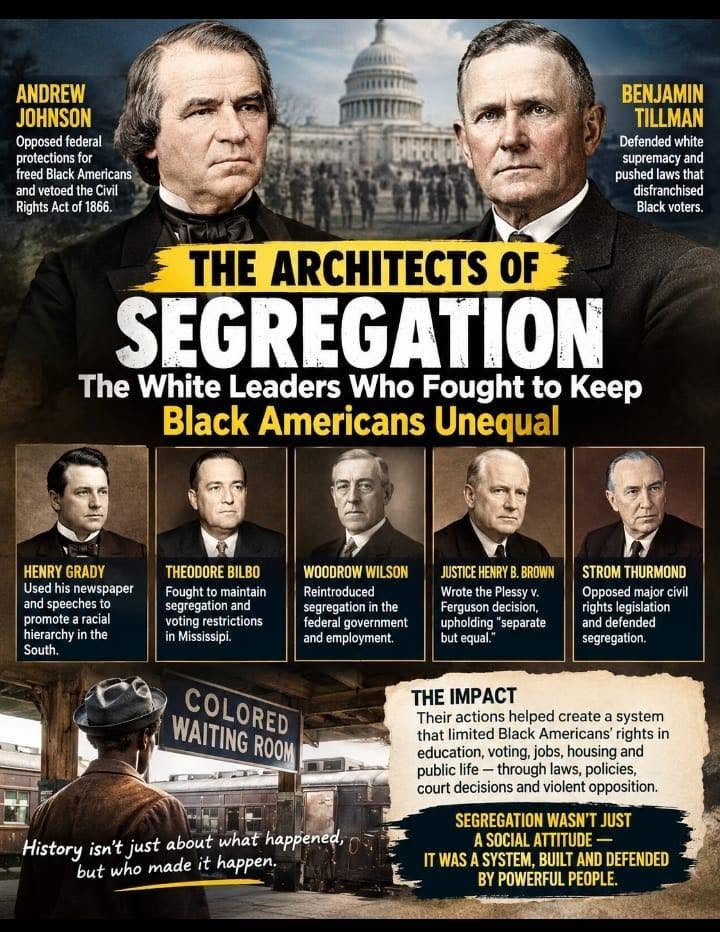
How did a country that abolished slavery allow racial segregation to continue for nearly another century?
On December 6, 1865, the United States ratified the 13th Amendment, abolishing slavery, except as punishment for a crime. Yet freedom did not immediately bring equality.
In the decades that followed, white political leaders, lawmakers, judges, and other powerful figures helped establish and defend systems that restricted Black Americans' rights, opportunities, and freedom.
Through discriminatory laws, court decisions, voting restrictions, and resistance to civil rights reforms, these individuals helped create and maintain what became known as the Jim Crow system.
Here are some of the important figures and the roles they played in this history.
- ANDREW JOHNSON — THE PRESIDENT WHO OPPOSED STRONG FEDERAL PROTECTIONS FOR FREED BLACK AMERICANS
Andrew Johnson became president after Abraham Lincoln's assassination in 1865.
During Reconstruction, the period following the Civil War, Johnson opposed important federal efforts to protect the rights of formerly enslaved people. He vetoed the Civil Rights Act of 1866 and legislation extending the Freedmen's Bureau, which assisted formerly enslaved people in their transition to freedom.
Congress overrode his veto of the Civil Rights Act.
The law established federal protections for citizenship and certain civil rights, although it did not eliminate racial discrimination.
Johnson's opposition to these measures intensified the conflict between his administration and congressional Republicans over the future of Black freedom and citizenship.
The lesson: Abolishing slavery was a major achievement, but protecting formerly enslaved people from discrimination required additional laws and enforcement.
- BENJAMIN TILLMAN — THE SENATOR WHO OPENLY DEFENDED WHITE SUPREMACY
Benjamin Tillman, a South Carolina politician who served as governor from 1890 to 1894 and as a U.S. senator from 1895 to 1918, openly defended white political domination.
He supported South Carolina's 1895 constitution, which introduced measures that effectively disfranchised many Black voters.
These restrictions included literacy tests and other voting requirements that were administered in discriminatory ways. Poll taxes and additional barriers also helped prevent Black citizens from exercising their voting rights.
Tillman openly advocated white supremacy and defended the political order that maintained white control over South Carolina.
His career illustrates how segregation and racial inequality were reinforced not merely by social prejudice but by state constitutions, election laws, and political institutions.
The lesson: The right to vote means little when those in power create rules designed to prevent eligible citizens from exercising it.
- HENRY GRADY — THE INFLUENTIAL EDITOR WHO PROMOTED A RACIAL HIERARCHY
Henry W. Grady was a prominent Georgia newspaper editor and an influential advocate of the post-Reconstruction New South.
He promoted industrial development and economic modernization across the Southern states. However, his vision of Southern progress did not require racial equality.
In his influential speeches, Grady advocated reconciliation between white Northerners and white Southerners while presenting Black people as a subordinate part of the South's social order.
His rhetoric helped promote a vision of regional unity that could coexist with white political dominance and racial inequality.
It is important to distinguish Grady's role from that of lawmakers who directly enacted segregation statutes: his influence was primarily through journalism, public speaking, and shaping white Southern opinion.
The lesson: Inequality can be sustained not only through legislation but also through the ideas and public narratives that make discrimination appear acceptable.
- THEODORE BILBO — THE POLITICIAN WHO DEFENDED RACIAL DISFRANCHISEMENT
Theodore G. Bilbo served as governor of Mississippi and later as a U.S. senator.
He was an outspoken white supremacist who used his political influence to defend racial segregation and white political control.
Mississippi's system of racial disfranchisement relied on mechanisms including poll taxes, literacy tests, and other requirements that were used to obstruct Black citizens' access to the ballot.
Bilbo's public rhetoric and political career reflected the continued influence of white supremacist politics well into the 20th century.
His example demonstrates that the struggle over Black voting rights did not end with the adoption of the 15th Amendment in 1870, which prohibited denying the right to vote on account of race.
The lesson: Constitutional guarantees can be undermined when political institutions fail to protect the people those guarantees are intended to serve.
- WOODROW WILSON — THE PRESIDENT UNDER WHOM FEDERAL OFFICES WERE RESEGREGATED
Woodrow Wilson served as president from 1913 to 1921.
His administration introduced racial segregation into parts of the federal civil service that had previously been more integrated.
Under his administration, some federal departments separated Black and white employees through segregated workspaces, screens, and other discriminatory practices. Black employees also faced barriers to hiring and promotion.
These policies reversed some of the progress African Americans had made in federal employment and reinforced racial discrimination within the national government.
Wilson's record is particularly significant because it shows that segregation was not exclusively a Southern state issue. Discrimination also existed within federal institutions.
The lesson: Even institutions belonging to the national government could reproduce racial inequality when their leaders permitted discriminatory policies.
- JUSTICE HENRY BILLINGS BROWN — THE JUDGE WHO HELPED GIVE SEGREGATION CONSTITUTIONAL PROTECTION
On May 18, 1896, the U.S. Supreme Court issued its decision in Plessy v. Ferguson.
Justice Henry Billings Brown wrote the majority opinion, which upheld a Louisiana law requiring separate railway accommodations for Black and white passengers.
The ruling established the constitutional doctrine commonly known as "separate but equal."
In practice, facilities and services provided to Black Americans were frequently inferior, underfunded, or inaccessible on equal terms.
The ruling gave segregation a powerful legal foundation and allowed discriminatory practices to continue across much of American public life.
However, Brown was not the only figure responsible for the decision. The ruling represented the position of the Supreme Court majority.
Justice John Marshall Harlan dissented, arguing that the Constitution should not recognize a superior or inferior class of citizens on the basis of race.
The Supreme Court eventually rejected the separate-but-equal doctrine in public education in Brown v. Board of Education in 1954.
The lesson: Court decisions can protect civil rights, but they can also legitimize discriminatory systems for generations.
- STROM THURMOND — THE SENATOR WHO FOUGHT AGAINST FEDERAL CIVIL RIGHTS LEGISLATION
Strom Thurmond, a South Carolina politician, served as governor and later as a U.S. senator.
In 1948, he ran for president as the candidate of the States' Rights Democratic Party, commonly known as the Dixiecrats. The party opposed federal civil rights proposals and defended racial segregation.
Thurmond delivered a lengthy Senate speech in 1957 opposing the Civil Rights Act of that year, which sought to strengthen federal protection of voting rights.
He also voted against the Civil Rights Act of 1964, landmark legislation that prohibited discrimination in important areas of public life and employment.
Thurmond's record is significant because it demonstrates that resistance to civil rights legislation continued at the highest levels of American government during the 20th century.
His later political career included a public break with some of his earlier positions, but that development does not erase his documented opposition to major civil rights measures.
The lesson: The struggle for equality involved sustained political battles over whether the federal government should protect Black Americans against racial discrimination.
---
HOW DID THEIR ACTIONS AFFECT BLACK AMERICANS?
These leaders did not all perform the same roles. Some opposed federal protections, some promoted white political dominance, some implemented discriminatory policies, and others defended segregation through the courts or resisted civil rights legislation.
Together with numerous other officials and institutions, their actions contributed to a system in which Black Americans faced restrictions in several areas of life.
Education: Segregated schools were frequently unequal in funding, facilities, and educational opportunities.
Voting: Poll taxes, literacy tests, discriminatory registration practices, intimidation, and violence prevented many Black Americans from voting.
Employment: Discrimination restricted access to jobs, promotions, and fair treatment in the workplace.
Public facilities: Jim Crow laws required racial separation in many schools, railway cars, restaurants, and other public spaces.
Housing: Discriminatory laws, restrictive covenants, and other practices helped maintain racial separation in residential areas.
Personal safety: Racial violence, including lynching and mob attacks, terrorized Black communities, while authorities frequently failed to provide meaningful protection.
These practices were not identical everywhere. Jim Crow laws were especially entrenched in the South, while discrimination and residential segregation also existed elsewhere in the country.
The Library of Congress documents how segregation, disfranchisement, and racial discrimination shaped American life long after slavery ended.
WHEN DID THIS SYSTEM BEGIN TO BREAK DOWN?
Black Americans never simply accepted segregation. They resisted through litigation, political organizing, journalism, boycotts, protests, education, and other forms of collective action.
One major turning point came on May 17, 1954, when the Supreme Court unanimously ruled in Brown v. Board of Education that racial segregation in public schools was unconstitutional.
The Civil Rights Act of 1964 subsequently prohibited discrimination based on race in important areas, including public accommodations and employment.
The Voting Rights Act of 1965 established stronger federal protections against racial discrimination in voting.
These victories did not immediately eliminate every form of racial inequality, but they dismantled major legal foundations of segregation.
THE BIGGER LESSON
The history of segregation reveals how inequality can survive even after a country formally abolishes slavery.
It can be maintained through laws, court decisions, voting restrictions, government policies, and public attitudes.
But this history is also a testament to the courage of Black Americans who challenged injustice, often at great personal risk, and helped force the nation to confront the gap between its democratic ideals and its treatment of its Black citizens.
History is not only about remembering what happened. It is about understanding how it happened, who helped sustain it, who resisted it, and what we can learn from it today.
LET'S DISCUSS:
Which of these figures or policies do you believe deserves greater attention in history classes, and why?
Do you think most people fully understand how segregation was maintained through American laws and political institutions long after slavery ended?
Stay connected with news and updates!
Join our mailing list to receive the latest news and updates from our team.
Don't worry, your information will not be shared.
We hate SPAM. We will never sell your information, for any reason.
