Step Outside This Weekend. The Moon Has Something to Say
May 27, 2026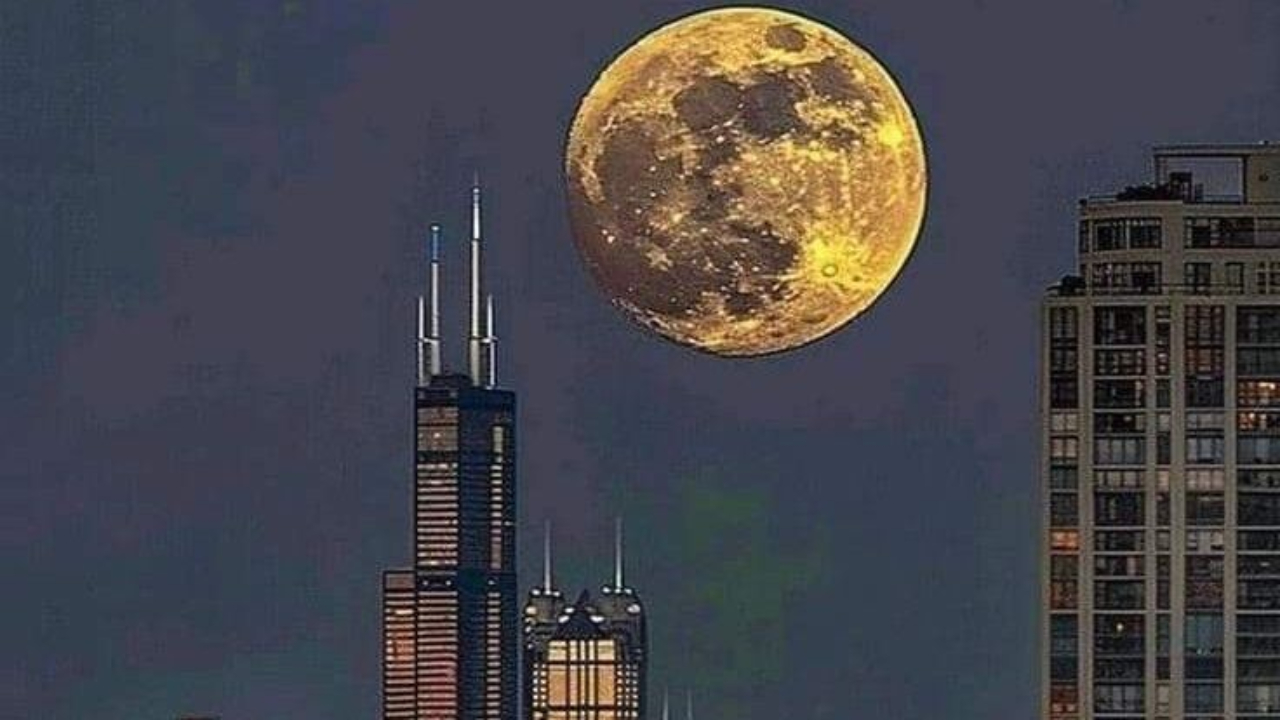
This Saturday, a Blue Moon rises over Chicago — and it comes with a story 500 years in the making.
Have you ever looked up at the sky and felt like the universe was trying to get your attention? This weekend, it just might be.
On the evening of Saturday, May 30, step outside after sunset and look east. Rising on the horizon will be a full moon — officially the second full moon of May, which gives it the name most of us have heard all our lives but may never have actually seen coming: a Blue Moon. It peaks in the early hours of Sunday, May 31, at 3:45 a.m. Chicago time. But the viewing sweet spot is that Saturday moonrise, when the moon hangs low and golden and big against the night sky.
Before you ask — no, it won’t be blue. And once you know why we call it that, the story gets a whole lot more interesting than the color.
CHICAGO VIEWING GUIDE
Best night: Saturday, May 30
Moonrise: Approx. 8:15 PM CDT — look east
Peak full moon: Sunday, May 31 at 3:45 AM CDT
Look for: Moon rising near Antares, the bright red heart of the Scorpius constellation
Bonus sky show: Venus & Jupiter in the west after sunset; Mars & Saturn in the east before dawn
Equipment needed: None. Your naked eye does the job.
Best spots: The lakefront, a park, anywhere with an open eastern horizon
So What Actually Is a Blue Moon?
The short version: a Blue Moon is the second full moon in a single calendar month. The lunar cycle runs about 29.5 days, which means most months only have one full moon. But every two to three years, the timing lines up so that a full moon lands near the beginning of the month — and then again near the end. When that happens, we call that second one a Blue Moon.
May 2026 is one of those months. The first full moon, the Flower Moon, rose on May 1. This weekend’s is the second — and that’s all it takes to earn the name.
There’s also an older definition worth knowing. Before the modern version took hold, some almanacs used “Blue Moon” to describe the third full moon in a season that had four — which happens about seven out of every nineteen years. Both definitions are real. Both refer to something that is rare but not impossible. Which, as it turns out, is exactly where the phrase came from.
The Phrase Is 500 Years Old — and It Started as an Insult
Here is where the history gets good.
The earliest recorded use of “blue moon” as a phrase dates to 1528 — not as astronomy, but as sarcasm. Two writers attacking the Roman Catholic Church dropped this line in a pamphlet:
“If they say the moon is blue / We must believe that it is true.”
In other words: these church leaders will tell you anything, and expect you to just go along with it. A blue moon was the equivalent of saying “when pigs fly.” It meant: absurd. Impossible. Never going to happen.
That meaning held for centuries. Then, in 1883, the Krakatoa volcano erupted in Indonesia with a force so violent it sent volcanic ash into the atmosphere around the entire globe. For months afterward, people in countries far from Indonesia looked up at the night sky and saw something they had never seen before: a moon that actually appeared blue. Suddenly “once in a blue moon” shifted from impossible to simply rare — something that could happen, but almost never did.
Then came the mistake that made it permanent.
In 1946, a writer named J. Hugh Pruett published a piece in Sky & Telescope magazine. He was working from an old reference and misread it — and published the definition we now all use: the second full moon in a calendar month. A radio show picked it up in 1980. Trivial Pursuit made it a question. By the time anyone got around to correcting the record, the new definition was already part of the culture. That, right there, is how folklore works. Truth and error travel together long enough, and eventually they become the same thing.
There’s One More Thing About This Moon
This particular Blue Moon comes with a twist that most people won’t know unless they’re paying close attention: it is also a micromoon.
The moon’s orbit around Earth is not a perfect circle. It’s an ellipse — slightly elongated — which means the moon is sometimes closer to us and sometimes farther away. When a full moon happens near its closest point, we call it a supermoon, and it looks bigger and brighter than usual. When it happens near its farthest point — called apogee — we get a micromoon. It looks a little smaller. A little dimmer. This weekend’s Blue Moon is at apogee, sitting about 252,000 miles from Earth, compared to an average distance of around 239,000 miles.
That makes it not just a Blue Moon, but technically a Blue Micromoon — the smallest full moon of 2026, the second of three consecutive micromoons this year. It won’t look dramatically different to the naked eye, but knowing it tells you something about how particular this moment is. These combinations don’t come around often. The next calendar Blue Moon won’t arrive until December 2028.
A Good Reason to Look Up
Saturday evening, a few minutes after 8 o’clock, the Blue Moon will begin to rise in the east. Near it, you should be able to see Antares — the orange-red star at the heart of the Scorpius constellation, burning steady beside the glowing disk of the moon. Look west at the same time and you’ll catch Venus and Jupiter low on the horizon. Wake early Sunday and Mars and Saturn will be rising in the east before dawn.
It is a full sky show, and it costs nothing to see it.
We don’t always need a reason to step outside and look up. But if you need one — this weekend, you’ve got one. Take the kids. Take the camera. Or just take a few minutes to stand still in the dark and let the sky remind you how big the world is beyond whatever has been sitting heavy on your mind.
The moon has been doing this for a very long time. It will be here long after all of us. But this particular configuration — this Blue Micromoon, in this May sky, over this city — happens once.
Don’t miss it.
Stay connected with news and updates!
Join our mailing list to receive the latest news and updates from our team.
Don't worry, your information will not be shared.
We hate SPAM. We will never sell your information, for any reason.
