
South Deering: Slag Valley, Steel, and the Long Struggle to Stay
Jun 03, 2026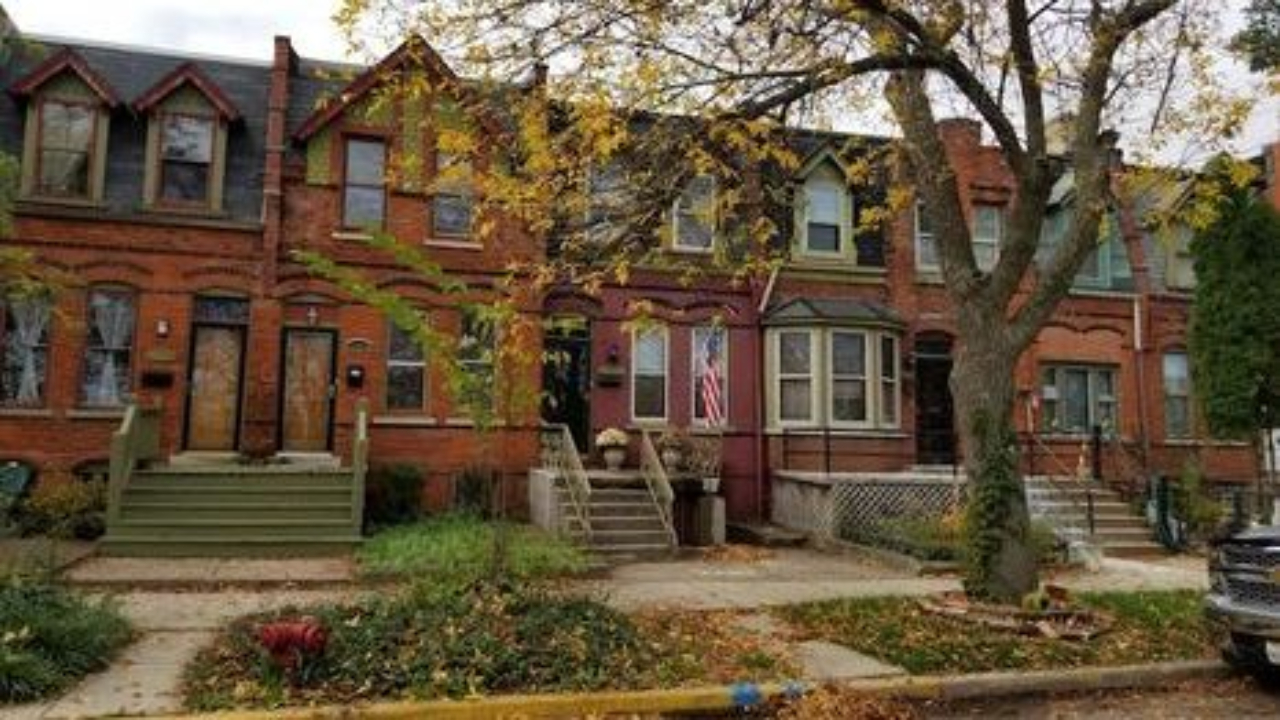
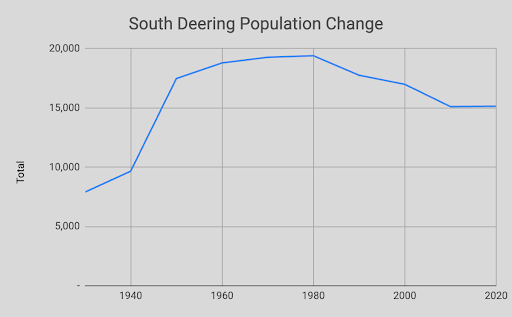
South Deering occupies Chicago's far Southeast Side, about thirteen miles from the Loop, and holds the distinction of being the largest of the city's 77 official community areas, a sprawling 10.7 square miles bounded by 95th Street to the north, the Little Calumet River to the south, the Calumet River to the east, and a web of rail lines and industrial corridors to the west. The size is deceptive. Roughly 80 percent of South Deering is zoned industrial, natural wetland, or parkland. The residential population of around 14,000 is clustered in a compact northeastern corner, pressed between Lake Calumet, the rail yards, and the ghost of a steel mill that once employed thousands and defined everything. South Deering is a neighborhood shaped almost entirely by what A QQQQindustry built here, what it took away, and what the people who stayed have done with what was left.
Trivia Question
On March 28, 1980, Wisconsin Steel Works in South Deering shut its doors without warning, leaving more than 3,400 workers without jobs, paychecks, pensions, or health benefits — the checks they had been issued that very week bounced. A veteran steelworker who had spent over thirty years at the mill refused to accept the closure as final and organized his coworkers into a committee that fought the mill's owners in court for seventeen years. Who was this organizer, what was the committee called, and what did they ultimately win?
South Deering by the Numbers
Irondale: Steel Before the Name Changed
Before it was South Deering, this neighborhood was called Irondale, a name that required no explanation. The Joseph H. Brown Iron and Steel Company opened along Torrence Avenue between 106th and 109th Streets in 1875, drawn by the Calumet River's access to Great Lakes shipping and the federal improvements that had deepened the waterway for industrial use. The mill was Chicago's first major steel operation in the Calumet region, and it marked the beginning of what would become one of the most productive industrial corridors in North America.
The earliest workers were English, Welsh, and Irish immigrants with iron-working backgrounds, drawn by the specific skills the furnaces required. As production expanded, Slovenian, Croatian, Polish, and other Eastern European workers arrived in successive waves. By the 1910s, a small Mexican community had established itself in the neighborhood, among the earliest Mexican settlements on Chicago's Southeast Side. The area was rough and industrial in character — crisscrossed by rail lines, dotted with foundries and slag heaps, its air heavy with the sulfurous output of the furnaces.
The neighborhood was renamed South Deering in 1903 in honor of Charles Deering, an executive of the Deering Harvester Company. The connection was not incidental. Deering Harvester merged with International Harvester in 1902 and eventually took control of the mill, which became Wisconsin Steel Works. The name on the neighborhood and the name on the mill were linked by the same corporate dynasty, a relationship that would prove fateful seventy-seven years later when that dynasty's decisions destroyed the community it had been given credit for building.
Slag Valley and the Shape of Industrial Life
The section of South Deering between 95th and 103rd Streets and Baltimore and Manistee Avenues earned the nickname Slag Valley a reference to the mountains of slag, the glassy industrial waste byproduct of steel production, that accumulated between the rail lines and the river. For decades, slag heaps were simply part of the landscape, as familiar to residents as the sound of the mill whistles that set the rhythm of daily life. Streets ran between them. Children played near them. The physical texture of the neighborhood was inseparable from the industry that produced it.
The residential section of South Deering that grew around the mill was a company town in all but formal designation. Workers lived within walking distance of their shifts, shopped on the same streets, attended the same churches (St. Kevin's, St. Francis de Sales), and others that organized parish life around the mill's ethnic communities — and spent their off hours in the taverns along Torrence Avenue that served cold beer to men who had spent eight hours in 2,000-degree heat. The mill and the neighborhood were a single organism, and for most of the twentieth century that arrangement seemed as permanent as the slag heaps that gave the district its name.
The Trumbull Park Homes public housing project, built by the Chicago Housing Authority in 1938 between 105th and 109th Streets, added a different dimension to South Deering's social geography. The project housed white working-class families during the Depression and postwar years, and the South Deering community organized with fierce determination to keep it that way — a story that would eventually break open into one of Chicago's most documented racial conflicts.
The Trumbull Park Riots: An Accidental Integration
On July 30, 1953, Donald and Betty Howard moved with their two children into an apartment at Trumbull Park Homes at 10630 South Bensley Avenue. The Chicago Housing Authority had processed their application without identifying the family as Black. Betty Howard was fair-skinned enough that CHA officials assumed she was white. Her husband Donald's darker complexion attracted a neighbor's suspicion within days. By August 5, the riots had begun.
What followed was nearly three years of sustained, organized racial terror. Crowds formed nightly outside the Howard apartment, throwing rocks, firing fireworks, hurling sulfur candles through windows. The South Deering Improvement Association, the neighborhood's civic organization, led the campaign for the Howards' removal and published the South Deering Bulletin, which openly encouraged residents to resist integration by any means available. A tavern on 105th and Torrence that had served Black customers was set on fire. The South Deering Methodist Church, which had welcomed Black congregants, was also burned. At peak moments, the Chicago Police Department deployed more than a thousand officers to Trumbull Park to contain the violence and physically escorted Black residents in and out of the neighborhood for years.
The CHA, facing pressure from civil rights advocates, chose to continue integration rather than capitulate. In October 1953, ten more Black families were moved into Trumbull Park, triggering a new surge of violence. Between August 1953 and June 1954, one South Deering resident was arrested approximately every 36 hours. Sporadic violence continued until 1963. It was not until that year that Black residents could enter the neighborhood park without a police escort.
Frank London Brown, a writer who moved his family into Trumbull Park in 1954 during the riots, turned the experience into a novel published in 1959, also called Trumbull Park. The book gives an intimate account of what it meant to live under siege in your own home — the physical fear, the psychological toll, the daily calculation of whether to stay or leave, and the quiet insistence of Black families who refused to be driven out. It remains one of the most important documents of Chicago's postwar racial history and one of the least read.
Wisconsin Steel: The Day the Checks Bounced
Wisconsin Steel Works operated for 105 years. It produced steel for two world wars, employed generations of South Deering families, and at its peak ran three shifts around the clock with thousands of workers on the floor at any given hour. On the morning of March 28, 1980, it closed without warning.
The shutdown was not the result of a gradual decline that workers had time to prepare for. It was an abrupt collapse — the product of a leveraged buyout gone wrong. In 1977, International Harvester had sold the mill to a company called Envirodyne, a financial conglomerate with no experience in steelmaking, using a loan from International Harvester itself as the primary financing. Envirodyne mismanaged the operation, and when the credit ran out, the mill simply stopped. Workers arriving for the morning shift on March 28 found the gates locked. The paychecks they had been issued that week bounced. Their pensions were gone. Their health benefits were gone. Their union — a company union long controlled by management — had no resources and no will to fight.
More than 3,400 workers lost everything simultaneously, with no notice and no safety net. African-American steelworkers, who had historically been assigned to the most dangerous and lowest-paid positions in the mill, were disproportionately harmed. Many had spent decades building toward a pension that simply ceased to exist on a Friday morning in late March.
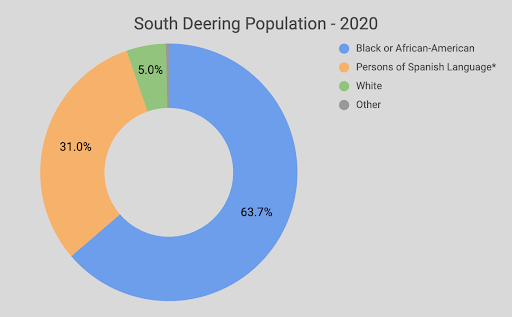
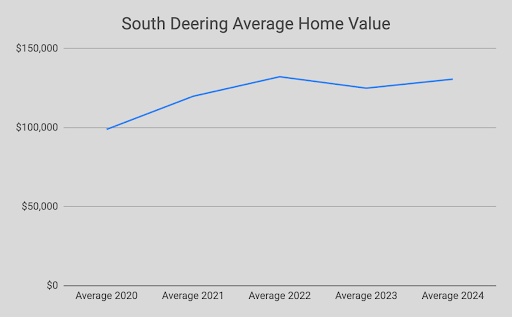
The neighborhood felt the collapse immediately and completely. Property values fell. Businesses along Torrence Avenue closed or shrank. Families that had lived in South Deering for two and three generations began to leave. By the summer of 1980, the demographic shift was already accelerating — white working-class families departing rapidly, replaced by Mexican-American and African-American families who moved into homes whose prices had dropped with the mill. Within a decade, a neighborhood that had been nearly all white was majority Black and Latino.
South Deering Today
South Deering today is a neighborhood living alongside its own industrial archaeology. The Wisconsin Steel site along Torrence Avenue where the mill operated for over a century, sat largely vacant for decades after the closure, a brownfield of contaminated soil and demolished structures that has resisted redevelopment. Portions of the site have been remediated, and there are ongoing discussions about future uses, but the sheer scale of the former industrial footprint makes transformation slow and expensive.
Lake Calumet, which takes up a large portion of the community area's interior, is one of the few inland lakes within Chicago city limits and a significant ecological resource. The Calumet region broadly, including South Deering's wetlands and the adjacent Hegewisch Marsh, supports a remarkable concentration of migratory birds, drawing birdwatchers who arrive to see species that use the Chicago lakefront and interior wetlands as a stopover on the Mississippi and Atlantic flyways. The proximity of heavy industry and genuine ecological richness is one of the more unusual qualities of Chicago's southeastern corner.
The residential community retains the working-class homeowner character that survived the mill's closure even as much else changed. Jeffrey Manor, the neighborhood's most stable residential sub-area in the northeast corner, has maintained relatively high homeownership rates and block-level civic engagement through decades of economic pressure. Trumbull Park Homes was demolished in 2011, replaced by a mixed-income development that opened on the same footprint where the riots of 1953 had played out.
Trivia Answer
The organizer was Frank Lumpkin, a veteran steelworker who had worked at Wisconsin Steel Works for over thirty years. Lumpkin was a Black man in an industry that had long confined workers of color to the most dangerous jobs and the bottom of the seniority ladder. He had seen the mill's inequities up close for decades. When it closed without honoring its obligations, he was not willing to accept that as the end of the story.
After the mill's abrupt closure on March 28, 1980 which left more than 3,400 workers without their final paychecks, pensions, or health benefits Lumpkin organized his former coworkers into the Save Our Jobs Committee (SOJ), a multiracial coalition of Black, Mexican-American, and white steelworkers and their families. The committee filed lawsuits against Wisconsin Steel's parent companies, International Harvester and Envirodyne, arguing the mill had been sold specifically to avoid compensating its workers. After seventeen years of legal battles, demonstrations, and community support programs, the Save Our Jobs Committee won settlements totaling approximately $17 million — less than half the $40 million owed, but a genuine accountability for one of the most consequential industrial closures in Chicago history. More than one in six former Wisconsin Steel workers died before the settlements were reached. Lumpkin's story is preserved in the archives of the Southeast Chicago Historical Society and the Chicago History Museum.
Stay connected with news and updates!
Join our mailing list to receive the latest news and updates from our team.
Don't worry, your information will not be shared.
We hate SPAM. We will never sell your information, for any reason.
