
SCOTUS Drops The Other Shoe on the Voting Rights Act
Apr 29, 2026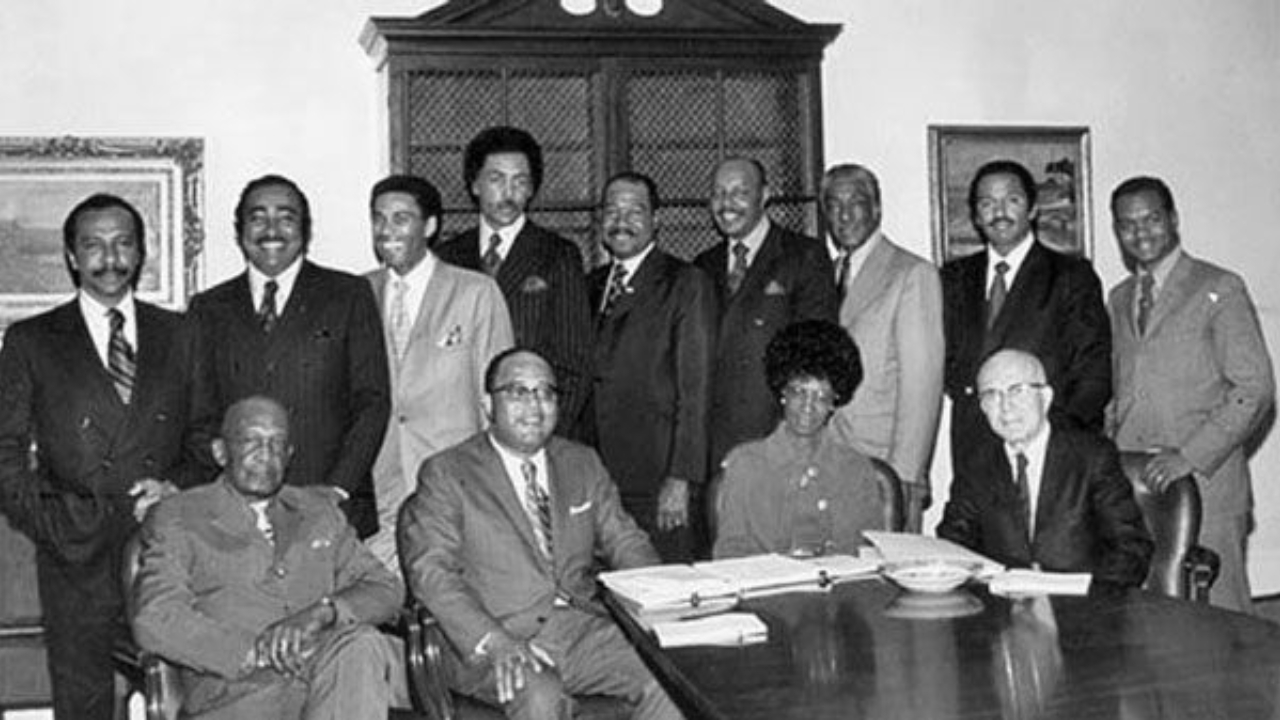
*Photo of the Inaugural Congressional Black Caucus.
The Supreme Court's Decision in Louisiana v. Callais Completes the Decimation of the Voting Rights Act
"Today’s decision renders Section 2 [of the Voting Rights Act] all but a dead letter….The decision here is about Louisiana’s District 6. But so too…about the many other districts, particularly in the South, that in the last half-century have given minority citizens, and particularly African Americans, a meaningful political voice." Justice Elena Kagan, in dissent Louisiana v. Callais
Decked out in tuxedos and formal gowns, they assembled for a State dinner held in a White House controlled by the most explicitly and destructively racist President to serve in 150 years. They dined on Dover Sole “expertly prepared and bathed in a nutty brown butter,” “tender” spring ramps, and potatoes pave. They raised glasses in toast to the British King, Charles.
One justice, Clarence Thomas was, it appears, the only Black guest in the room.
I imagine they slept well after this event. Perhaps Justice Alito was awakened after a few hours to take an antacid tablet, or just to marvel once more in the hours before dawn at his handiwork – an opinion that signals the demise of the most consequential and important civil rights statute to ever be enacted by Congress – the Voting Rights Act. The 1982 Amendment to that Act Congress made clear that electoral practices that result in the diminution or denial of Black voting power violate Section 2 of the Act, which protects against electorial practices or systems that deny Black voters an equal opportunity to elect their candidates of choice.Congress’ adoption of this “effects test” was explicity enacted to overturn the Supreme Court’s 1980 decision in Mobile v. Bolden, in which the Court held that only practices that were intentionally discriminatory could violate the Voting Rights Act.
The “effects test” adopted by Congress in 1982 was upheld by the Supreme Court four years later in the landmark case Thornburgh v. Gingles. But it has been the white whale for a certain generation of conservative lawyers shaped in the crucible of the Reagan Justice Department under the careful tutelage of former Attorney Generals Ed Meese and William French Smith, who had worked assiduously but without success to stop Congress from enacting the amendment.
The 1982 Amendment to the Voting Rights Act was a civil rights triumph. In fact, civil rights groups and their allies on Capitol Hill ran circles around Republicans who were opposed to the Amendment. They won bipartisan support for the Amendment. The civil rights coalition was better organized and brought a range of expertise to lobbying, organizing and litigation, which proved overwhelming. As Lani Guinier, the late civil rights lawyer and scholar who played a principal role as a young lawyer at the NAACP Legal Defense Fund in crafting the amendment later explained, “the conservative think tanks…were still new to the business of trying to influence public policy in a coordinated and well-heeled way” in 1982.
In the Reagan Justice Department, John Roberts, as Special Assistant to the Attorney General and then in White House Counsel’s office was the point person tasked with jettisoning adoption of the “effects test” – even after the House had voted overwhelmingly to support it. Roberts deemed the “effects test” as a “radical experiment,” insisting in copious internal memos that it would create a “quota system” of Black electoral districts. At one point when cautioned about commiting these views to writing, Roberts grew agitated at the momentum building for the bill’s passage, exclaiming, “something must be done!” Justice Alito was also a lawyer working in the Justice Department, as an Assistant to the Solicitor General, at that time.
What the conservative legal elite were unable to defeat on Capitol Hill in the early 80s, they worked to defeat in the Courts over the ensuing decades. The Voting Rights Act has been under attack from those forces with steady and unrelenting challenges for more than 30 years. The ascension of lawyers who were graduates of the school of Justices Rehnquist and Scalia to the highest levels of the federal judiciary began to bear fruit in the early aughts, and peaked with the Court’s decision gutting Section 5 of the Voting Rights Act in the 2013 Shelby County v. Holder case. Louisiana v. Callais has now completed the work.
In the forty years after the passage of the 1982 amendments to the Act, Black political representation grew exponentially – largely because of the network of lawyers and activists who could monitor redistricting efforts at the state and local level. That work has not been easy. In every redistricting cycle since 1971, the state of Texas has been found to have engaged in racial gerrymandering. Other southern states have similar patterns of racial redistricting. It has been the determination, hard work, and resources of civil rights groups and lawyers who have held the line, ensuring Black and Hispanic representation in legislatures throughtout the South.
That work has largely been successful despite continued chipping away at the integrity of the core statute that protects voting rights. When the Congressional Black Caucus was formed in 1971 it had thirteen members. It now has sixty-two. In 1981 before the Amendments to Section 2 of the Voting Rights Act, Mississippi, Alabama, and Georgia had no Black congressional representation, although the population of those states were 35%, 26% and 27% at the time.
There were only 1500 Black elected officials in the entire country in the decade before passage of the 1982 Amendments to the Voting Rights Act. Within 30 years that number grew to 9,000. Today the number stands at well over 10,000 Black elected officials across the country. Those changes are not due to the goodness of the hearts of legislative redistricting committees. That progress is due to continuous vigilance and yes, the threat of litigation under the Voting Rights Act, by local and national activists and lawyers.
But once again, as in the Shelby County decision, this Supreme Court has decided that they have seen enough. From their sheltered perch on First Street in Washington, D.C., they have deemed the hard-fought-for work of ensuring minority representation as done. It is “a cause for celebration,” they tell us in Callais, that no longer requires the protection of the amended statute that President Reagan reluctantly signed, conceding that voting rights is “the crown jewel of American liberties.”
So, what does this all mean?
Can it happen again? Could Black people really be boxed out of the political process? We would do well to remember that there were eight Black members who served in Congress during Reconstruction. By 1900, due to unrestrained voter suppression, an indifferent and even hostile Supreme Court, violence, and a somnabulent Congress, there were none. The number eight was not reached again until 1969. Now think of your city council, your county commission, your school board, your state legislature. The Callais decision applies to those districts as well.
We will not allow it to happen again. But it will take concerted action and a clear recognition of the threats we are facing. We have more power, greater resources, a wider array of allies, and broader experience to draw on in the fight this time around. But we must not rest on (what remains of) our laurels.
The Supreme Court has struck down a critical protection for electoral districts that ensure Black (and presumably Hispanic) political voice. The majority even makes explicitly clear that Black voting strength and representation can be subordinated to an array of state interests including, a state’s interest in protecting white incumbents; a state’s aesthetic interest in drawing districts that are neatly shaped; or even a state’s interest in preserving the political power of one political party in perpetuity. Cloaked in the mystical robes of “colorblindness” the conservative majority can make the most absurd arguments with a straight face.
This is why it is a mistake to consider today’s decision just a blow for the political rights of racial minorities. Today’s decision strikes a blow at the fragile infrastructure of our democracy. It casts aside the precious and noble actions undertaken by countless generations of activists, lawyers, and legislators, who worked to bring this country closer to becoming a true multi-racial democracy. It rides roughshod over the will of Congress. In its place, the Court leaves a bare-fisted zero-sum game of partisan politics and an open door to the return of full-on racial exclusion in political representation. So long as it’s dressed up as partisan gerrymandering or incumbency protection, it’s all good.
The Court’s action today has been undertaken with disregard for the boundaries of judicial power. It dismisses with either arrogance or willful ignorance, the reality of ongoing and revived racism in political life. It runs over its own precedents with reckless haste. And it takes up the pen to rewrite a congressional statute that has been the law of the land for forty-four years. This is the Court that can do it all – judge, legislate, turn back time, erase facts, and rewrite history.
The majority on this Court is unrestrained. Democrats who say they want congressional power in the mid-terms this year, had better be prepared if they are successful to address Supreme Court reform without hesitation.
Stay connected with news and updates!
Join our mailing list to receive the latest news and updates from our team.
Don't worry, your information will not be shared.
We hate SPAM. We will never sell your information, for any reason.
