
Robert Smalls: The Man Who Stole a Confederate Warship
Jun 25, 2026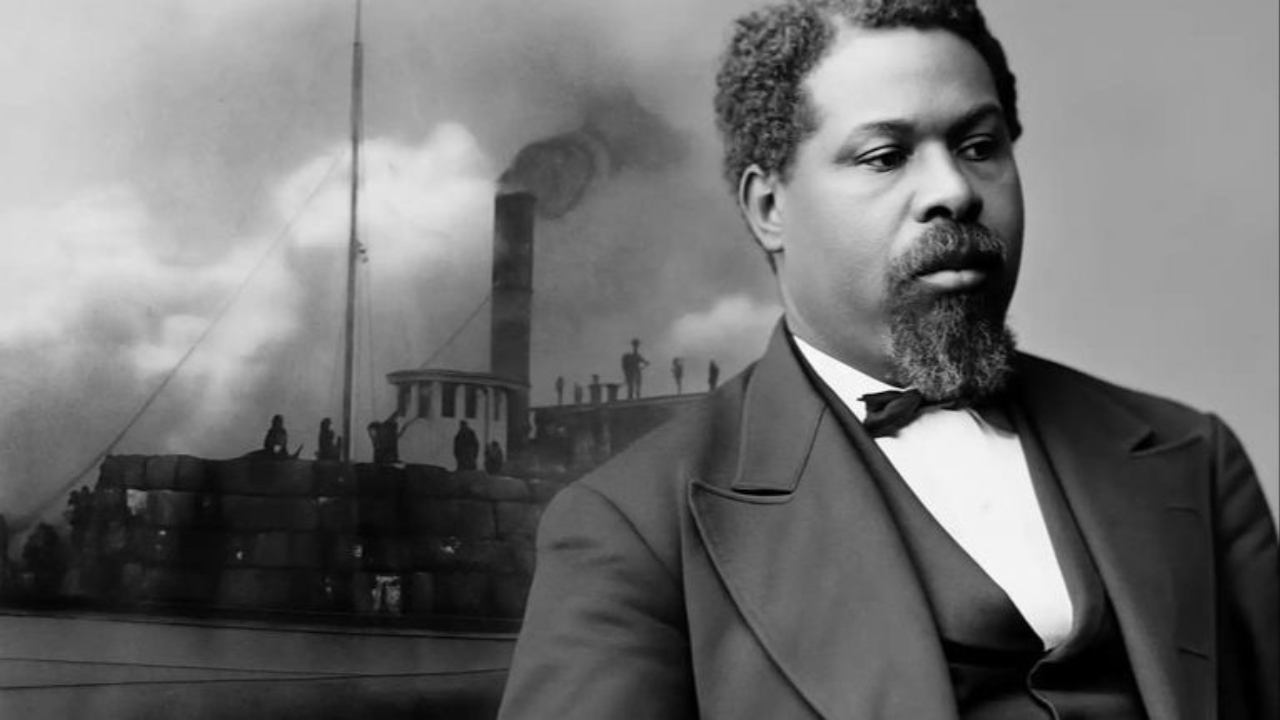
Born into bondage on the South Carolina coast, Robert Smalls mastered the waterways that would carry him to freedom — and then used every ounce of that hard-won freedom to fight for the rights of his people.
There is a kind of freedom that cannot be given. It must be seized — sometimes in the dark, in the dead of night, with your wife and children hidden below deck, your heart hammering against your ribs, and the guns of Fort Sumter looming fifty feet overhead. That was the kind of freedom Robert Smalls chose. And once he had it, he spent the rest of his life making sure others could have it too.
Born Behind the Big House
Robert Smalls came into the world on April 5, 1839, in a small cabin behind a planter's house at 511 Prince Street in Beaufort, South Carolina. His mother, Lydia Polite, was enslaved by a man named Henry McKee — and there are strong indications, though never confirmed, that McKee may have also been Robert's father. What is certain is that Lydia raised her son in the shadow of an institution designed to break the spirit of every person it touched.
Lydia herself had grown up working the fields, taken from her own family at the age of nine. But Robert was treated differently — more favorably, kept closer to the house, shielded from the worst of what slavery looked like in the South Carolina Lowcountry. This disturbed Lydia deeply. She feared her son would grow into a man without understanding what it truly meant to be enslaved. So she made a deliberate and heartbreaking choice.
She arranged for Robert to be sent into the fields — to work alongside the field hands, to witness the whippings, to see with his own eyes the full brutality of the system that owned him. It worked. The boy who had been sheltered became a young man on fire with righteous anger. He landed in the Beaufort jail more than once for his defiance. His mother, now fearing for his safety, made another difficult request: she asked McKee to send Robert to Charleston, where he could be hired out for labor.
McKee agreed. Robert Smalls was twelve years old when he arrived in Charleston.
A Life on the Water
Charleston in the 1850s was one of the busiest port cities in the American South. Its harbor was a living, breathing engine of commerce — ships coming and going, cotton bales being loaded, goods being unloaded, enslaved workers performing every category of skilled maritime labor imaginable. It was here that Robert Smalls found his calling.
He began as a hotel waiter, then worked as a lamplighter, a stevedore foreman, a sail maker, and a rigger. He earned one dollar a week — the rest of his wages went straight to his enslaver. But what he gained on the waterfront was worth far more than money. He learned the tides, the channels, the hidden shoals. He memorized the harbor's rhythms the way musicians memorize scales — until it was less like knowledge and more like instinct.
By the time he was in his late teens, there were few people in Charleston who knew those waters better than Robert Smalls. His reputation as a skilled navigator earned him work that most enslaved men never touched. And it was on the waterfront that he met the woman who would share his life — Hannah Jones, an enslaved hotel maid. They married on December 24, 1856, with their owners' permission, and moved into a room together, though they belonged to different enslavers and neither of them was free.
Robert made an attempt to buy Hannah's freedom. Her owner demanded $800 — a sum that might as well have been a million dollars for a man allowed to keep only one dollar of his weekly earnings. He couldn't do it. But he made his wife a promise he intended to keep: one day, they would be free.
The Planter — and a Plan
In April 1861, the Civil War ignited with the Confederate bombardment of Fort Sumter — literally in Robert Smalls' backyard. By the fall of 1861, the Confederacy had put his maritime skills to direct use, assigning him to serve aboard the CSS Planter, a 147-foot sidewheel steamer that served as an armed transport and dispatch vessel for General Roswell S. Ripley's Confederate command in Charleston harbor. The Planter's duties were serious: surveying waterways, laying harbor mines, moving troops and artillery, delivering dispatches between the Confederate fortifications.
Smalls did his job with his usual excellence, earning the confidence of both the enslaved crew and the three white officers who commanded the vessel — Captain Charles C. J. Relyea, a pilot named Smith, and an engineer named Pitcher. He watched everything. He studied the harbor signals, the checkpoint protocols, the timing of Confederate patrols. He memorized the body language and mannerisms of Captain Relyea.
And from the pilothouse of the Planter, on clear days, he could see the Union Navy's blockade fleet — seven miles away across the open water.
Seven miles. That was the distance between slavery and freedom.
In April 1862, Smalls began planning in earnest. He shared the idea with all the enslaved crew members except one — a man he did not trust. The plan required absolute secrecy, perfect timing, and an almost supernatural cool under pressure. What Smalls was proposing was, by any definition, impossible. He intended to steal a Confederate warship, sail it through five heavily armed Confederate forts, make it past the most fortified harbor in the South, and deliver it — along with all of the people he loved — to the Union fleet waiting outside.
The plan had one essential ingredient: the officers' habit of spending their nights ashore with their families, in violation of Confederate General Orders. Smalls knew this happened regularly. He intended to exploit it.
"Good Morning, Sir — I've Brought You Some of the Old United States Guns"
On May 12, 1862, the Planter returned to Charleston after a trip to Coles Island, where it had picked up four large artillery pieces — a 32-pounder pivot gun and a 24-pounder howitzer among them — along with 200 pounds of ammunition, Confederate signal codebooks, and detailed maps of the harbor's minefields. It was exactly the cargo Smalls needed to deliver to the Union. That evening, Captain Relyea, the pilot, and the engineer went ashore as usual — against orders, leaving only the enslaved crew aboard.
Smalls asked if the crew's families could come aboard that night. The captain agreed, setting a time for them to leave. The families came. They stayed. And then, at 3 o'clock in the morning on May 13, 1862, Robert Smalls put on Captain Relyea's uniform and his wide-brimmed straw hat, brim pulled low over his face. He lit the boilers. The Planter eased away from Southern Wharf in total darkness.
First, a stop at North Atlantic Wharf — where Hannah and the children were waiting, along with the families of the other crew members. Sixteen additional people boarded in the dark. Nine men. Five women. Three children. Seventeen people total now aboard the Planter, all of them enslaved, all of them gambling their lives on one man's plan.
What happened next requires you to sit with it for a moment. Smalls steered the Planter on its normal route — not too fast, not too slow — as if it were any ordinary pre-dawn delivery run. He blew the ship's whistle with the correct Confederate signals as he passed Fort Johnson. He copied Relyea's posture exactly: arms folded, standing on deck, moving with the unhurried confidence of a man in command. The guard boat that normally patrolled those waters happened to be under repair that night.
Then came Fort Sumter.
The most heavily armed Confederate fortification in the harbor. Its walls rose fifty feet above the waterline. Its guns could shred the Planter in seconds. Some of the crew begged Smalls to steer wide, to give the fort a wide berth. Smalls refused. He understood what they might not: veering off the normal route would guarantee suspicion. He held course.
"When we drew near the fort," one crew member said later, "every man but Robert Smalls felt his knees giving way, and the women began crying and praying again."
At around 4:15 in the morning, Smalls pulled the whistle cord: two long blows and a short one — the Confederate password to pass the fort. The sentry at Fort Sumter challenged the vessel. There was a long, terrible pause. Then the fort signaled all clear. Confederate sentries waved their hats and called out, "Blow the d— Yankees to hell!"
The Planter sailed past Fort Sumter and out of range of Confederate guns. The alarm was not raised until the ship was already beyond reach.
Now Smalls made his final move. Instead of turning toward Morris Island as expected, he headed straight for the Union fleet. He ordered the Confederate flags — the Palmetto flag and the Confederate battle flag — hauled down. In their place, his wife raised a white bed sheet she had brought aboard for exactly this moment.
The USS Onward, one of the blockade ships, spotted the approaching steamer and prepared to fire. Its No. 3 port gun was being elevated when a crewman shouted: "I see something that looks like a white flag!" The sunrise, just cresting the horizon, made the improvised flag visible. The cannon was held.
The Planter pulled alongside the Onward. Robert Smalls stepped forward, removed his hat, and addressed the Union captain with a line that belongs in every American history book ever written:
"Good morning, sir! I've brought you some of the old United States guns, sir — that were for Fort Sumter, sir!"
In fewer than four hours, Robert Smalls had done the impossible. All seventeen people aboard — nine men, five women, and three children — were free.
War Hero, Naval Captain, and a Conversation with Lincoln
The news swept through the North like wildfire. Robert Smalls was on the front pages of newspapers from New York to Boston. Congress passed a special bill awarding him and his crew prize money for delivering the Planter and its cargo; Smalls received $1,500 as his share. The Confederacy, meanwhile, court-martialed the three officers who had gone ashore that night and put a $4,000 bounty on Smalls' head.
The ship's Confederate signal codebooks and the detailed maps of Charleston harbor's minefields — perhaps the most strategically valuable cargo on board — were handed over to the Union Navy. Within a week, that intelligence allowed Union forces to capture Coles Island and its Confederate batteries.
But Smalls wasn't done. He had a mission that went far beyond himself and his family. In August 1862, with the encouragement of Union General David Hunter, Smalls traveled to Washington, D.C. He met with Secretary of War Edwin Stanton and, by some accounts, with President Abraham Lincoln himself. He lobbied with everything he had for the Union to begin enlisting Black soldiers. He had seen firsthand what Black men were capable of when they had something to fight for. He knew what an army of freed and freedom-seeking men could do.
Lincoln listened. Within months, the Union began recruiting Black troops. It is believed that Smalls personally recruited some 5,000 soldiers. Nearly 200,000 African American men ultimately served in the Union Army and Navy during the war — a tide-turning contribution that gave the Union a critical manpower advantage while dealing a devastating psychological blow to the Confederacy. The war that had begun as a struggle to preserve the Union transformed, in part because of Robert Smalls' advocacy, into a war of liberation.
Smalls returned to active service, piloting the Planter — now a Union vessel — through seventeen military engagements. During the April 1863 assault on Fort Sumter, he piloted the ironclad USS Keokuk into battle. In one celebrated moment, when the Planter came under what was described as "very hot fire" and the white captain hid in the coal bunker, Smalls stepped up and took command of the vessel. For that act of courage, he was promoted to the rank of captain — becoming the first African American to captain a vessel in United States military service. By 1865, he was earning $1,800 a year, one of the highest salaries paid to any Black serviceman during the war.
Buying His Enslaver's House — and Running for Office
When the war ended, Robert Smalls went home to Beaufort. He went home as a hero. He went home as a free man. And in January 1864, using his prize money from the capture of the Planter, he had already done something that belongs in the category of poetic justice: he purchased, at a Union tax auction, the mansion of Henry McKee — the man who had enslaved him as a child, in the very house behind which his mother had given birth to him.
Robert Smalls now owned the home his enslaver had once owned. According to the 1870 Census, when he was just 31 years old, the Smalls family had $6,000 in personal property and $1,000 in real estate. The value of his former enslaver's mansion.
In a detail that speaks volumes about his character, when Mrs. McKee fell ill in her old age and had nowhere to go, Robert Smalls allowed her to remain in what had once been her own home and cared for her until she died.
He opened a general store for freedmen. He helped found the Enterprise Railroad, a horse-drawn line connecting the Charleston wharves to inland depots — with an almost entirely Black board of directors, described by scholar Bernard Powers as "the most impressive commercial venture by members of Charleston's Black elite." He owned and published the Beaufort Southern Standard newspaper. And in 1864, while piloting the Planter to Philadelphia for repairs, he was arrested for riding in a segregated streetcar. His response was to organize a boycott — one that ultimately led to the desegregation of Philadelphia's entire transit system in 1867.
And then he ran for office.
Five Terms in Congress — and a Legacy That Endures
In 1867, Robert Smalls helped found the Republican Party of South Carolina. In 1868, he served as a delegate to the South Carolina Constitutional Convention — a groundbreaking biracial assembly that rewrote the state's foundational law. Smalls was one of the driving forces behind what may be his most lasting legislative achievement: he championed a provision requiring South Carolina to establish the first free and compulsory public school system in the United States, open to children of all races.
He was elected to the South Carolina House of Representatives in 1868, to the State Senate in 1872, and in 1874 — as most of the South was falling back under white Democratic control — the citizens of Beaufort sent Robert Smalls to the United States House of Representatives. He would serve five nonconsecutive terms in Congress, representing South Carolina's coastal district until 1887.
His congressional record was as consequential as it was courageous. In 1875, he introduced a landmark amendment providing that no distinction whatsoever would be made on account of race in the enlistment of men into the United States Army. He fought relentlessly against the disenfranchisement of Black voters across the South, knowing that the right to vote was the cornerstone of every other right. He secured funding for improvements to Port Royal Harbor and fought for appropriations that benefited his district's infrastructure.
He also opposed segregation — of the military, of railroads, of public restaurants — at a time when doing so required extraordinary personal courage. The elections he ran in were sometimes violent. The Reconstruction era was being systematically dismantled around him. Red-shirt paramilitaries terrorized Black voters. State legislatures gerrymandered districts to dilute Black political power. But Smalls held on, representing his people as long as the machinery of democracy allowed.
In 1895, when South Carolina's white-dominated legislature rewrote the state constitution to strip Black citizens of their voting rights — essentially pulling the door shut on the Reconstruction era and beginning the long nightmare of Jim Crow — Robert Smalls stood on the floor of that convention and delivered his answer:
"My race needs no special defense, for the past history of them in this country proves them to be the equal of any people anywhere. All they need is an equal chance in the battle of life."
A Life Completed — A Legacy That Refuses to Be Buried
After leaving Congress in 1887, Smalls was appointed Collector of Customs at the port of Beaufort — a post he held for much of the next two decades despite constant racist opposition from those who wanted a white man in the job. He served in this role under Republican presidents and was forced out whenever Democrats reclaimed the White House, only to return when the winds shifted. He finally stepped down in 1913.
Robert Smalls died on February 23, 1915, in the Beaufort house where he had once been enslaved — the same house he had purchased, the same address behind which his mother Lydia had given birth to him in a slave cabin seventy-six years before. He is buried at Tabernacle Baptist Church in Beaufort, beneath a monument bearing his own words.
He had witnessed slavery, fought in a war, sailed a stolen Confederate warship to freedom, convinced a president to arm Black soldiers, served in Congress, built schools, published newspapers, desegregated a city's transit system, bought his enslaver's mansion, and cared for his enslaver's widow. He had done all of this before the country truly decided to reckon with what any of it meant.
W.E.B. Du Bois wrote that "the slave went free; stood for a brief moment in the sun; then moved back again toward slavery." Robert Smalls lived every part of that sentence. But what Du Bois' lament doesn't fully capture is what Smalls and men like him did with that moment in the sun — the institutions they built, the votes they cast, the laws they wrote, the children they educated, the dignity they refused to surrender.
Since 2023, the state of South Carolina has celebrated Robert Smalls Day every May 13th. The United States Navy renamed one of its guided-missile cruisers the USS Robert Smalls in 2023. The house at 511 Prince Street in Beaufort is a National Historic Landmark.
And somewhere in the archives of American history, there is still the image of a 23-year-old man standing in the predawn darkness of Charleston Harbor, wearing a straw hat, his children below deck, his wife's bedsheet tucked away for the moment he would need it, sailing a Confederate warship toward the morning and toward freedom.
He was already free in every way that mattered.
CLICK HERE FOR THE YOUTUBE VIDEO STORY
Stay connected with news and updates!
Join our mailing list to receive the latest news and updates from our team.
Don't worry, your information will not be shared.
We hate SPAM. We will never sell your information, for any reason.
