
O'Hare: The Neighborhood That Shares Its Name with the World
Jun 10, 2026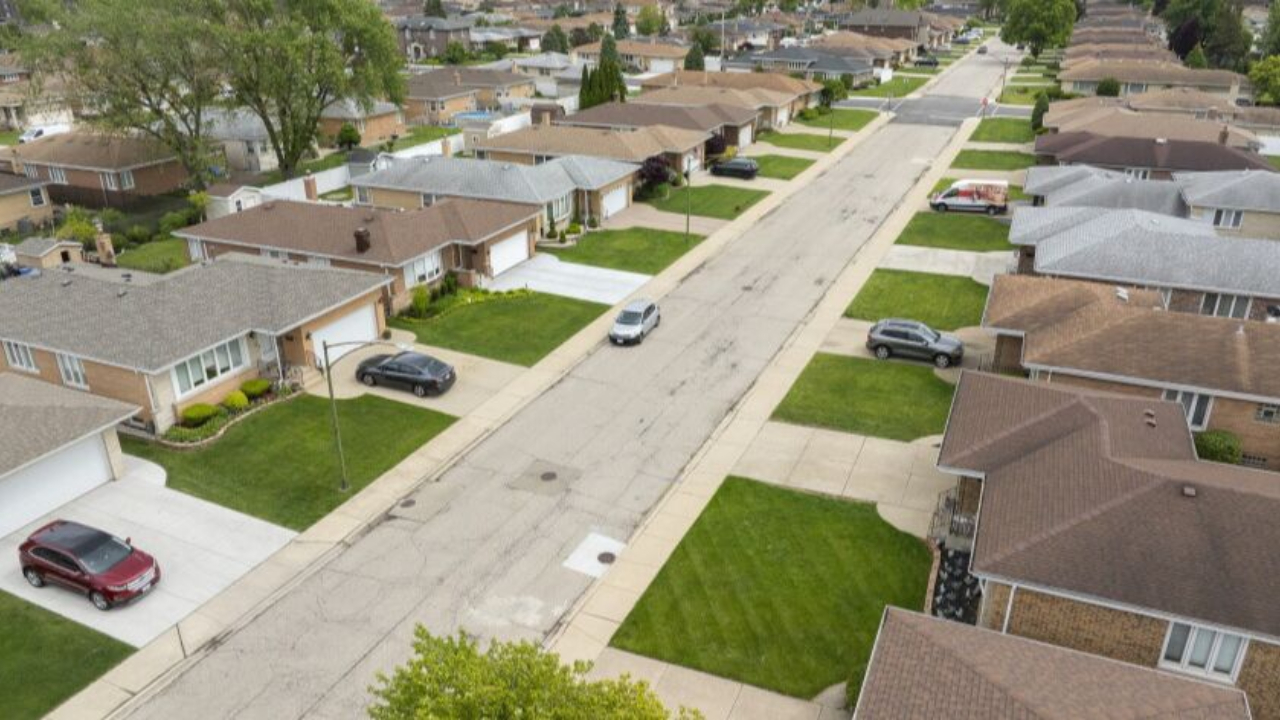
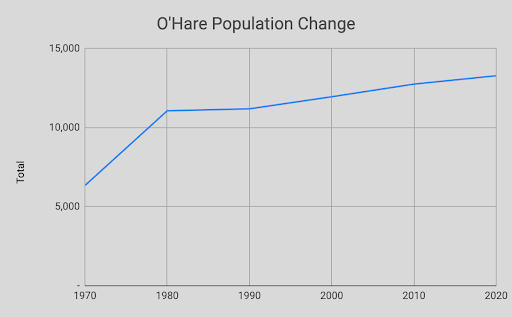
O'Hare is Chicago's 76th community area, added to the official map in 1956 when the city annexed the airport and the land surrounding it on the far Northwest Side. It sits approximately sixteen miles from the Loop, bounded by Irving Park Road and Higgins Avenue to the south, the Des Plaines River to the east, Foster Avenue to the north, and a tangle of interstates and township lines to the west — a boundary that makes it the only Chicago community area that crosses into DuPage County. At 13.3 square miles, it is one of the city's larger community areas. In terms of civic identity, it is one of the least known. Most of the roughly 13,000 people who live here are aware that they share their address with the busiest airport in the Western Hemisphere. Fewer know much about the man whose name is on both.
Trivia Question
O'Hare International Airport and the Chicago neighborhood that surrounds it is named for a World War II naval aviator who became the Navy's first ace and first naval recipient of the Medal of Honor. But the story behind the name involves two generations of an American family and connects directly to Al Capone's criminal empire. Who was the aviator, what did he do to earn the Medal of Honor, and what was his father's relationship to Capone?
O'Hare by the Numbers
Chief Blinking Eye and the Land Before the Airport
The land that became the O'Hare community area has been occupied, in one form or another, for thousands of years. The Potawatomi, Ottawa, and Chippewa peoples lived and traveled through the Des Plaines River valley long before European contact, and one of the most consequential figures in early Chicago history has his burial ground within the area's forest preserves to this day.
Alexander Robinson also known by his Potawatomi name, Che-Che-Pin-Qua, meaning "Blinking Eyes" or "The Squinter" — was a mixed-heritage fur trader and tribal leader born around 1789 on Mackinac Island to an Ottawa mother and a British father. Multilingual in Odawa, Potawatomi, Ojibwa, English, and French, he became an indispensable intermediary between Native communities and American settlers in the chaotic early years of Chicago's founding. In 1812, when Potawatomi warriors attacked the garrison evacuating Fort Dearborn — the massacre that killed dozens of American soldiers and settlers on what is now the Near South Side — Robinson used his relationships and his canoe to personally ferry survivors to safety at Fort Mackinac.
For his role in saving American lives and in subsequent treaty negotiations, Robinson was granted approximately 1,200 acres of land along the Des Plaines River between Irving Park Road and Foster Avenue by the Second Treaty of Prairie du Chien in 1829, land that sits within and adjacent to today's O'Hare community area. He lived on the reservation until his death in 1872, reportedly at the age of more than 80. He is buried with his wife Catherine Chevalier and members of their family at a marked grave site near East River Road and Lawrence Avenue, now within the Cook County Forest Preserve. The preserve itself is named for him: Che-Che-Pin-Qua Woods, Robinson Woods, and Catherine Chevalier Woods together preserve a remnant of the landscape he knew, within sight of the runways that carry 80 million passengers a year over the land he was given as thanks for his courage.
Orchard Place: The Wartime Airport That Became O'Hare
For most of the nineteenth century and well into the twentieth, the land northwest of the city remained quiet scattered farms, a railroad depot at Orchard Place that opened in 1887, and the small residential community of Schorsch Forest View that began to take shape along Cumberland Avenue in the 1950s as the Schorsch Brothers real estate company built modest ranch homes on the area's flat terrain. The airport changed all of that, and it changed it permanently.
During World War II, the federal government requisitioned land at what is now O'Hare and built Douglas Aircraft Plant No. 2, which manufactured C-54 Skymaster transport planes for the war effort. The facility was served by a military airfield initially called Orchard Place Airport, a name still memorialized in O'Hare's IATA code, ORD. After the war, the facility was transferred to the city of Chicago and converted to civilian use, operating initially as Orchard Depot Airport.
In 1949, the city renamed the airport in honor of Edward "Butch" O'Hare, a naval aviator from a Chicago family who had been killed in aerial combat in 1943. The choice of name was deliberately civic — honoring a war hero with a Chicago connection at a moment when the city was positioning the new airport as a postwar civic monument. Chicago officially annexed the airport and the surrounding land in 1956, creating Community Area 76 in the process. O'Hare International Airport opened to commercial traffic in 1955 and was designated an international airport in 1963. By 1962 it had already surpassed Midway to become the busiest airport in the world, a title it has traded back and forth with Atlanta's Hartsfield-Jackson for decades.
Schorsch Forest View and the Neighborhood Behind the Terminals
There are actual residents of the O'Hare community area, a fact that surprises most Chicagoans who think of it only as an airport. The residential section is concentrated in Schorsch Forest View, the neighborhood along North Cumberland Avenue between Lawrence and Montrose Avenues that the Schorsch Brothers real estate company developed in the 1950s. The company built ranch homes that earned a regional reputation for quality construction, and the neighborhood that grew around them became a stable, working-class community with a strong sense of its own identity.
Schorsch Forest View residents tend to stay. The neighborhood's tight-knit character has survived decades of airport expansion, flight-path noise, and the constant churn of travelers passing through their corner of the city. The community has organized consistently around quality-of-life issues like noise mitigation, infrastructure investment, school funding with the focused determination of people who have chosen to live somewhere that the rest of the city treats as a transit waypoint rather than a neighborhood.
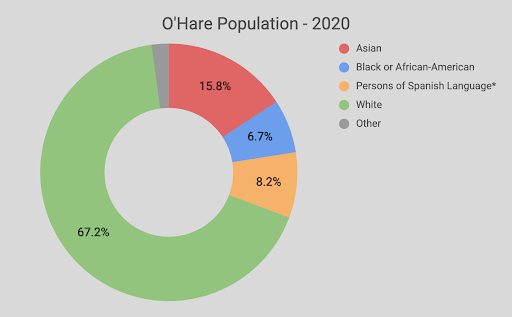
One distinctive feature of the O'Hare community area is its foreign-born population. Roughly 60 percent of residents are foreign-born, and about 70 percent of residents over five years old speak a language other than English at home — figures that dwarf the city average of 20 percent foreign-born. Ukrainian immigrants have been particularly drawn to the area in recent years, centered on an ornate gold-domed Ukrainian Catholic church that has become a community landmark. Polish, Filipino, and South Asian families are also well-represented. The community is cosmopolitan in a way that has nothing to do with the airport and everything to do with the affordability and access that the neighborhood's Northwest Side location provides.
An Airport Neighborhood With a Geography Problem
One of O'Hare's more unusual distinctions is that it is the only Chicago community area that extends outside Cook County. The southwestern edge of the airport — including part of the terminal complex — lies in DuPage County, making the O'Hare community area technically a two-county neighborhood. The city of Chicago has jurisdiction over the airport regardless, but the county line runs through the concourse in a way that surprises even longtime Chicagoans who encounter it.
The transportation infrastructure concentrated in the O'Hare community area is extraordinary even by Chicago standards. In addition to the airport itself, the neighborhood contains the convergence of Interstate 90, Interstate 190, Interstate 294, Illinois Route 72, Illinois Route 171, and U.S. Routes 12 and 45. The CTA Blue Line terminates at the airport's transit station, providing a direct rail connection to the Loop. Metra's North Central Service stops at O'Hare Transfer. And the combination of the airport, the interstate network, and proximity to Rosemont has made the area function as an edge city for the northwest suburbs — a cluster of hotels, corporate campuses, and logistics operations that effectively operates as a second downtown for the region's northwestern quadrant.
O'Hare Today
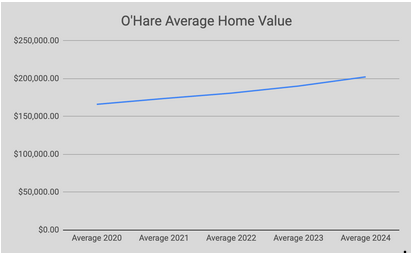
For residents of Schorsch Forest View, daily life unfolds in the shadow — and under the flight paths — of one of the world's great airports. The noise is real and chronic. The neighborhood association has fought for soundproofing programs, and many homes have been retrofitted with noise-dampening windows paid for through federal airport mitigation funds. The trade-off residents accept is access: to employment at the airport and its surrounding businesses, to the Blue Line that runs directly downtown, and to a housing market that remains more affordable than comparable neighborhoods elsewhere in the city.
The O'Hare expansion project — a multi-decade, multi-billion-dollar modernization of the airport's terminal and runway infrastructure — is still unfolding, with new gates, a renovated global terminal, and additional runway capacity continuing to reshape the physical footprint of the airport and, by extension, the community area around it. Each expansion has brought new noise, new traffic, and new economic activity in roughly equal measure.
The forest preserves along the Des Plaines River — Che-Che-Pin-Qua Woods, Robinson Woods, and the surrounding natural corridors — provide residents and visitors a counterpoint to the airport's relentless motion: old-growth trees, hiking trails, and the grave of a Potawatomi chief who was given this land in 1829 for the courage he showed when Chicago was not yet a city. The planes take off every 40 seconds over those woods. Che-Che-Pin-Qua's family has been resting beneath them for more than 150 years. Both things are true at once, and that particular combination of the very old and the very loud is as O'Hare a story as any.
Trivia Answer
The aviator was Lieutenant Commander Edward "Butch" O'Hare. On February 20, 1942, flying alone with limited ammunition, he attacked a formation of nine Japanese bombers bearing down on the undefended aircraft carrier USS Lexington and shot down five of them in under four minutes, saving the ship and its crew. He became the Navy's first flying ace and the first naval aviator to receive the Medal of Honor in World War II. He was killed in aerial combat in November 1943 at age 29. His father, Edward "Easy Eddie" O'Hare, was a Chicago lawyer who served as a business partner and legal fixer for Al Capone, managing the mob's racing operations and helping structure its financial affairs during Prohibition. Easy Eddie later cooperated with federal investigators — a decision widely believed to have contributed to his murder on November 8, 1939, one week before Capone was released from Alcatraz. No one was ever charged. Chicago renamed Orchard Depot Airport in honor of Butch O'Hare in 1949, and when the city annexed the surrounding land in 1956, the name of Capone's lawyer's son became the name of a Chicago neighborhood.
Stay connected with news and updates!
Join our mailing list to receive the latest news and updates from our team.
Don't worry, your information will not be shared.
We hate SPAM. We will never sell your information, for any reason.
