
Norwood Park: The Village That Never Quite Forgot It Was One
Jun 24, 2026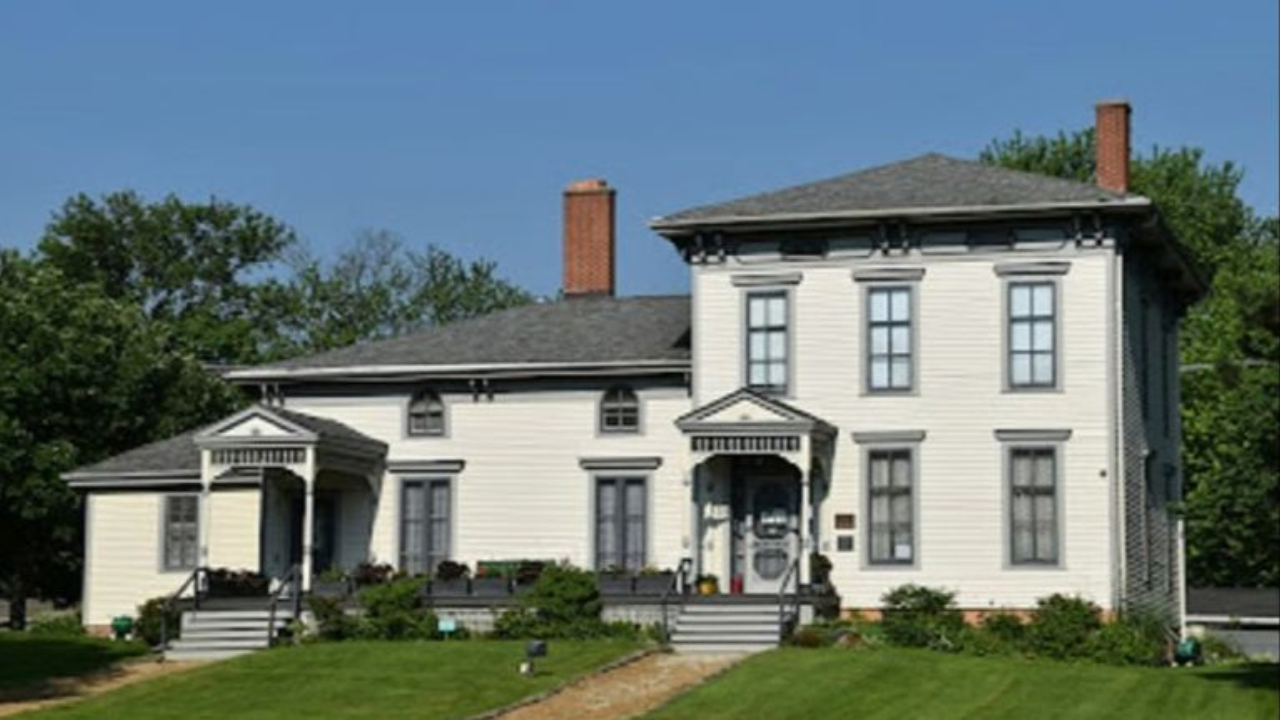
Norwood Park sits on Chicago's far Northwest Side, about eleven miles from the Loop, and wears its age more visibly than any other neighborhood in the city. It is bounded by Devon Avenue to the north, Foster and Gunnison Avenues to the south, the Chicago River's North Branch and Austin Avenue to the east, and Cumberland and Canfield Avenues to the west. Within those borders are six distinct sub-neighborhoods: Old Norwood Park, Norwood Park East, Norwood Park West, Oriole Park, Big Oaks, and Union Ridge. Together they form a community area that covers nearly nine square miles of curving streets, Victorian homes, brick bungalows, and the kind of deep-rooted civic identity that comes from being a place long before the city caught up with it.
Trivia Question
The oldest surviving building in the city of Chicago stands in Norwood Park, at 5622-5624 North Newark Avenue. It was built in 1833 by the first non-indigenous settler to claim land in the area, and it still stands today, housing the Norwood Park Historical Society. The building survived the Great Chicago Fire of 1871 intact, but not by luck or heroic intervention. What is the building called, and why did the fire leave it untouched?
Norwood Park by the Numbers
A Novel, a Railroad, and the Making of a Suburb
The organized development of Norwood Park began in 1868, when a group of Chicago investors formed the Norwood Park Land and Building Association, purchased roughly 860 acres of farmland near the Chicago and North Western Railway tracks, and set about creating what they described as an ideal suburb. They took their inspiration, and their name, from Henry Ward Beecher's popular 1868 novel Norwood, or Village Life in New England, which depicted the virtues of small-town community life in lyrical terms. They added the word Park to the name because another Illinois post office already held the name Norwood, and confusion was to be avoided.
The Association hired designers to lay out the new community in a way that deliberately departed from Chicago's rigid grid. Rather than straight lines and right angles, Norwood Park's residential streets follow the natural contours of the glacial ridge, curving gently through the landscape in a pattern that one developer's brochure from 1907 described as producing proper living conditions, fresh air and sunshine, and good surroundings. One street in Old Norwood actually forms a complete circle. Three small parks were incorporated into the plan from the beginning, and hundreds of shade trees were planted along the new streets. A hotel was built for prospective buyers to stay while inspecting lots. Ads in Chicago newspapers described the community as offering everything an ideal suburb should provide: eleven miles from the courthouse on the Chicago and North Western, thirty minutes' ride.
The village was formally incorporated in 1874. It organized its own township government, drawing pieces of four surrounding townships to create a self-governing unit of nine square miles. Residents built large Victorian homes on wide lots along the ridge, and a downtown of sorts emerged near the train station, with a town hall, shops, and churches clustered around the rail stop at Northwest Highway and Raven Street. By the 1880s, Norwood Park was a functioning suburb in the full sense of the word, and it would remain one for nearly two more decades.
Annexation and the Long Argument About Staying Independent
The vote to join Chicago, taken on November 7, 1893, was not a foregone conclusion. Norwood Park residents debated the question with the seriousness of people who understood what they were giving up. Independence meant local control, low taxes, and the quiet that came from being a dry community whose promotional brochures boasted of having five churches and no saloons. Joining Chicago meant city services, better transit, and access to the public school system that the village's growing population was beginning to need.
The final tally was 124 in favor of annexation and 27 against. Chicago had been expanding aggressively in 1893, building itself up for the World's Columbian Exposition, and Norwood Park was among a wave of communities absorbed into the city in that period. The village's curvilinear streets were left unchanged, which is why Old Norwood remains visually distinct from the grid-based neighborhoods that surround it on three sides. The prohibition on alcohol that the village had maintained was not carried into Chicago law, which created something of a cultural adjustment. As late as 2014, eight precincts in the community area remained dry, a residual effect of local option laws that had accumulated over decades. The area's first liquor store in fifty years opened in 2016, and it did so without controversy, though it came with restrictions including an early closing time and a minimum bottle price.
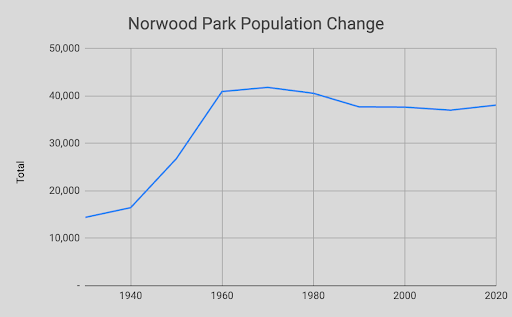
The eastern portions of what is now the Norwood Park community area were developed later, after annexation, and reflect a different character. The land east of Old Norwood was marshy and required drainage infrastructure before residential construction could begin. Bungalows and two-flats went up in those sections from the 1920s onward, creating the denser, more Chicago-typical fabric of Norwood Park East and the areas around Big Oaks and Union Ridge. By 1930, the combined population had reached 14,000. It would grow steadily for decades more.
Taft High School and the Neighborhood That Invented Grease
William Howard Taft High School, which opened in 1939 at 6530 West Bryn Mawr Avenue, serves the entire Norwood Park community area and carries a distinction that its entrance sign announces without apology: Home of the Musical Grease. The claim is accurate and the story behind it is worth knowing.
Jim Jacobs was born in 1942 and grew up in Norwood Park during the 1950s, attending Taft High School in the years when rock-and-roll was new, greasers and their girlfriends defined high school social geography, and the drive-in movie was the dominant social institution of adolescent life on the Northwest Side. He wanted to write a musical that used the music he actually loved, not the showtunes that dominated Broadway, and that told stories drawn from his own experience rather than from literary adaptations or historical spectacle.
The girls' gang at Taft who called themselves the Pink Ladies gave him his female lead characters. The greasy hair, the hot rods, the food, the dances, the codes of loyalty and cool that governed Taft's hallways in the 1950s became the world of Rydell High. Jacobs worked with his collaborator Warren Casey on the script and the songs. Grease debuted at a small Lincoln Park theater in 1971, scheduled for four performances, and became an immediate sensation. It moved to Broadway in 1972, where it ran for 3,388 performances, the longest-running show in Broadway history at the time. The 1978 film starring John Travolta and Olivia Newton-John turned it into one of the most recognizable musicals ever produced. Jacobs has said that every major character in the original show was based on a real person he knew at Taft, a fact that gives the neighborhood an unusual claim on American popular culture.
Taft's drama department has staged its own productions of Grease. Faculty and staff wear letterman sweaters from the era at school events. The principal has observed that Taft maintains the working-class mentality that Jacobs was writing about, and that this continuity is part of what makes the school's connection to the show feel genuine rather than ceremonial.
Terry Kath, Robert Hanssen, and the Weight of Notable Graduates
Taft High School's alumni list contains a range of notable figures that tests the limits of a single neighborhood's capacity for irony. Terry Kath, the guitarist and co-founder of the rock band Chicago, grew up in Norwood Park and attended Taft before the band formed in 1967. Kath was considered by Jimi Hendrix to be among the finest guitarists alive. He died in 1978 at age 31 from an accidental self-inflicted gunshot wound while handling a pistol he believed to be unloaded.
Robert Hanssen was born in 1944 to a family in Norwood Park, the son of a Chicago police officer who was, by most accounts, emotionally harsh toward the quiet, bookish boy. Hanssen graduated from Taft in 1962, studied chemistry at Knox College, took Russian language courses, and eventually joined the FBI. From 1979 until his arrest in 2001, he sold classified intelligence to the Soviet Union and later to Russia, passing 6,000 documents and 26 computer disks to his handlers in exchange for more than $1.4 million in cash, bank funds, and diamonds. The Department of Justice described his espionage as possibly the worst intelligence disaster in United States history. He was sentenced to 15 consecutive life terms and died in federal prison in 2023.
The two men graduated from the same high school roughly fifteen years apart, in the same Northwest Side neighborhood, the sons of working-class city families who had settled in Norwood Park for the same reasons. What they did with those origins could not have been more different. Both are part of Norwood Park's story, and the neighborhood does not pretend otherwise.
Superdawg, the Metra Station, and a Neighborhood That Holds Together
At the corner of Milwaukee and Devon Avenues, on the neighborhood's northern edge, stands one of Chicago's most recognizable drive-in restaurants. Superdawg opened in 1948, built by Maurie and Flaurie Berman as a summer job experiment that became a permanent institution. The two iconic figures standing atop the drive-in, Maurie the Superdawg and Flaurie his companion, have been gazing at each other from their respective roof peaks for over seventy-five years. Superdawg serves Chicago-style hot dogs, crinkle-cut fries, and milkshakes through a carhop service model largely unchanged from the postwar years. It has appeared in movies, television shows, and food publications, and it draws customers from across the city who treat it as a pilgrimage. It is also simply where Norwood Park families have gone on Friday nights since the Truman administration.
The Norwood Park Metra station, on the Union Pacific Northwest Line at Northwest Highway and Raven Street, was designed in 1907 in the Prairie style by the firm of Frost and Granger and is itself on the National Register of Historic Places. The station serves as the commercial heart of Old Norwood, with restaurants, bars, and local businesses clustered along Northwest Highway on either side of the tracks. The neighborhood holds a classic car show on Natoma Avenue in summer, a Memorial Day parade that has run continuously since 1922, and a seasonal rhythm of block parties and community events that reflects the self-contained village character Norwood Park has never entirely surrendered.
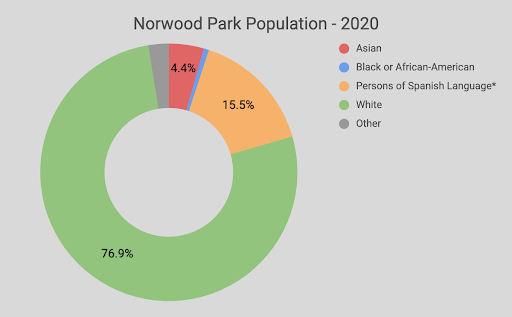
The Serbian-American community, which settled in Norwood Park in significant numbers in the late twentieth century and is centered around Serbian Road and the Serbian Orthodox Cathedral of St. Sava, has added a distinctive cultural presence to the neighborhood's predominantly Irish-Catholic and Polish-American base. The community area remains predominantly white at roughly 80 percent, with a growing Hispanic population of about 12 percent, largely concentrated in Norwood Park East and Big Oaks.
Trivia Answer
The building is the Noble-Seymour-Crippen House, named for its first three owners. It was built in 1833 by Mark Noble, an English immigrant who was among the very first non-indigenous settlers to claim land in the Norwood Park area. The house was expanded significantly by Thomas Seymour in the 1850s and later occupied by the Crippen family. It survived the Great Chicago Fire of 1871 for a straightforward reason: at the time of the fire, Norwood Park was not yet part of Chicago. The neighborhood was an independent village approximately eleven miles from the city's limits, well beyond the reach of the blaze that destroyed much of downtown and surrounding areas. The fire burned eastward and northward through the city but stopped before it reached the far Northwest Side communities. The Noble-Seymour-Crippen House was declared a Chicago Landmark in 1988 and added to the National Register of Historic Places in 2000. It now houses the Norwood Park Historical Society and is open for public tours on Saturday afternoons
Stay connected with news and updates!
Join our mailing list to receive the latest news and updates from our team.
Don't worry, your information will not be shared.
We hate SPAM. We will never sell your information, for any reason.
