
Mount Greenwood: The City's Edge, the City's Own
Apr 29, 2026
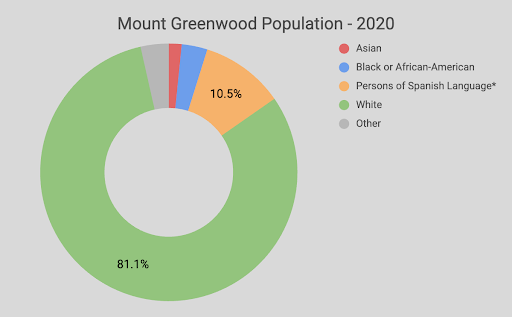
Mount Greenwood sits at the far southwestern corner of Chicago, about fourteen miles from the Loop, close enough to the city limits that its borders on three sides are suburbs rather than other Chicago neighborhoods. It is bounded by 103rd Street to the north, 115th Street to the south, Pulaski Road to the west, and Sacramento Avenue to the east, with Evergreen Park, Oak Lawn, and Merrionette Park pressing in from the edges. It is one of the smallest community areas in Chicago by population, one of the most ethnically homogenous, and one of the most precisely self-defined. Ask any resident where Mount Greenwood ends and something else begins, and they will tell you exactly.
Trivia Question
Mount Greenwood Cemetery, which gave the neighborhood its name, holds nearly 60,000 graves including roughly 300 that date to the Civil War era. Among the most famous people buried there is a legendary figure from the American West whose single most remarkable act of duty involved a presidential document, a wounded body, and a 120-mile ride. Who is he, and what was the document he carried?
Mount Greenwood by the Numbers
Cemeteries, Saloons, and a Name
The neighborhood's story begins with the dead. In 1879, a surveyor named George Washington Waite received an eighty-acre federal land grant on the far southwest prairie and opened a cemetery on the site, naming it Mount Greenwood, for the stand of trees visible across the flat landscape. The sandy, porous soil proved ideal for burial. Other cemeteries followed quickly: Mount Olivet, Saint Casimir, and several others, until the neighborhood was ringed by eight of them. For a time it was known, with equal parts affection and dark humor, as "the Seven Holy Tombs."
Funerals in that era were all-day affairs. Mourners traveled from the city by special funeral trains and streetcars, and by the time services ended they needed somewhere to rest, eat, and, frequently, drink. A strip of saloons and restaurants opened along 111th Street to serve them, also drawing patrons from a nearby horse racing track. The cemetery district had developed, improbably, into something of a party town. The neighboring Village of Morgan Park, a dry community, moved to annex Mount Greenwood and shut the saloons down. Local property owners outmaneuvered them in 1907 by incorporating as their own village first, preserving their taverns and their independence in one stroke.
Mount Greenwood governed itself for twenty years. The most memorable episode of that era was the Battle of the Ditch, a dispute between the village and the cemetery over a drainage channel the village claimed was contaminating their drinking water. When the cemetery refused to act, residents took matters into their own hands, arriving with picks and shovels and filling in the ditch themselves. In 1927, the village voted to annex into Chicago, lured by the promise of city services. The sewers arrived nine years later, delivered by the Works Progress Administration. Residents were still lobbying for curbs and gutters into the 1960s.
Irish Catholic, Blue Collar, To the Core
Through the mid-twentieth century, Mount Greenwood filled in with the families who defined the neighborhood's enduring identity: Irish-Catholic city workers such as police officers, firefighters, paramedics, teachers, and union tradespeople who were required to maintain a Chicago address and chose to live as far from downtown as the city allowed. Mount Greenwood today ranks fourth among all communities in the United States for the percentage of residents who self-identify as Irish American, at 46 percent. The Catholic institutional presence reflects it: Brother Rice, Marist, and Mother McAuley high schools anchor the neighborhood alongside Saint Xavier University, which relocated here from the Douglas neighborhood in 1956.
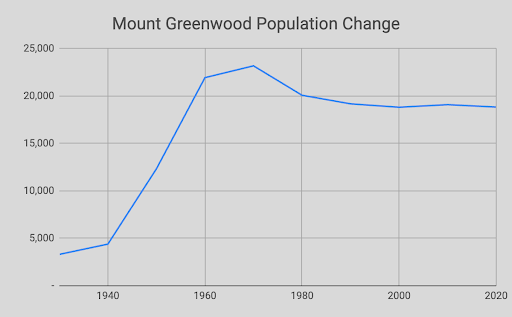
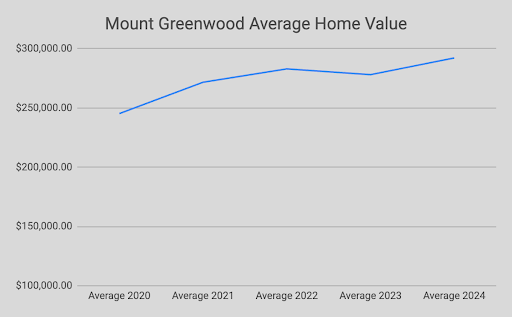
The neighborhood's housing stock grew rapidly between 1930 and 1950; bungalows, ranch homes, and larger single-family houses that remain well-maintained and in high demand. The homeownership rate today is 87.5 percent, nearly double the citywide average. Crime rates are among the lowest in Chicago, a fact locals attribute in part to the density of off-duty first responders on every block. Nearly 90 percent of residents commute by car, a figure that tells you something about the neighborhood's character and its relationship to the rest of the city.
Author John R. Powers grew up in Mount Greenwood and turned his childhood into a bestselling trilogy of comic novels, beginning with The Last Catholic in America in 1973. His affectionate nickname for the neighborhood — "the Seven Holy Tombs" — stuck in the popular imagination long after the books went out of print, and it appears on T-shirts and bar signs in the neighborhood to this day.
The Last Farm and the Agricultural School
By the 1980s, Mount Greenwood held the last working farm within Chicago city limits, operated by a Dutch-descended farmer named Peter Ouwenga on land at the southeast corner of 111th and Pulaski. When Ouwenga retired and sold the property to the Chicago Board of Education in the mid-1980s, the city converted it into the Chicago High School for Agricultural Sciences, a magnet school that remains one of the more unusual public schools in a major American city, offering students hands-on agricultural education on a working farm site, in a neighborhood otherwise entirely residential. The school drew controversy in its early years when busing plans brought Black students into the predominantly white community, triggering protests that reflected the same tensions visible across Chicago's far Southwest Side during that era.
Mount Greenwood Today
Mount Greenwood today is largely what it has been for half a century: stable, residential, ethnically homogenous, and fiercely local in its identity. It came to national attention in November 2016 when an off-duty Chicago police officer fatally shot Joshua Beal, a Black man from Indianapolis, during a confrontation near a funeral procession. The incident drew Black Lives Matter protesters into the neighborhood and counter-demonstrations by residents, exposing the depth of the community's identification with law enforcement and the persistence of its racial insularity.
What is clear is that Mount Greenwood holds on. The cemeteries are still there, still accepting residents at a steady pace. Mount Greenwood Cemetery itself, the one that started everything in 1879, remains unincorporated Cook County to this day, a rectangular hole in the map of the 19th Ward, privately owned and technically outside the jurisdiction of the city that grew up around it. It plows its own roads, pays its own water bill, and answers to no alderman. In a neighborhood that has always insisted on doing things its own way, even the cemetery is independent.
Trivia Answer
The legendary figure buried in Mount Greenwood Cemetery is Robert H. Haslam, known as "Pony Bob" one of the most celebrated riders of the Pony Express. In 1861, despite having been seriously wounded by arrows in a Native American attack along the trail, Pony Bob completed a 120-mile relay ride carrying Abraham Lincoln's first inaugural address westward toward California. It was one of the most remarkable feats in Pony Express history, accomplished at record pace and under extraordinary physical duress. Haslam is buried in Mount Greenwood Cemetery, a few miles from where Chicago ends and the suburbs begin, a long way from the Nevada desert where he made his name.
Stay connected with news and updates!
Join our mailing list to receive the latest news and updates from our team.
Don't worry, your information will not be shared.
We hate SPAM. We will never sell your information, for any reason.
