Morgan Park: The Village at the End of the Ridge
May 13, 2026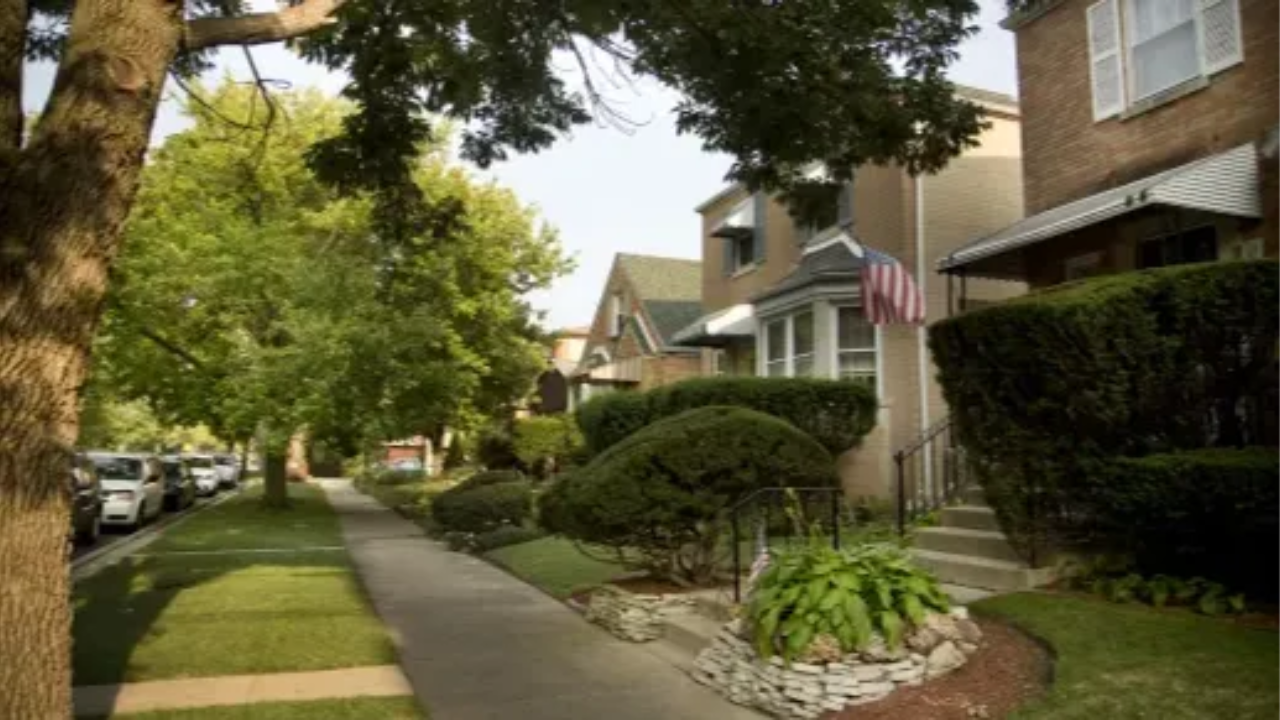
Morgan Park occupies Chicago's far South Side, about thirteen miles from the Loop and pressing hard against the city's southern border. It is bounded by 107th Street to the north, 119th Street to the south, roughly California Avenue to the west, and Halsted Street (north of 115th) and Ashland Avenue (south of 115th) to the east. It sits atop the Blue Island Ridge, the same glacial formation that runs through Beverly and Washington Heights and its most distinguishing physical feature is Longwood Drive, a winding, wooded boulevard along the ridge's spine that feels less like a Chicago street than a country lane in an English market town. That impression is not accidental. The people who laid out Morgan Park in the 1870s were trying to build something that Chicago, in their view, emphatically was not.
Trivia Question
A house at 10856 South Longwood Drive in Morgan Park served as both a home and an early meeting place for one of the most consequential community service organizations in world history, an organization that today has more than 1.4 million members in over 46,000 clubs across more than 200 countries. The organization's founder discovered Morgan Park while hiking with a Chicago outdoors club and fell in love with the ridge's wooded hills, which reminded him of Vermont. What is the organization, and what is the name of the home he shared with his wife on Longwood Drive?
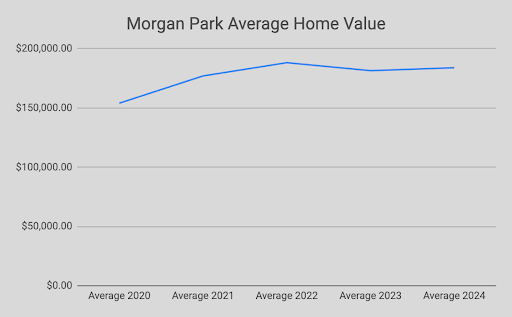
Morgan Park by the Numbers
Horse Thieves, a London Banker, and a Dream of Suburbia
Before Morgan Park was a respectable community, it had a reputation to live down. In the early 1840s, the ravine-cut terrain along the southern end of the Blue Island Ridge provided convenient cover for horse thieves operating between Chicago and the surrounding townships. Early settler Isaac T. Greenacre described the area around what is now Vincennes Avenue between 115th and 121st Streets as a place where outlaws could disappear into steep-sided ravines choked with tall grass. It was not the most promising beginning for a future garden suburb.
The neighborhood's transformation began with Thomas Morgan, the son of a London banker who inherited a fortune and used it to establish a cattle and sheep ranch on the ridge in 1844. Morgan cleared trees, built a house, and worked the land for the better part of a quarter century. When the Blue Island Land and Building Company purchased roughly 3,000 acres from the Morgan family in 1869, they inherited a name — and a vision. The company hired landscape designer Thomas F. Nichols to lay out the new community, and Nichols delivered something genuinely unusual for Chicago: curved streets that followed the ridge's contours, small parks at irregular intervals, roundabouts, and a deliberate avoidance of the grid that defined the rest of the city. The developers planted 11,500 trees on the 480-acre tract and advertised the new community as a refuge from "the smoke and other nuisances" of urban life. They were selling suburban calm inside the future city limits, two decades before the city arrived.
Morgan Park incorporated as a village in 1882, and two features of that incorporation set the neighborhood's character in ways that persist to this day. First, the village was established as a dry community east of Western Avenue — no saloons permitted, a reflection of the temperance-minded Protestant institutions that anchored the neighborhood's early identity. That prohibition technically still stands. Second, the village's name honored Thomas Morgan, the rancher whose family had sold the land — a man who had nothing to do with building the community but whose cattle had grazed the ridge long enough to earn the association.
Three Colleges, a Seminary, and an Unusual Civic Identity
What distinguished Morgan Park from other far South Side settlements in its early decades was an extraordinary concentration of educational institutions. By the 1870s, three colleges had established themselves on the ridge: the Blue Island Academy (later Morgan Park Academy), the Baptist Union Theological Seminary, and the Morgan Park Military Academy. This density of higher education gave the neighborhood an intellectual and civic character that attracted families seeking something more than a working-class bungalow belt.
The Baptist Union Theological Seminary connection proved particularly consequential. George Walker, whose family had ties to the old University of Chicago — itself a Baptist-affiliated institution — played a significant role in the founding of the present University of Chicago in Hyde Park in 1890. The theological lineage running through Morgan Park's Baptist institutions and into one of the great research universities in the world is a thread that most neighborhood histories underplay.
Morgan Park Military Academy, founded in 1873, became the neighborhood's most enduring educational institution. Its campus on the ridge produced graduates who went on to military careers, public service, and business across the country. The academy remains in operation today, one of the oldest private military schools in the Midwest and a steady presence on the ridge for more than 150 years. Morgan Park Academy, the successor to the Blue Island Academy, continues as a private preparatory school on the same grounds where the neighborhood's first serious educational ambitions took root.
The Longwood Drive House and the Birth of a Global Movement
Among the many people drawn to Morgan Park's wooded ridge in the early twentieth century was a Chicago attorney named Paul Percy Harris, who first encountered the neighborhood on a winter hike with the Prairie Club of Chicago and was immediately struck by its resemblance to the Vermont hills where he had grown up. Harris was a man who had built a successful law practice but found city life isolating. He had begun assembling a small circle of fellow professionals who rotated their meetings among each other's offices — hence the name they eventually settled on for the organization: Rotary.
Harris purchased a house at 10856 South Longwood Drive in 1912, named it Comely Bank after the Edinburgh street where his Scottish-born wife Jean had grown up, and made it the informal headquarters of a movement that was already spreading far beyond Chicago. Early Rotary meetings were held in the basement in a makeshift boardroom consisting of two sawhorses and a plank with a tablecloth. The garden behind the house, which Harris called his Garden of Friendship, hosted reunions of Rotarians from around the world as the organization expanded to six continents by 1921 and took the name Rotary International in 1922.
Harris lived at Comely Bank until his death in 1947. The house on Longwood Drive is now maintained as a memorial and museum by Rotary International, open to Rotarians and visitors from around the world who make a pilgrimage to the quiet South Side street where one of the most successful civic organizations in history was nurtured. Harris and his first club president, Silvester Schiele — who lived at 2028 West 110th Street, within walking distance along the ridge — are buried together at Mount Hope Cemetery on 115th Street, a short walk from the home where they plotted Rotary's future.
Race, the Dan Ryan, and a Neighborhood Divided
African-American residents had been present in Morgan Park since the 1890s, when French immigrants and Black families began settling the eastern section of the neighborhood. Their presence was explicitly conditional: an informal covenant restricted Black residents to the area east of Vincennes Avenue, keeping the ridge's western blocks white and middle-class by design. That arrangement held for decades, enforced not by law but by custom, covenant, and community pressure.
The postwar decades dismantled it. As African-American families moved southward from the expanding Black Belt and blockbusting agents worked the blocks between Vincennes and Western, the neighborhood's racial composition shifted rapidly. The construction of Interstate 57 (the Dan Ryan Expressway's West Leg) in 1958 carved a physical boundary along Vincennes Avenue that mirrored and reinforced the old racial divide. The highway did not cause the segregation; it codified a line that had already been drawn in the neighborhood's social geography.
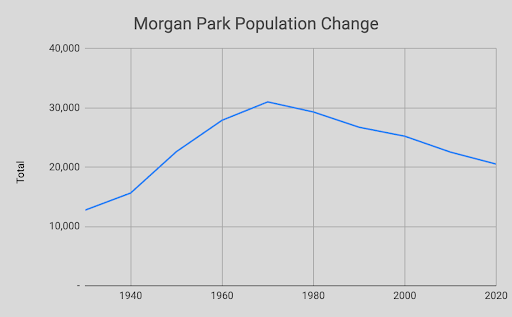
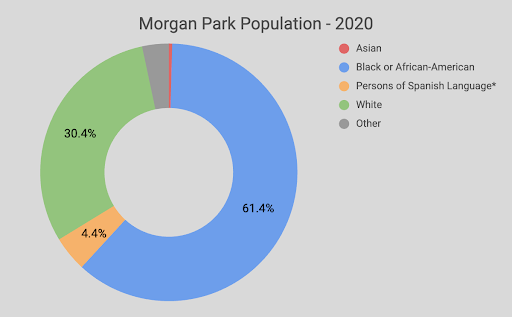
By the 1980s and 1990s, that division had blurred considerably. Morgan Park today is one of the more genuinely integrated communities on Chicago's South Side, roughly 55 percent Black and 37 percent white, with a middle-class character that has held across the demographic transition more successfully than many comparable neighborhoods. The ridge blocks west of Longwood Drive retain their estate-quality architecture and their dry status. The eastern sections carry a different history but contribute to the same neighborhood.
Notable Residents and a Raisin in the Sun
Morgan Park has produced people worth knowing about. Mae Jemison, the physician and NASA astronaut who in 1992 became the first African-American woman to travel in space, grew up in Morgan Park. Peter Cetera, the bass guitarist and lead vocalist who co-founded the band Chicago and wrote some of the most commercially successful rock songs of the 1970s and 1980s, spent his formative years here. Both figures reflect the neighborhood's unusual demographic range — a community that was producing classical suburbanites and barrier-breaking firsts at the same time.
Morgan Park also carries a distinction in American theater. In Lorraine Hansberry's A Raisin in the Sun — the 1959 play that became one of the defining works of twentieth-century American drama — the matriarch Lena Younger speaks of her dream to buy a two-story house in Morgan Park. The reference was not incidental. In 1959, Morgan Park represented exactly what Hansberry meant it to represent: a decent, stable, middle-class neighborhood that Black families aspired to reach but were systematically prevented from entering. The play's central conflict — the Younger family's fight to move into a white neighborhood in Clybourne Park — was the same fight being waged, in less dramatic but no less real terms, on the streets of Morgan Park itself.
Morgan Park Today
Morgan Park today retains a quality rare in a city of Chicago's density: the feeling of a place that was designed with intention and has held its character across 150 years of history. Longwood Drive is still one of the most beautiful residential streets in Chicago, winding, canopied, lined with homes designed by notable architects including Dankmar Adler and Dwight Perkins. The Beverly Arts Center, shared between Beverly and Morgan Park, anchors the community's cultural life with theater, music, and arts education. Home Run Inn Pizzeria, one of the South Side's most beloved pizza institutions, operates in the neighborhood. The Metra Rock Island Line serves three stations within Morgan Park — at 107th, 111th, and 115th Streets — giving residents a direct connection to the Loop that has made the area viable as a city neighborhood despite its suburban removal.
The alcohol prohibition east of Western Avenue, adopted when the village incorporated in 1882, remains on the books today, a legal artifact of the neighborhood's Baptist founding that has survived annexation, world wars, and a century of social change. In practice it means that Morgan Park's commercial strips along Western Avenue support bars and restaurants, while the ridge blocks to the east remain formally dry. It is the kind of detail that could only exist in Chicago: a Victorian temperance ordinance still shaping where you can order a drink on a Tuesday night, in a neighborhood where the founder of Rotary International once hosted reunions in his garden for friends who had traveled from six continents to be there.
Morgan Park is what happens when a place is laid out with a clear idea of what it should be and then defended, imperfectly, often unjustly, but persistently against everything that might make it something else. The ridge is still there. The trees are still there. The winding streets that don't follow the grid are still there. So is Comely Bank, at the end of a driveway on Longwood Drive, waiting for Rotarians to come and remember where it all started.
Trivia Answer
The organization is Rotary International, the global community service organization founded in Chicago in 1905. Its founder, attorney Paul Percy Harris, purchased a home at 10856 South Longwood Drive in Morgan Park in 1912 and named it Comely Bank — after the street in Edinburgh, Scotland, where his wife Jean had grown up. Harris had discovered Morgan Park on a winter hike with the Prairie Club of Chicago; its wooded, hilly terrain reminded him of his Vermont childhood. Early Rotary meetings were held in the basement at Comely Bank, and the home's garden became a gathering place for Rotarians from around the world as the organization expanded across six continents. Harris lived at Comely Bank until his death in 1947. The house is now maintained as a museum and memorial by Rotary International, and Harris is buried at Mount Hope Cemetery on 115th Street, less than a mile from his Longwood Drive home.
Stay connected with news and updates!
Join our mailing list to receive the latest news and updates from our team.
Don't worry, your information will not be shared.
We hate SPAM. We will never sell your information, for any reason.
