
Morgan Park: Rail Lines, Roots, and a Legacy of Stability
Dec 18, 2025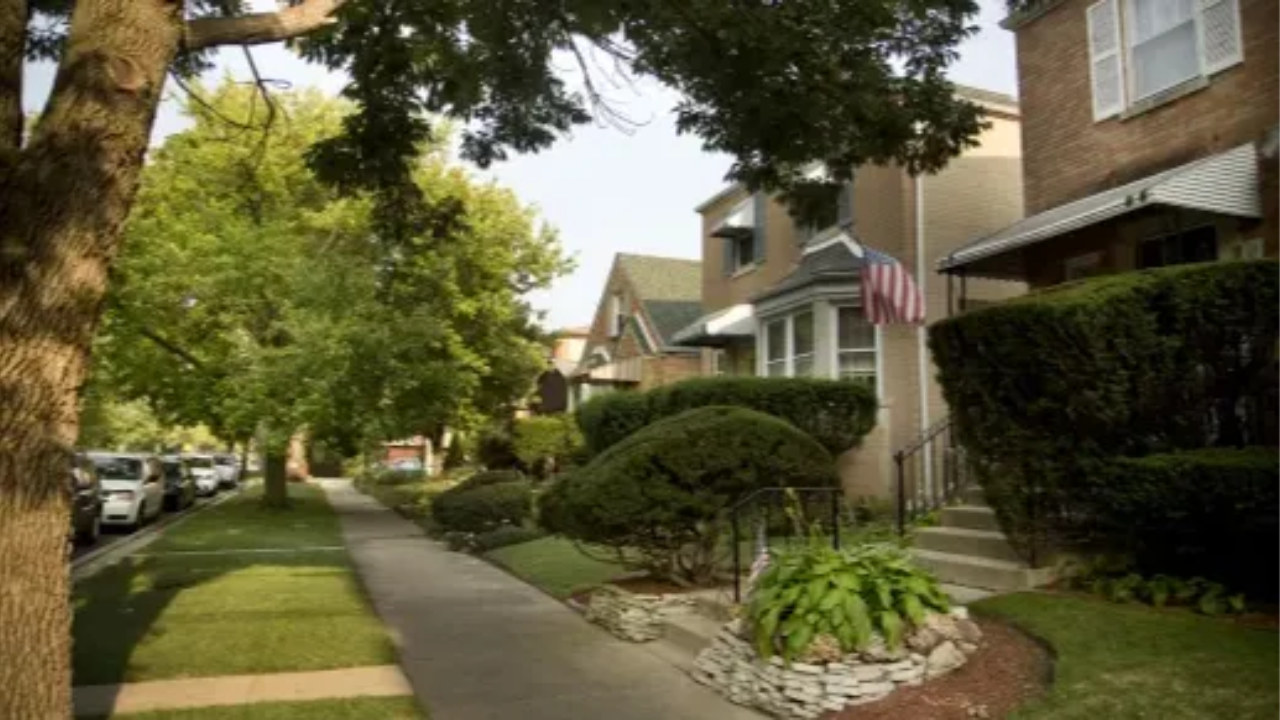
Introduction
Morgan Park is a residential neighborhood on Chicago’s Far South Side, bounded by 107th Street to the north, 119th Street to the south, Interstate 57 to the east, and Vincennes Avenue to the west. Originally developed as an independent village, the neighborhood sits between the city and the south suburbs and has long functioned as a transitional area shaped by rail access, education, and homeownership rather than heavy industry.
Trivia Question:
Which Morgan Park High School graduate later became the first Black woman to travel into space?
Morgan Park by the Numbers
Early Settlement and Founding
Before urban development, the land that became Morgan Park was part of the open prairie used by Native American tribes and later settled by European farmers in the mid-19th century. Permanent settlement increased after the extension of rail lines through the area, which made the region attractive to commuters and investors.
Morgan Park was laid out in the 1870s by Thomas F. Nichols, with a street plan that included curving roads, small parks, and traffic circles. In 1869, the Blue Island Land and Building Company acquired land from the heirs of Thomas Morgan, an early English settler, and subdivided the area between Western Avenue and Vincennes Avenue that now makes up much of the Morgan Park community area. Although the Chicago, Rock Island and Pacific Railroad ran through the area as early as 1852, regular commuter service to downtown Chicago did not begin until the opening of the suburban line in 1888.
Annexation and Growth
For several decades, Morgan Park operated as an independent village. In 1914, it was annexed by the City of Chicago, bringing municipal services while preserving much of its original suburban layout. Annexation connected the neighborhood more directly to the city’s infrastructure but did not fundamentally alter its residential character.
The presence of commuter rail service along the Rock Island line supported steady growth and allowed residents to work elsewhere while maintaining a quieter neighborhood environment.
Institutions and Landmarks
Education has been central to Morgan Park’s history. The Baptist Theological Union moved to the neighborhood in 1877, attracting faculty, students, and national attention. The institution later evolved into the University of Chicago Divinity School before relocating to Hyde Park, but its early presence established Morgan Park as a place associated with scholarship and civic life.
Historic landmarks within the neighborhood include the Morgan Park Academy, founded in 1873, which remains one of the oldest private schools in Chicago. Several large churches built in the late 19th and early 20th centuries continue to serve as architectural and community anchors.
Residential architecture also reflects the neighborhood’s history, with well-preserved single-family homes, bungalows, and early 20th-century designs lining streets laid out during the village period.
Demographic Change and Today
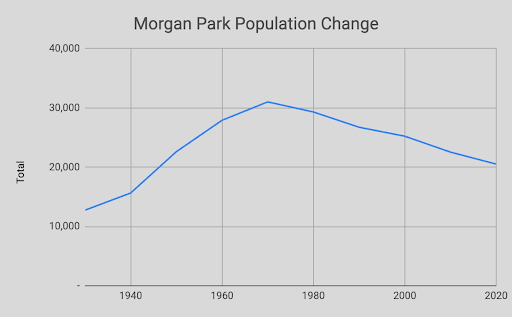
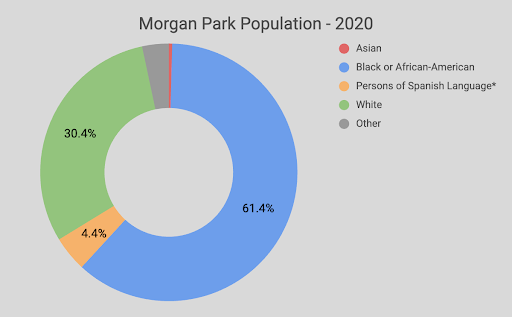
During the early and mid-20th century, Morgan Park was largely white and middle class. Like many Chicago neighborhoods, it experienced demographic change in the postwar period, becoming predominantly Black by the late 20th century. The transition occurred gradually and was accompanied by relatively high rates of homeownership and neighborhood stability. Community organizations, churches, and schools played a key role in maintaining continuity during periods of broader South Side disinvestment.
Today, Morgan Park remains a largely residential neighborhood with limited commercial development. Its location near the city’s southern boundary, access to Metra rail service, and proximity to suburban Cook County continue to shape daily life. While challenges such as aging housing stock and infrastructure persist, the neighborhood has retained much of its original layout, presence, and reputation.
Trivia Answer
Morgan Park native, Mae Carol Jemison (born October 17, 1956) . An engineer, physician, and former NASA astronaut. She became the first Black woman to travel into space when she served as a mission specialist on the Space Shuttle Endeavour in 1992.
Stay connected with news and updates!
Join our mailing list to receive the latest news and updates from our team.
Don't worry, your information will not be shared.
We hate SPAM. We will never sell your information, for any reason.
