Montclare: The Quiet Corner Where Chicago Finally Runs Out of Room
Jul 30, 2026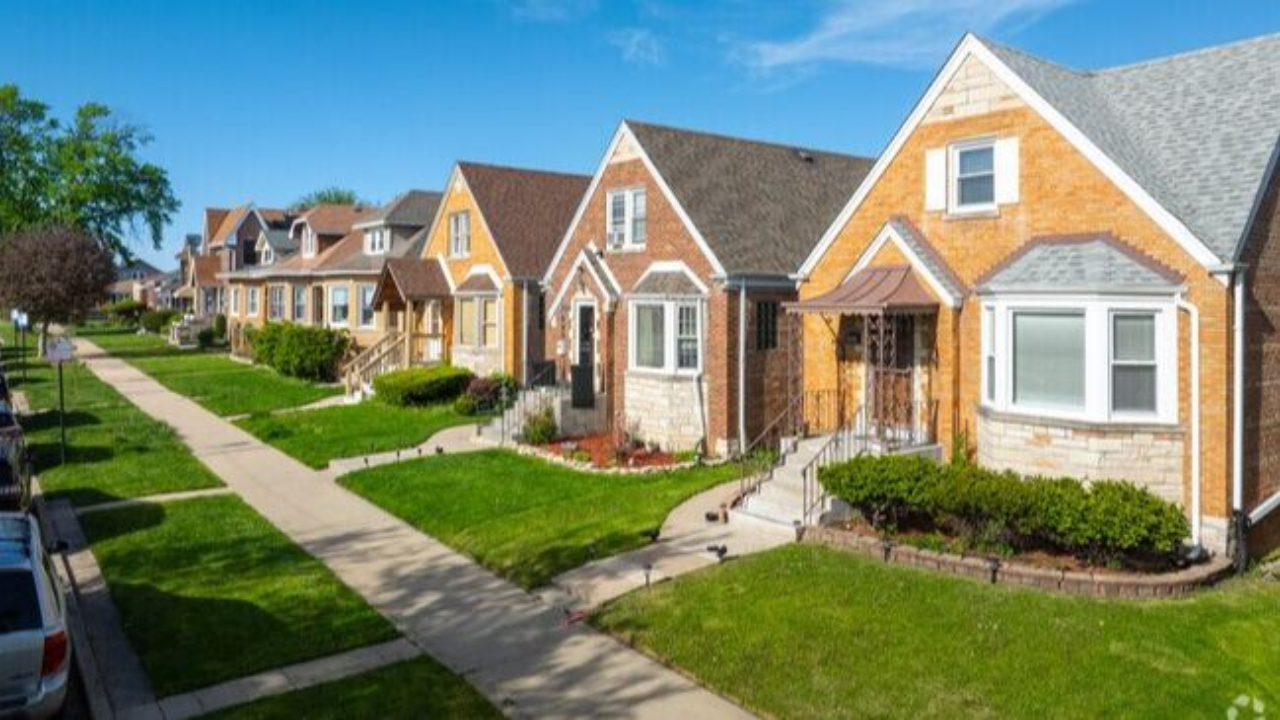
Montclare sits on Chicago's far Northwest Side, nine miles from the Loop and pressed hard against the suburban border formed by Elmwood Park and Harwood Heights. It is bounded by Belmont Avenue to the north, the Chicago, Milwaukee, St. Paul and Pacific Railroad tracks to the south and east, and Harlem Avenue to the west. At less than one square mile, it is one of the smallest community areas in the city. Its population of roughly 14,000 makes it one of the least dense. It has no elevated train stop, no landmark building, no famous street corner. What it has is a Metra station that holds a quiet distinction: the Mont Clare station on the Milwaukee District West Line is the last outbound stop within Chicago city limits before the train crosses into the suburbs. Montclare is where the city, on this particular rail corridor, lets go.
Trivia Question
A boy grew up on Rutherford Avenue in Montclare in the 1920s and 1930s, attended local schools on the Northwest Side, and went on to become one of the most celebrated running backs in professional football history. In 1949 he became the third player in NFL history to rush for more than 1,000 yards in a single season, accomplishing the feat despite playing with a significant physical limitation that forced him to practice in civilian clothes rather than a uniform. He was inducted into the Pro Football Hall of Fame in 1974. Who was he, what team did he play for, and what was the physical limitation he played through during that record-breaking season?
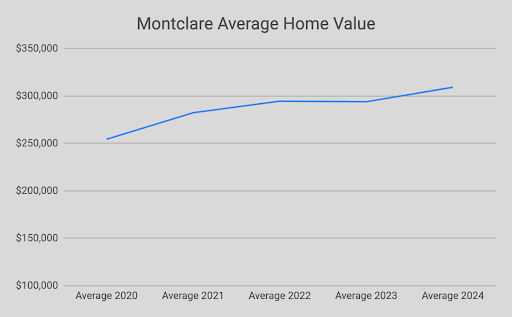
Montclare by the Numbers
William Sayre and Ninety Acres of Prairie
The story of Montclare begins, like so many Northwest Side communities, with a single settler and a land claim. In 1836, a man named William Sayre arrived in Jefferson Township and staked a claim to roughly 90 acres of rolling prairie by the simple expedient of moving onto it and calling it his. The land surveys of the era were imprecise enough that Sayre could not immediately get legal title to the property. When the survey was eventually corrected, he bought the land outright and settled in for the long work of farming it.
Sayre and his wife Harriett Lovett, the first married couple registered in Jefferson Township, farmed their acreage and used Grand Avenue as their road to the downtown Chicago markets, a nine-mile route that took them along a diagonal road cutting southeast through the prairie. They were joined over the following decades by a small cluster of German and Scandinavian farm families who worked the flat, fertile ground and lived at the unhurried pace of agricultural life far from the city.
The arrival of the railroad in 1872 changed the equation, though not immediately. Sayre granted the Chicago and Pacific Railroad Company right-of-way over his property, and a station was built. Developers platted the area the following year and gave the new community a name borrowed from Montclair, New Jersey, a prosperous suburb of Newark that carried associations of respectability and green residential life. They added the "e" to the end, making it Montclare, a spelling that has been both contested and accepted in various official contexts ever since. The railroad brought little growth. The lots the developers offered sat largely vacant. A single daily train, poorly timed for commuters, did nothing to attract new residents, and the line was eventually absorbed by the Chicago, Milwaukee and St. Paul Railroad.
The Long Wait for Paved Streets
When Chicago annexed Montclare in 1889 along with the rest of Jefferson Township, the neighborhood had fourteen houses and 120 residents. Those numbers made Montclare one of the most sparsely settled of the communities absorbed in the city's massive 1889 annexation, which added 125 square miles and nearly a quarter million people to Chicago in a single legislative stroke.
The annexation improved things slowly. The Grand Avenue streetcar was extended to Montclare in 1912, and Tudor-style frame houses began appearing on the neighborhood's streets in response. Bungalows followed in the 1920s, after the decade brought the paved streets and water and utility connections that had previously been absent. The housing that went up in those years gave Montclare its lasting architectural character: brick bungalows, raised ranches, and Tudor cottages arranged on modest lots along a residential grid that feels more like a suburb than a city neighborhood, because in many respects that is precisely what it was designed to be.
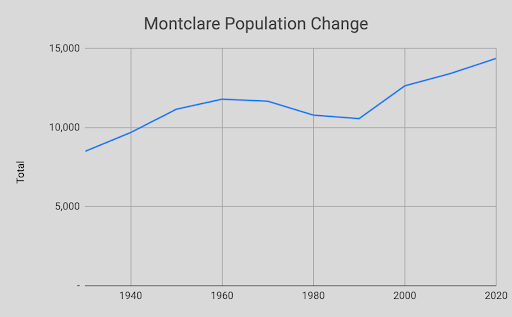
The community that formed during the interwar years was predominantly German, Polish, and Italian in ancestry, organized around the Catholic parishes and neighborhood institutions that anchored Northwest Side life. It was, by most accounts, a quiet place: low crime, well-maintained blocks, the kind of community where families stayed for generations and newcomers were known by name within a few months of arriving. The Encyclopedia of Chicago describes it plainly: Montclare has had a stable population since about 1960.
The Park That Carries Two Families' Names
Rutherford Sayre Park, the 13.94-acre green space that anchors the neighborhood's social life along Belden Avenue, carries the names of the two families most responsible for shaping Montclare's early years. The Sayre family's connection is clear: William Sayre's homestead occupied the western portion of what became the park. Thomas A. Rutherford, the area's first postmaster and another early settler, donated the eastern section at the corner of Belden and Oak Park Avenues. The park properties were set aside just before World War I and came under the control of the Chicago Park District, which built a fieldhouse with an assembly hall and gymnasium in 1916.
Today Rutherford Sayre Park offers baseball and softball fields, a combination football and soccer field, tennis courts, a playground with a spray pool, and a nature area planted with native species starting in 2019. The Galewood-Mont Clare Branch of the Chicago Public Library operates out of the park's fieldhouse, one of the more compact but well-used library branches on the Northwest Side. The park is the neighborhood's gathering point, the place where the rhythms of Montclare's daily life are most visibly on display: youth sports on Saturday mornings, older residents walking the perimeter in the evenings, children cycling between the spray pool and the tennis courts in summer.
Max Bedacht and an Unlikely Political Footnote
Montclare carries one additional historical footnote that its residents are perhaps less inclined to celebrate. Max Bedacht, a German-born political activist who helped establish the Communist Party of America in 1919, lived at 3101 North Nordica Avenue in Montclare from 1923 to 1928, according to testimony he later gave before the House Un-American Activities Committee. Bedacht was a significant figure in the early American communist movement and served in various capacities in party leadership before eventually breaking with the party in the late 1940s.
His presence on a quiet Montclare residential street in the 1920s, while the neighborhood was still being built out from farmland into bungalow blocks, is the kind of detail that neighborhood histories rarely surface but that speaks to the broader diversity of American political life in that era. Montclare's working-class Catholic identity was already taking shape during Bedacht's years on Nordica Avenue. The two things coexisted without apparent friction, as such things often did in a city large enough to accommodate contradictions without requiring them to resolve.
Demographic Transition and the Neighborhood Today
Montclare remained predominantly white and working-class through most of the twentieth century, organized around its Catholic parishes, its bungalow blocks, and the Metra line that carried residents downtown and back. The transition that remade much of Chicago's Northwest Side arrived later here than in some adjacent communities, held off by the neighborhood's geographic position at the city's western edge and by the strength of its institutional anchors.
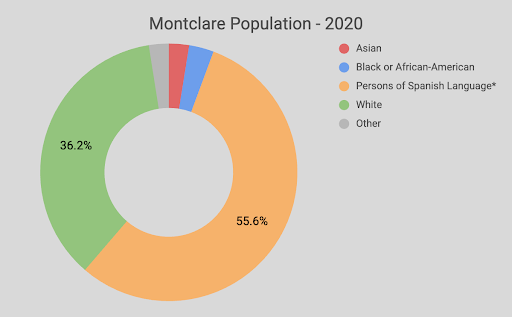
By the 1980s, the demographic shift was underway. Hispanic families, predominantly of Mexican origin, began moving into the neighborhood as earlier European-immigrant families relocated to the suburbs. The transition has continued steadily: the 2023 census estimate puts the Hispanic population at roughly 58 percent, with white residents at about 32 percent. The change has been accompanied by the same generational debate visible across the Northwest Side: longtime residents adjusting to a neighborhood that looks different than the one they grew up in, newer residents building community in a place that did not originally make room for them.
What has not changed is the fundamental character of the neighborhood's housing stock and its civic ethic. The bungalows that went up in the 1920s and 1930s are still there, maintained with the same attention that each generation of owners has brought to them. The homeownership rate remains above the city average. Rutherford Sayre Park fills on weekends with families whose names have changed but whose relationship to the neighborhood's green space is continuous with every generation that came before them.
The Mont Clare Metra station remains what it has always been: the last stop in Chicago before the train moves on to Elmwood Park and beyond. Forty-one trains a day make the run in each direction. For the residents who board here each morning and return each evening, the station is simply the punctuation mark at either end of a workday. For the city of Chicago, it is something slightly more: the western boundary of what the Milwaukee District West Line considers Chicago, a line in the prairie that William Sayre first crossed in 1836 when he laid claim to ninety acres by the simple act of being there.
Trivia Answer
The player was Tony Canadeo, who grew up on Rutherford Avenue in Montclare and went on to play for the Green Bay Packers from 1941 to 1952, with two years out for military service during World War II. In 1949, he became only the third player in NFL history to rush for more than 1,000 yards in a single season, gaining 1,052 yards despite a shoulder injury so severe that he could not put on a shoulder pad during practice. His solution was to practice in street clothes and an overcoat while his coaches evaluated his form, then suit up fully on game days. He was inducted into the Pro Football Hall of Fame in 1974, the first Packer to be enshrined who was not a quarterback or lineman. Known as the Gray Ghost of Gonzaga for his prematurely gray hair, Canadeo remains one of the least celebrated Hall of Famers relative to the quality of his career, a distinction that suits the quiet Northwest Side neighborhood where he grew up.
A Final Word: Chicago, Block by Block
This blog series began on the Southwest Side with a bungalow belt neighborhood named for a lawn and a park, and it ends on the Northwest Side in a neighborhood named for a New Jersey suburb that a group of developers thought sounded respectable. In between, the series has covered neighborhoods built on steel mills and wartime factories, on Dutch flower gardens and ancient portage routes, on the ambitions of canal commissioners and the grief of immigrant families far from home. It has visited the graves of Pony Express riders and the birthplace of Rotary International. It has documented race riots and labor massacres, the rise and collapse of industries that once employed hundreds of thousands, and the recurring cycle in which one community's departure creates the opening for the next community's arrival.
Chicago is a city of 77 officially recognized community areas, and each of them contains more history than a single blog post can hold. What this series has tried to do, neighborhood by neighborhood, is surface the specific and the surprising: the facts that residents know and visitors rarely discover, the stories that explain why a street curves the way it does or why a neighborhood carries the name it does or why a building that looks like a movie palace is now flying a Polish flag. Chicago's history is not abstract. It lives in its blocks and its buildings, in the names on its streets and the graves beneath its parking lots, in the architectural choices of people who are long dead and the demographic patterns of people who are very much alive.
Every neighborhood in this series is still being written. The bungalows are still occupied. The churches are still holding services in languages their founders never spoke. The parks are still filling on summer weekends with families whose connection to this city is brand new and families whose connection goes back five generations. Chicago keeps becoming itself, and the process is never finished.
Stay tuned for more Chicago historical content.
Stay connected with news and updates!
Join our mailing list to receive the latest news and updates from our team.
Don't worry, your information will not be shared.
We hate SPAM. We will never sell your information, for any reason.
