
Hegewisch: Chicago's Far Corner and the Prairie Where History Happened
May 20, 2026
Hegewisch occupies Chicago's extreme southeastern corner, pressed against the Illinois-Indiana state line in a way that makes it feel less like a Chicago neighborhood than a small town that woke up one morning to find itself annexed. It is bounded by 128th Street to the north, 138th Street (Brainard Avenue) to the south, the Indiana state line to the east, and the Bishop Ford Freeway and Torrence Avenue to the west. Wetlands, rail yards, and industrial corridors separate it from the rest of Chicago on three sides, making it one of the most geographically isolated community areas in the city, a distinction its residents wear as a badge of pride rather than a complaint. The South Shore Line commuter train, which runs all the way to South Bend, Indiana, stops here before crossing the state line. It is the last stop in Illinois, and in many ways, it feels like it.
Trivia Question
On Memorial Day 1937, a newsreel crew from one of America's major film studios was present on a prairie near Hegewisch to document a labor protest outside a steel mill. What they filmed that afternoon was one of the most violent episodes in American labor history. But the footage was suppressed — withheld from public viewing for fear it would incite a reaction across the country. What happened that day, how many people died, and what eventually forced the film into the open?
Hegewisch by the Numbers
A Failed Vision and a Stubborn Town
Hegewisch was founded in 1883 by Adolph Hegewisch, a German-born businessman who served as president of the U.S. Rolling Stock Company and harbored an ambition common to the industrial age: to build not just a factory but a community around it. His model was the Pullman planned town just to the northwest — a self-contained company settlement where workers lived, worshipped, and shopped within walking distance of the plant. Hegewisch purchased roughly 100 acres centered on what is now 135th and Brandon for his rail car manufacturing operation, and investors assembled an additional 1,500 acres to the north and northeast for working-class housing.
The vision was never fully realized. Two canals that Hegewisch planned to dig — connecting the Calumet River, Wolf Lake, and Lake Michigan — never materialized, and without that waterway infrastructure, the industrial base he imagined never took hold at the scale he intended. Only about 500 people had moved to the area by 1885. The U.S. Rolling Stock Company struggled and was eventually sold, changing hands and names multiple times before becoming Pressed Steel Car Company. Chicago annexed the community in 1889 as part of the massive Hyde Park annexation that also brought in Pullman and South Chicago.
What saved Hegewisch from the fate of other failed company towns was steel. As the mills of the Calumet region expanded through the early twentieth century Wisconsin Steel, Republic Steel, and other operations drawing from the ore boats on Lake Calumet, Hegewisch became home to the workers who staffed them. Polish, German, and other Central European immigrant families settled the rows of bungalows and frame houses that filled in the neighborhood's grid, and a community took shape around the rhythms of mill shift work: churches, taverns, corner stores, and the steady sound of industry audible from nearly every block.
The Buried Newsreel
What made the Memorial Day Massacre a landmark moment in both labor history and media history was what happened to the evidence. A newsreel crew from Paramount Pictures was present on the prairie that afternoon and filmed the entire episode — the march, the police line, the shooting, the fleeing crowd, the wounded on the ground. The footage was unambiguous: it showed peaceful marchers being shot in the back as they ran.
Paramount refused to release the film. An official at the company explained that distributing footage of police killing unarmed workers would risk creating, in his words, "mass hysteria." Major newspapers including the Chicago Tribune and the New York Times ran accounts that largely accepted the police version of events, describing the strikers as violent agitators who had attacked officers. The Tribune published photographs of the scene with captions framing the police as restoring order against an unruly mob.
The footage remained suppressed until U.S. Senator Robert La Follette of Wisconsin, chairing a Senate subcommittee investigating violations of workers' civil rights, subpoenaed the film. When the newsreel was screened for the committee and later shown in cinemas, the truth of what had happened became undeniable. The Senate concluded that the police had used excessive and unprovoked force, had lied about the equipment they carried, and had conducted no honest investigation of their own conduct. The massacre became a defining moment in the national debate over the right to organize — a wound that took decades to fully reckon with and whose echoes can still be heard on Avenue O every May 30th.
Isolation, Steel's Decline, and the Airport That Wasn't
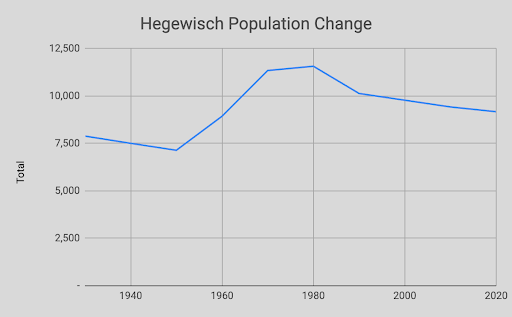
Hegewisch's geographic isolation, a feature of its founding that never quite resolved itself and shaped its twentieth-century trajectory in ways both protective and limiting. The rail lines and wetlands that cut it off from the rest of Chicago also insulated it from some of the blockbusting and rapid demographic pressure that remade other South Side neighborhoods in the 1950s and 1960s. The transition was slower and quieter here, driven more by the economics of steel than by the racial dynamics that defined neighborhoods to the north.
When the steel industry began its long collapse in the late 1970s and accelerated through the 1980s with Wisconsin Steel closing its South Deering mill in 1980, Republic Steel shuttering operations not long after Hegewisch absorbed the blow without the catastrophic disinvestment that leveled other mill communities. It hurt. The population declined. Young people left. But the neighborhood held its physical character in a way that South Chicago and Pullman, more exposed to the broader city's pressures, did not entirely manage.
The most dramatic threat to Hegewisch came not from economic decline but from a municipal planning proposal. In 1990, Mayor Richard M. Daley announced plans for a Lake Calumet Airport — a third major Chicago airport that would have required demolishing more than 4,200 homes and displacing over 10,000 residents, essentially erasing Hegewisch from the map. The neighborhood organized against the proposal with the ferocity of a community that had survived a massacre and a steel collapse and was not about to be bulldozed by city hall. Two years later, facing opposition from state legislators and mounting doubts about the project's costs, Daley declared the airport plan dead. Hegewisch was still on the map.
Hegewisch Today
Today, Hegewisch is a neighborhood of roughly 10,000 residents, smaller than its mid-century peak but stable, and notable for maintaining a quality of life that visitors from other parts of the city find surprising. It has more undeveloped land than any other Chicago neighborhood, with nearly 475 acres of open space and Wolf Lake on its eastern edge, part of the William W. Powers State Recreation Area. The Powderhorn Prairie Marsh Nature Preserve protects a remnant of the wetland landscape that once covered the Calumet region. Fishing, kayaking, and cycling draw residents and visitors year-round in a setting that feels nothing like the rest of the city.
The neighborhood has three distinct sub-areas: Old Hegewisch, the original townsite; the Avenues, where streets are named alphabetically (Avenue F, Avenue G, and so on in a naming convention found nowhere else in Chicago); and Avalon Trails, a postwar residential subdivision. It also contains Chicago's only trailer park — Harbor Point Estates, built on a former landfill east of Avenue F, home to roughly 190 manufactured houses.
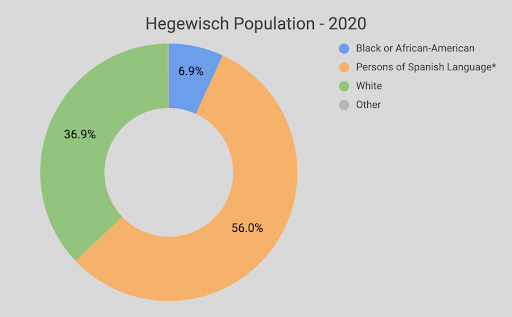
Mexican-American families began arriving in significant numbers in the 1980s as European immigrant families departed for the suburbs, and the transition has been notably smooth by Chicago standards. Greek and Jordanian families also established roots in the neighborhood during this period. Today the population is roughly half Hispanic and half white, with a working-class homeowner character that links it to every generation of Hegewisch residents going back to the Polish and German steelworkers who first settled the bungalows.
Pudgy's pizza, Doreen's, and Steve's Lounge fish fry anchor the neighborhood's culinary identity. The Southeast Chicago Historical Society keeps the labor history and the Memorial Day Massacre specifically alive for anyone who wants to understand what happened on that prairie. The Hegewisch Times, a quarterly community newspaper, has been chronicling the neighborhood's life for years.
Hegewisch is easy to miss. It does not appear on most mental maps of Chicago, and getting there from the Loop requires either the South Shore Line (the only commuter line in the Chicagoland area not part of Metra) or a long drive on the Bishop Ford Freeway. Locals have always understood this, and have always found it more feature than bug. The neighborhood that Adolph Hegewisch tried to build as an industrial utopia became something more modest and more durable: a small town at the edge of a great city, shaped by steel and loss and the stubborn insistence of people who decided to stay.
Trivia Answer
On Memorial Day, May 30, 1937, Chicago police opened fire on peaceful striking steelworkers and their families as they marched across a prairie toward the Republic Steel plant near Hegewisch. Ten people were killed four that afternoon, six more in the days that followed and nearly a hundred others were wounded. The event became known as the Memorial Day Massacre. A newsreel crew from Paramount Pictures filmed the entire episode but refused to release the footage, fearing it would cause mass unrest. The film was suppressed by Paramount and ignored by major newspapers, which largely published accounts favorable to the police. The footage was eventually forced into the open by U.S. Senator Robert La Follette, whose Senate subcommittee investigating violations of workers' civil rights subpoenaed the film. When screened, the newsreel made clear that police had fired on an unarmed, retreating crowd without provocation. No officers were ever prosecuted. The massacre became a pivotal moment in American labor history, and the ten men who died are still honored at a sculpture on Avenue O in Hegewisch every Memorial Day.
Stay connected with news and updates!
Join our mailing list to receive the latest news and updates from our team.
Don't worry, your information will not be shared.
We hate SPAM. We will never sell your information, for any reason.
