
Gage Park: Neighborhood Built Around a Park and Remade by Migration
Feb 18, 2026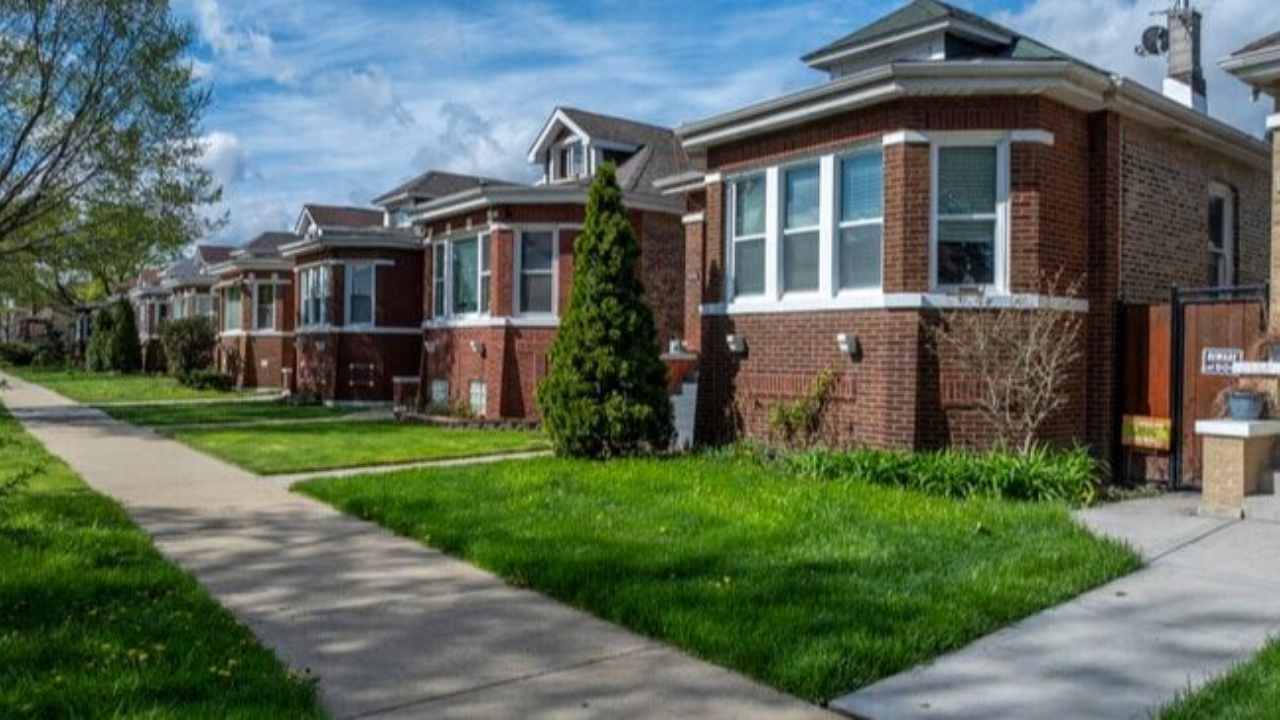
On Chicago’s Southwest Side, Gage Park stands as a neighborhood shaped by open green space, working class roots, and waves of migration that continue to define it today. Located roughly eight miles southwest of the Loop, Gage Park is one of the city’s 77 officially designated community areas and has long served as a gateway for families seeking opportunity, stability, and community.
The neighborhood is bounded by 55th Street to the north, 67th Street to the south, Western Avenue to the east, and Central Park Avenue to the west. Within these boundaries, residential blocks radiate outward from the park that gives the area its name.
Trivia Question
Which early twentieth century transportation development helped fuel the rapid construction of Chicago bungalows in Gage Park by making homeownership feasible for working class families commuting to industrial jobs?
Gage Park by the Numbers
Early Land and Settlement
Before it became part of Chicago, the land that would become Gage Park was open prairie used for farming. In the mid-nineteenth century, settlers established small farms that supplied food to the growing city. The area remained sparsely populated for decades, largely because it lay beyond the dense industrial corridors that fueled rapid development elsewhere on the South Side.
That began to change in the late 1800s, when improved transportation routes and Chicago’s westward expansion made the land more attractive for residential development.
The Park That Shaped the Neighborhood
Gage Park takes its name from the public park at its center. The land was acquired by the South Park Commission in the 1870s and named for George W. Gage, a former Chicago mayor who served from 1899 to 1903 and was an advocate of park expansion.
The park became the organizing feature of the neighborhood. Unlike areas that grew around factories or rail yards, Gage Park developed around open green space. Tree lined residential streets were laid out in a grid pattern, and housing construction accelerated in the early twentieth century.
The presence of a substantial public park gave the area a suburban feel while still remaining firmly within city limits.
Annexation and Residential Growth
Gage Park was annexed into Chicago in stages during the late nineteenth century as the city expanded its borders. By the early 1900s, developers began constructing brick bungalows, two flats, and single family homes designed for working class families.
The neighborhood experienced its most intense growth between 1910 and 1930. Many residents were European immigrants and the children of immigrants, particularly Irish, Polish, and Lithuanian families who worked in nearby industrial corridors or at the Union Stock Yards to the east.
The architecture from this period remains one of Gage Park’s defining features. Solid brick homes with raised basements and modest front lawns line much of the neighborhood today.
Mid-Century Stability and Change
For much of the mid-twentieth century, Gage Park was considered a stable, predominantly white ethnic neighborhood. Parish churches, local schools, and small commercial corridors along streets like 55th and 63rd served as anchors of daily life.
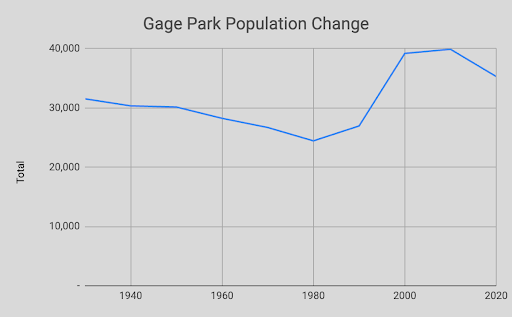
Beginning in the late twentieth century, demographic changes reshaped the community. As many white families moved to the suburbs, Latino families, particularly Mexican immigrants and Mexican American residents, began moving into the neighborhood in significant numbers.
By the early 2000s, Gage Park had become one of Chicago’s most vibrant Latino communities. Spanish language businesses, cultural organizations, and family-owned restaurants became prominent along its commercial strips.
Commercial Corridors and Community Institutions
Unlike neighborhoods built around a single major retail district, Gage Park developed several smaller commercial corridors along major east west streets. These corridors provide grocery stores, bakeries, restaurants, and service businesses that reflect the neighborhood’s evolving demographics.
Community institutions have played a major role in maintaining neighborhood cohesion. Schools, churches, and local nonprofit organizations provide social services, youth programming, and immigration assistance.
Gage Park itself remains a central gathering place, offering sports fields, a fieldhouse, and community events throughout the year.
Housing and Urban Form
Gage Park is often associated with Chicago’s classic bungalow belt. The majority of homes were built in the early twentieth century and remain owner occupied. The consistency of the housing stock gives the neighborhood a strong visual identity.
The residential grid is largely uninterrupted by heavy industry, which differentiates Gage Park from many South Side neighborhoods that grew around factories. This has contributed to its long term residential stability. Like many working class neighborhoods, Gage Park has faced economic pressures, including housing foreclosures during the Great Recession and concerns related to public safety. Yet it has also demonstrated resilience through high rates of home ownership, strong block clubs, and active community groups.
In recent years, local leaders have focused on economic development, youth programs, and preserving affordable housing to ensure that longtime residents can remain in the neighborhood.
Gage Park Today
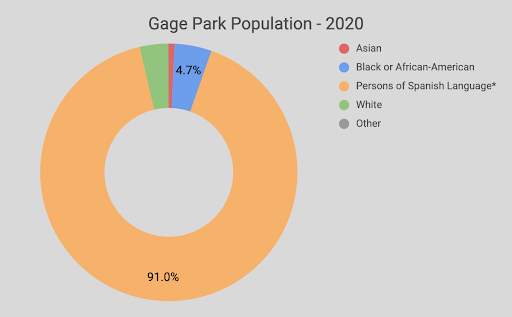
Today, Gage Park is predominantly Latino and continues to serve as an entry point for immigrant families building new lives in Chicago. Its streets reflect a blend of early twentieth century architecture and contemporary cultural identity.
The neighborhood’s story is one of adaptation. What began as farmland became a bungalow community centered on a public park. That community then transformed through migration while retaining its residential core.
Gage Park stands as a reminder that Chicago’s neighborhoods are constantly evolving, shaped by those who arrive and invest in their future.
Trivia Answer
The expansion of electric streetcar lines and improved rail transit in the early 1900s.
Stay connected with news and updates!
Join our mailing list to receive the latest news and updates from our team.
Don't worry, your information will not be shared.
We hate SPAM. We will never sell your information, for any reason.
