
Forest Glen: The Neighborhood the City Grew Up Around
Jul 22, 2026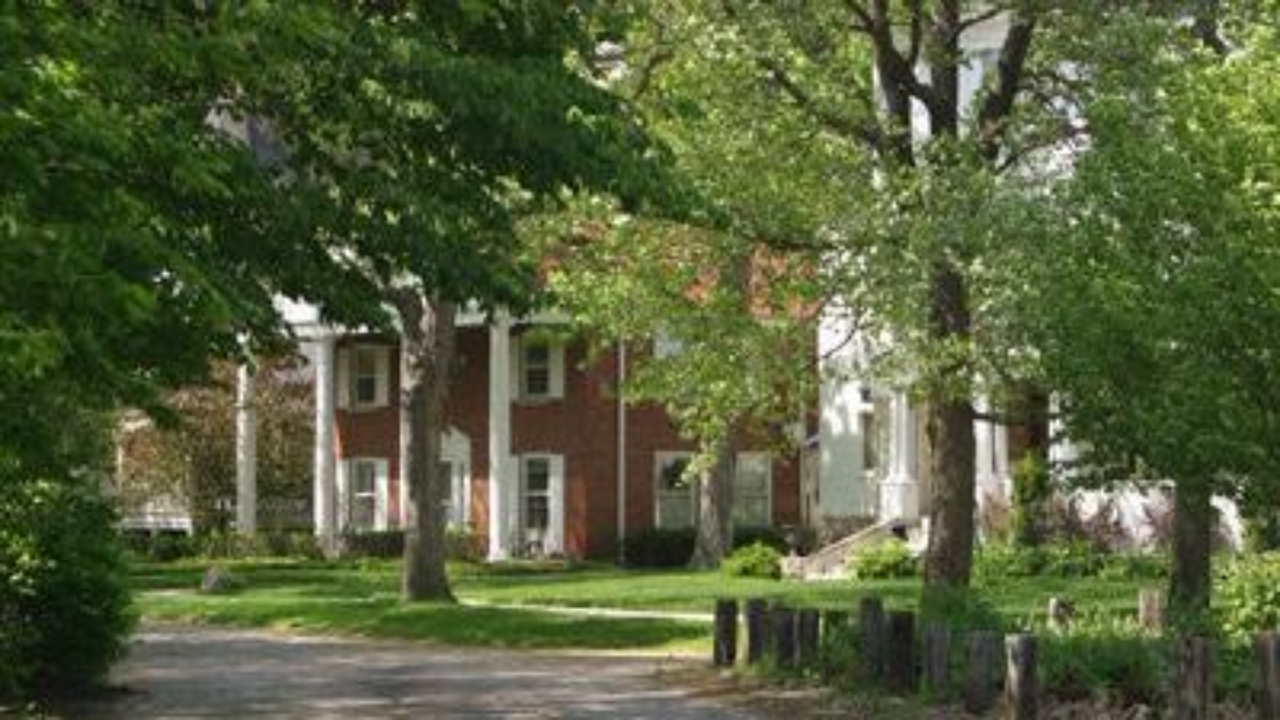
Forest Glen occupies Chicago's far Northwest Side, roughly eleven miles from the Loop, and feels like a place that has successfully resisted the full force of urban density without ever leaving the city. It is bounded by the North Branch of the Chicago River to the north, Foster Avenue to the south, Cicero Avenue to the east, and the Metra Milwaukee District North Line tracks to the west. Within those boundaries lie six distinct sub-neighborhoods: Forest Glen, Edgebrook, North Edgebrook, Old Edgebrook, Wildwood, and Sauganash, each with its own character, its own architectural identity, and its own relationship to the forest preserves and river corridors that define this corner of the city. The Encyclopedia of Chicago calls Forest Glen perhaps the most stereotypically suburban of Chicago's community areas. That description is meant neutrally. The neighborhood accepts it as a compliment.
Trivia Question
The Sauganash neighborhood in Forest Glen takes its name from one of the most remarkable figures in early Chicago history: a man of mixed Mohawk and Irish heritage born near Fort Niagara in 1780, who served as secretary to the Shawnee leader Tecumseh and was later appointed chief of three Chicago-area tribes so that he could negotiate what became one of the largest single land cessions in American history. He was so well known in early Chicago that the city's first hotel was named after him. The U.S. government granted him 1,600 acres of land along the North Branch of the Chicago River, and that land is now the neighborhood that carries his name. Who was he?
Forest Glen by the Numbers
Ancient Ground: The North Branch and Caldwell's Reserve
The land that became Forest Glen was shaped by water and by the people who followed it. The North Branch of the Chicago River runs along the community area's northern edge, and the corridors on either side of it served for centuries as travel routes for the Potawatomi, Odawa, and Ojibwe peoples who inhabited the Great Lakes region. Forests of oak and elm covered the ridges above the river. Wetlands and prairie filled the lowlands between. It was, by every account, a particularly rich and sheltered landscape.
The most consequential early figure in the neighborhood's history arrived in the first decades of the nineteenth century. He was a man of extraordinary background, the son of a Scots-Irish officer in the British army and a Mohawk woman, born near Fort Niagara in 1780. Multilingual, commercially shrewd, and personally trusted by both American officials and tribal leaders, he had served as secretary to Tecumseh during the War of 1812 and navigated the fur trade across two countries before settling in the Chicago region. By 1830, the Potawatomi, Ottawa, and Ojibwe peoples, knowing that the American government intended to force them off their lands and wanting the most effective possible negotiator in their corner, appointed him chief of all three tribes.
His role in the treaty history of early Chicago is woven directly into the landscape of Forest Glen. In recognition of his services to the United States government, he was granted 1,600 acres of land along the North Branch of the Chicago River, a tract that stretched across what is now the Sauganash neighborhood and surrounding areas. That grant, known as Caldwell's Reserve, became the foundation on which one of Forest Glen's most distinctive sub-neighborhoods was eventually built. The man himself died of cholera in 1841 while traveling west with the Potawatomi people whose removal from Illinois he had ultimately been unable to prevent. A bronze plaque still marks the site of the Old Treaty Elm at the corner of Kilbourn and Rogers Avenues in Sauganash, where a frontier trail marker stood until 1934 on the boundary of his former reserve.
Captain Hazelton, the Homestead, and the Making of a Settlement
Permanent European-American settlement in Forest Glen began in earnest after the Civil War. Captain N. J. Hazelton, a Union Army veteran, arrived in 1866 and staked a claim to a substantial tract of wooded land along the North Branch of the Chicago River. He built a home, farmed the land, and held the property for decades. In 1906, the federal government reclaimed a portion of Hazelton's holdings as part of a conservation program, and those acres became the foundation of the Forest Glen. Hazelton's house still stands in Forest Glen, one of the neighborhood's oldest surviving structures.
Other early settlers followed similar patterns: buying land along the river, clearing portions for farming, and maintaining the surrounding forest as a resource rather than an obstacle. The settlement was annexed into Chicago in 1889 along with the rest of Jefferson Township, but annexation brought little immediate change. Roads were dirt. Rail service was limited. The character of the area remained that of a rural outpost at the city's expanding edge.
Old Edgebrook: 48 Homes in the Woods
The most architecturally distinctive corner of Forest Glen is Old Edgebrook, a tiny historic district of 48 homes tucked between Central and Devon Avenues and the Edgebrook Golf Course, surrounded on all sides by Cook County Forest Preserve land. The neighborhood was platted in 1894 by Alderman and businessman Arthur Dixon in collaboration with executives of the Chicago, Milwaukee, and St. Paul Railway Company, and its original residents were exactly who that partnership suggests: railway officials who wanted to live in a wooded retreat within commuting distance of their downtown offices.
Old Edgebrook was designated a Chicago Landmark in 1988, and the city's landmark description captures its quality precisely: surrounded by the Cook County Forest Preserve, Old Edgebrook's rural ambiance makes it atypical for a neighborhood located in a major metropolitan area. There are exactly two streets leading into and out of the enclave, Prescott and Louise, both of which run through a block of woods before reaching Central Avenue. The sidewalks in Old Edgebrook are dirt, not concrete. The streets curve around the existing trees rather than requiring the trees to give way to the street. The homes represent nearly every residential architectural style popular from the 1890s through the 1940s: Victorian, Queen Anne, Colonial Revival, Prairie School, and several that defy easy categorization, including a castle-like mansion from the 1920s that anchors one of the wooded corners with considerable authority.
With only 48 homes, Old Edgebrook turns over property rarely and slowly. When a house becomes available, it tends to sell quickly, and buyers come from across the city and the suburbs. The combination of landmark status, forest preserve surroundings, Metra commuter rail access a short walk away, and an almost impossible-to-replicate nineteenth-century railroad suburb ambiance have made Old Edgebrook one of the most coveted small residential districts in Chicago. Most Chicagoans have no idea it exists.
Wildwood and the Curb-Less Streets
North of Old Edgebrook, the Wildwood neighborhood occupies the strip of Forest Glen between Devon and Touhy Avenues. Wildwood shares some of Old Edgebrook's wooded character but has a more suburban residential scale, with single-family homes on generous lots and, most notably, streets without curbs. The absence of curbs in Wildwood is not an oversight or a sign of deferred maintenance. It is a deliberate preservation of an older residential aesthetic in which the edge between street and yard was defined by grass rather than concrete. Combined with the canopy of mature trees covering most of the blocks, it gives Wildwood a distinctly rural quality for a neighborhood that is, technically, inside the city of Chicago.
Satellite imagery of Wildwood compared to surrounding areas makes the point visually. The tree coverage is remarkable, dense enough to obscure rooflines from above. Community efforts to protect the neighborhood's tree canopy have been ongoing since the 1970s, when Dutch Elm disease threatened the elm population and residents organized to replace lost trees with a diverse mix of species that no single disease could eliminate entirely.
Sauganash: Judges, Lawyers, and a Neighborhood That Holds Its Own
Sauganash is the largest and most residentially dense of Forest Glen's sub-neighborhoods, and it carries a particular reputation in Chicago civic culture. The Encyclopedia of Chicago notes that many city administrators, upper-echelon police and fire officials, lawyers, judges, and politicians live in Forest Glen, and Sauganash is where that profile is most concentrated. Judges and prosecutors from the Cook County courts, senior officers of the Chicago Police Department, and attorneys who practice in the Daley Center and federal courthouse have all been drawn to Sauganash's combination of large lots, strong schools, relative quiet, and easy access to the Kennedy Expressway and the Metra.
The Sauganash Historic District, a recognized Chicago landmark area, preserves the character of the original Koester and Zander subdivision with its large lots, mature trees, and architecturally varied housing stock ranging from Tudor cottages to brick colonials to Prairie-influenced designs. The streets are named, with deliberate historical nods, after figures and places connected to the area's Native American and early settler history. Sauganash Avenue, Caldwell Avenue, and others reflect the real estate firm's effort to give the subdivision a sense of historical depth that turned out, ironically, to be more accurate than the Treaty Elm plaque they also installed.
The Forest Preserves as the Defining Feature
What distinguishes Forest Glen from every other Chicago community area is not its architecture or its demographics but its relationship to the Cook County Forest Preserves. More than any other city neighborhood, Forest Glen is physically shaped by protected natural land on its borders and woven through its interior. The Billy Caldwell Golf Course, Caldwell Woods, LaBagh Woods, Indian Boundary Woods, and Forest Glen Woods form a nearly continuous corridor of protected land along the North Branch of the Chicago River. The North Branch Trail, a paved multiuse path accessible from within the neighborhood, runs north through the forest preserves toward the northern suburbs and is used by residents for cycling, running, and walking year-round.
The forest preserves also serve as a buffer between Forest Glen and the commercial and industrial corridors to the east and south. Driving north on Cicero Avenue and turning west into Forest Glen is a disorienting experience the first time: the transition from the commercial density of the arterial street to the tree-canopied quiet of the neighborhood interior takes less than a block. The city is still there. It just becomes inaudible.
Forest Glen Today
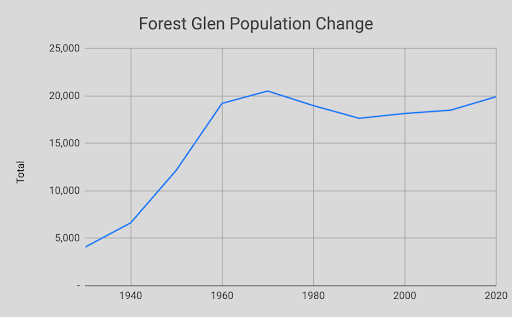
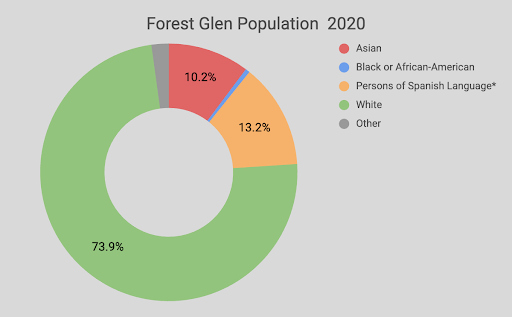
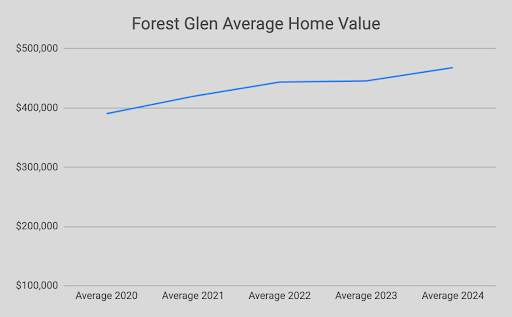
Forest Glen today is one of Chicago's most economically stable community areas, with a median household income over $100,000, a homeownership rate well above the city average, and an educational attainment level placing it among the most highly educated neighborhoods in Chicago, with more than 58 percent of residents holding a bachelor's degree or higher. The population is roughly 73 percent white, 10 percent Asian, and 12 percent Hispanic, with a demographic profile that has remained relatively stable over the past decade.
The Edgebrook Metra station at Devon, Lehigh, and Caldwell Avenues serves commuters on the Milwaukee District North Line to Union Station. The Edgebrook branch of the Chicago Public Library anchors the neighborhood's commercial center on Devon Avenue alongside local restaurants and small businesses that serve the community rather than drawing visitors from across the city.
Forest Glen remains a neighborhood easy to overlook from outside and difficult to leave from within. The 48 homeowners of Old Edgebrook, the judges and prosecutors of Sauganash, the families walking curb-less Wildwood streets under a canopy of deliberately varied tree species all share a community that has kept its character through a century of Chicago's expansions, expressways, and demographic shifts. The North Branch still runs through the forest preserves at the neighborhood's edge. The trees that Captain Hazelton's conservation-minded successors protected are still standing. The plaque at Kilbourn and Rogers, the one the real estate developers almost certainly invented, still tells the story of the Old Treaty Elm to anyone who stops to read it. Forest Glen holds on to its history, real and constructed alike, with the quiet conviction of a neighborhood that has never been in a hurry.
Trivia Answer
The figure is Billy Caldwell, known by his Potawatomi-given nickname Sauganash, meaning roughly "English-speaking" in the Potawatomi language. Born near Fort Niagara in 1780 to a Mohawk mother and a Scots-Irish British army officer, Caldwell became a fur trader, fought alongside Tecumseh during the War of 1812, and eventually settled in the Chicago region. Fluent in Potawatomi, Odawa, Ojibwe, English, and French, he was appointed chief of the Ottawa, Ojibwe, and Potawatomi peoples so that he could negotiate on their behalf with the American government. In 1833 he helped broker the Treaty of Chicago, which ceded more than five million acres of tribal land in Illinois and Wisconsin to the United States, effectively completing the removal of Native peoples from the Chicago region. As recognition of his services, the government granted Caldwell 1,600 acres along the North Branch of the Chicago River, a tract known as Caldwell's Reserve that now encompasses the Sauganash neighborhood. Chicago's first hotel, built by innkeeper Mark Beaubien, was named the Sauganash in his honor. Caldwell died of cholera in 1841 while traveling west with the Potawatomi people to their Kansas reservation, the removal he had been unable to prevent.
Stay connected with news and updates!
Join our mailing list to receive the latest news and updates from our team.
Don't worry, your information will not be shared.
We hate SPAM. We will never sell your information, for any reason.
