Edison Park: Chicago's Furthest Corner and Its Most Village-Like Neighborhood
Jun 18, 2026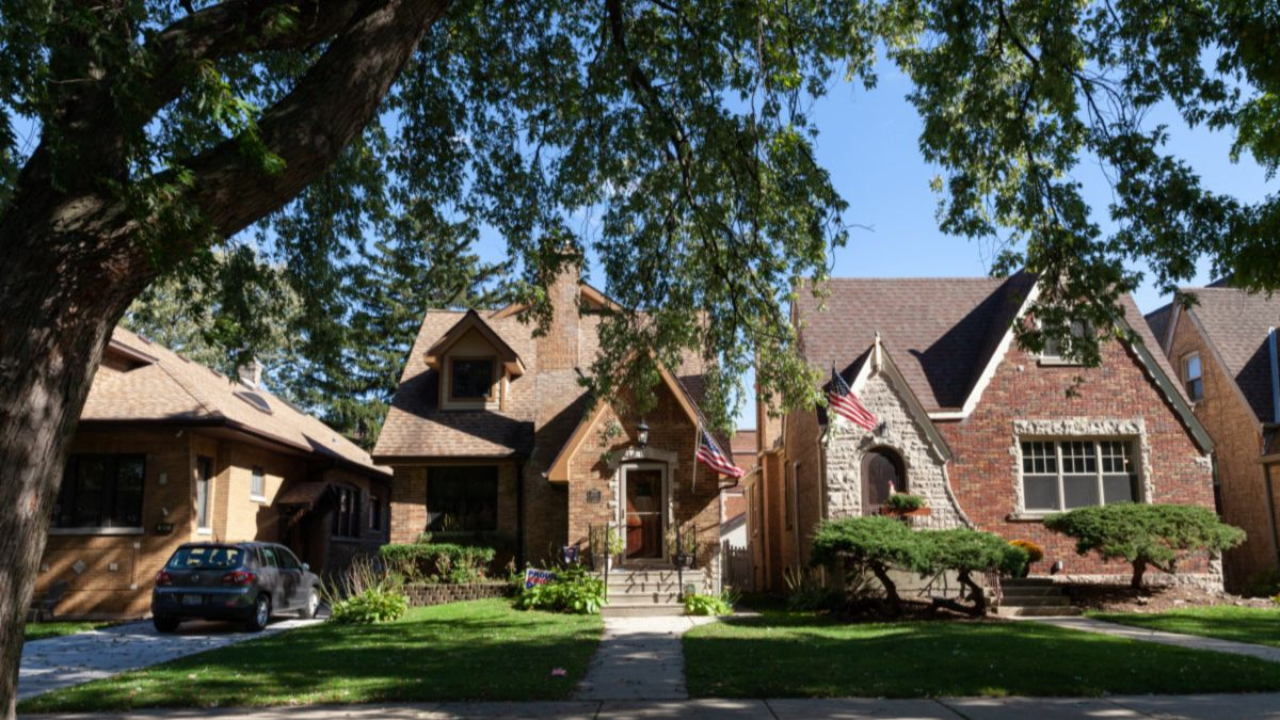
Edison Park sits at Chicago's far northwestern tip, about fifteen miles from the Loop and pressed between the suburbs of Park Ridge to the west and Niles to the east. It is bounded by Devon Avenue to the south, the city limits to the north, Cumberland Avenue to the east, and the Des Plaines River corridor to the west. At just 1.17 square miles, it is one of the smallest community areas in the city. Residents of the neighborhood are fond of saying that when they make the trip downtown, they are going to the city, which is as precise a description of Edison Park's relationship to Chicago as any census tract could provide.
Trivia Question
Every residential street in Edison Park that runs north to south begins with the letter O. Oliphant, Oleander, Ottawa, Oriole, Oketo, Oshkosh, Oconto, Osceola, Olmsted, Onarga and others follow one after another through the neighborhood's compact grid. This is not a coincidence or a developer's quirk. There is a precise mathematical reason why the O streets land exactly where they do in Chicago's far northwest corner. What is it?
Edison Park by the Numbers
Portage, Prairie, and the First Settlers
Long before Edison Park had a name or a railroad stop, the land it occupies served a practical geographic purpose. Situated on a low glacial ridge between the Des Plaines River watershed to the west and the North Branch of the Chicago River to the east, the area was a natural portage crossing for Native American travelers and later for French voyageurs who needed to move their canoes between two river systems. Portage Park to the south is better remembered for this function, but Edison Park sat along the same overland corridor and served the same purpose for generations of travelers moving between the Great Lakes drainage and the Mississippi basin.
The Potawatomi occupied the area until the forced removal that followed the Treaty of Chicago in 1833. European American settlement arrived slowly, beginning in 1834 with John and Katherine Ebinger and their son Christian, who homesteaded on the Des Plaines River's eastern bank. Christian Ebinger married and farmed the land for decades, becoming prominent enough in the local community that the public elementary school eventually built in the neighborhood carried his name. The Ebingers were among a small cluster of German farming families who worked the prairie through the middle of the nineteenth century, growing crops and watching the railroad slowly approach from the east.
Canfield, Ridgelawn, and a Famous Inventor's Name
The Chicago and North Western Railway laid its tracks through the area in the 1850s, creating a stop that would become the seed of a future community. By the 1870s, the settlement around the depot was beginning to take shape under the name Canfield. It was a modest place, a handful of farmsteads and homes clustered around the rail line, competing for attention with Norwood Park to the southeast and Park Ridge to the west.
In 1881, Canfield was formally incorporated as a village. For most of the following decade it grew slowly, struggling to distinguish itself from better-known neighbors. Then, in 1890, a group of real estate developers made a decision that would define the neighborhood permanently. They had installed six early electric arc lights at key intersections, making Canfield one of the first communities on Chicago's northwest side to offer electric illumination. Seeing an opportunity, they petitioned Thomas Alva Edison, the nation's most famous inventor and the man most associated with electric light, to allow the village to take his name. Edison, who was known to receive such requests with reasonable good humor, gave his blessing. Canfield became Edison Park on May 10, 1890.
It is worth noting, as the Chicago Sun-Times did in its neighborhood profile, that there is some historical ambiguity about exactly how formal that blessing was. Local historian Richard Suerth observed that whether Edison truly gave explicit consent or whether developers simply announced the name with his tacit approval is not entirely clear. The arc lights they installed were also not Edison's incandescent bulbs but an earlier technology from a competing system. None of that has diminished the neighborhood's pride in the connection. A historical marker on Northwest Highway commemorates the renaming and Edison's role in it, and the name has held without challenge for 135 years.
Annexation and the Case of the Missing High School
Edison Park remained an independent village for thirty years after the renaming. It sat just beyond Chicago's city limits, close enough to benefit from the city's gravity but separate enough to govern its own affairs. Two smaller sub-developments, Canfield and Ridgelawn, were consolidated under the Edison Park name, and the village grew modestly through the 1890s and 1900s as its railroad connection drew commuters who wanted suburban quiet but needed downtown employment.
The decision to join Chicago came down to something mundane and consequential in equal measure: the village did not have a high school. Students of appropriate age had to travel by rail to Carl Schurz High School in Jefferson Park or, in earlier years, find their way to whatever secondary school was within reach. In 1910, the same year Schurz opened, Edison Park residents voted to annex into Chicago, accepting the trade of village independence for access to the Chicago Public Schools system. The annexation was completed on November 8, 1910. It brought with it Chicago's street grid, Chicago's municipal services, and Chicago's street-naming conventions, which is where the O streets come from.
First Responders, Irish Catholics, and a Village Within a City
The character of Edison Park through the twentieth century was shaped by the same forces that defined Mount Greenwood, Beverly, and other far-flung Chicago communities: a heavily Irish-Catholic population, a high concentration of police officers, firefighters, and other city workers, and an ethos of homeownership and neighborhood maintenance that has persisted across generations.
Edison Park has one of the highest concentrations of residents with Irish ancestry of any neighborhood in Chicago, with Irish Americans historically comprising more than three-quarters of the population. The community is organized around Catholic parish institutions, most prominently St. Juliana, which opened its parish school in 1928 and has anchored the neighborhood's southwest corner for nearly a century. Multiple Catholic parishes serve the area, each with its own school, and the resulting density of parochial education has given Edison Park educational options that more centrally located Chicago neighborhoods often lack.
The neighborhood also holds one of the highest concentrations of law enforcement and fire department personnel of any Chicago community area. Yard signs supporting the Chicago Police Department are common, union flags and American flags often fly from the same porch, and the block party on Oriole Avenue described by Chicago Magazine in 2023 -- with its cornhole board painted with the Chicago Police Department emblem and its mix of Back the Blue flags and Proud Union Home signs -- captures something real about the neighborhood's political identity. It is a place where working-class civic loyalty and institutional affiliation run together, without much tension between them.
Northwest Highway, Restaurant Row, and a President at a Corner Table
Northwest Highway, which cuts diagonally through the heart of Edison Park from southeast to northwest, is the neighborhood's commercial spine and its social gathering point. The road follows a much older route, a variant of the historic Rand Road that connected early Chicago to its northwestern hinterland, and its diagonal path gives Edison Park an organizing artery that cuts across the otherwise regular grid in a way that feels slightly European.
In the blocks around the Metra station, Northwest Highway has developed into what locals call Restaurant Row. Italian restaurants, Irish pubs, pizza taverns, and neighborhood bars line the corridor in numbers disproportionate to a community of eleven thousand people. The strip draws diners from Park Ridge and Niles as well as from the neighborhood itself, and has held its commercial density through cycles that have hollowed out similar strips elsewhere on the Northwest Side.
One restaurant on that strip earned a footnote in American political history. Zia's Trattoria, at the corner of Northwest Highway and Oliphant Avenue, was the setting for a 2001 episode of the Chicago public television show Check, Please!, in which three guests are invited to review each other's restaurant recommendations. One of the three guests that episode was a young Illinois state senator from the South Side who had recently lost a Democratic primary for a congressional seat and was widely regarded as a politician whose best days were behind him. His name was Barack Obama, and he praised the pasta. Seven years later he was elected President of the United States. Zia's is still there.
Edison Park Today
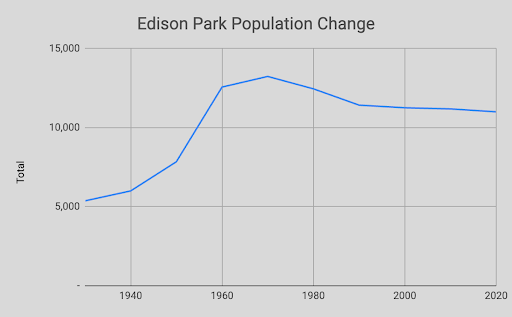
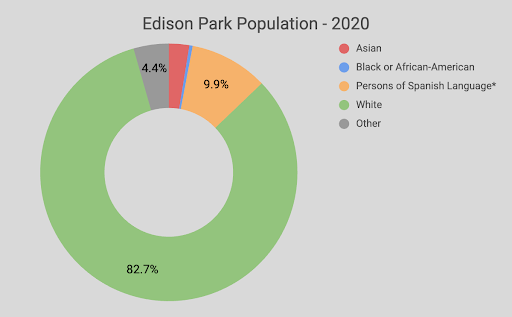
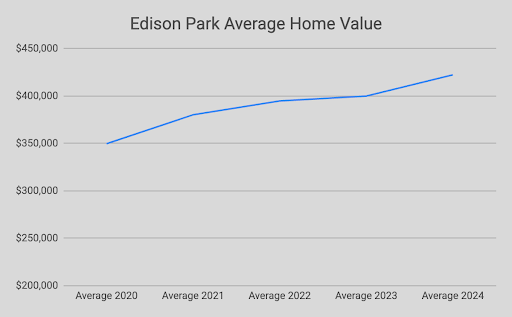
Edison Park today is essentially the neighborhood it was in 1960, which is either its greatest strength or its most notable limitation depending on who you ask. The population is around 11,500, almost entirely white at roughly 81 percent, with a growing Hispanic population approaching 14 percent as Mexican-American families have moved in from Jefferson Park and surrounding areas. Property values have climbed steadily, with median home prices in the $400,000 range and strong demand from buyers seeking a safe, suburban-feeling neighborhood within Chicago city limits.
The Metra Union Pacific Northwest Line stops at Edison Park station, providing service to Ogilvie Transportation Center downtown in roughly thirty minutes. The CTA Blue Line is accessible at O'Hare station a short distance to the south. The Kennedy Expressway is minutes away. For a neighborhood that joined Chicago specifically to access better institutions, the transit and highway access has remained a genuine asset.
The Edison Park fieldhouse, which opened in 1907 as a public school before being leased to the Chicago Park District in 1936, was added to the National Register of Historic Places in 2007. It is one of only a handful of Chicago Park District structures to receive that designation and serves today as a community hub for art classes, children's programming, and the Northwest Society of Model Railroaders, whose electric train displays run regularly in the building. The park around it is small but well-used, a green center to a neighborhood that prides itself on its tidiness.
Edison Park is the neighborhood that convinced Thomas Edison to lend his name to a Chicago suburb because it turned on a few electric lights before its neighbors did. Whether or not he gave his formal blessing, the name stuck, the neighborhood held together, and the O streets remain. Fifteen miles from the Loop, at the end of the grid and the edge of the city, Edison Park has been insisting on its own distinctness since 1890. It has not stopped.
Trivia Answer
Chicago's north-south streets were assigned names alphabetically based on their distance west from the city's eastern boundary near the lakefront. Each letter of the alphabet corresponds to approximately one mile. A streets fall around one mile west of the lakefront, B streets around two miles, and so on. Edison Park sits approximately fifteen miles west of the lakefront. O is the fifteenth letter of the alphabet. So every north-south street in Edison Park begins with O. The pattern was formalized in the early twentieth century as part of the Chicago street-naming and address system, which was designed so that Chicagoans could determine their approximate east-west position in the city from the first letter of any named north-south street. In Edison Park, the system works with unusual elegance because the neighborhood's narrow east-west footprint means almost all of its residential streets fall within the same letter band.
Stay connected with news and updates!
Join our mailing list to receive the latest news and updates from our team.
Don't worry, your information will not be shared.
We hate SPAM. We will never sell your information, for any reason.
