
Dunning: The Neighborhood That Chicago Built on Its Forgotten
Jul 09, 2026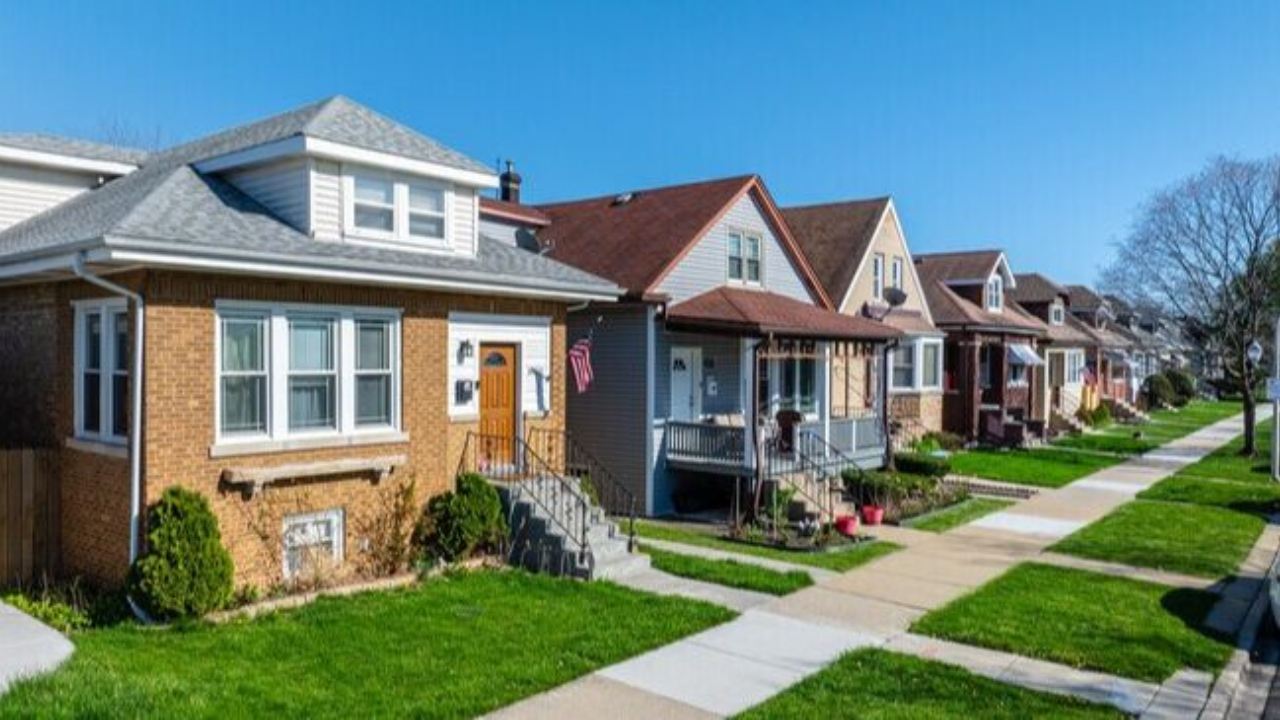
Dunning occupies Chicago's Northwest Side, roughly twelve miles from the Loop and pressing against the suburban border formed by Harwood Heights, Norridge, River Grove, and Elmwood Park. It is bounded by Montrose Avenue to the north, Irving Park Road to the south, Harlem Avenue to the west, and Narragansett Avenue and Oak Park Avenue to the east. It is a neighborhood of bungalows and two-flats, corner taverns and city workers, a community college campus and a cheesecake factory. It is also a neighborhood built, quite literally, on top of one of the largest and most consequential burial grounds in the history of Cook County. Most of the people who live here know something about that history. Most of the people who shop at the mall nearby do not.
Trivia Question
In 1989, construction workers breaking ground on a residential development near Irving Park Road and Narragansett Avenue in Dunning made a discovery that stopped work and rewrote the neighborhood's history. They had accidentally disturbed the long-forgotten remains of thousands of people buried on the grounds of a Cook County institution that operated on this site for more than six decades. Approximately how many people are believed to be buried across the former grounds in Dunning, and who were they?
Dunning by the Numbers
The County's Solution to Its Most Inconvenient Problems
In 1851, the Cook County Board of Commissioners made a decision rooted in a philosophy common to the era: remove the city's most troubled and destitute residents from sight. The board chose a tract of remote prairie on the northwest edge of Jefferson Township, approximately nine miles from downtown, and designated it the site of a new County Poorhouse. The distance was a feature, not a flaw. Getting the indigent, the mentally ill, and the chronically sick far from the city's respectable commercial center was understood to be both humanitarian and practical. The pastoral setting, proponents argued, would calm disturbed minds. The reality turned out to be considerably grimmer.
The Cook County Poor Farm opened in 1854 on a 320-acre site bounded roughly by today's Montrose, Harlem, and Irving Park Road corridor. It began as an almshouse, a working farm where those without means could grow food and shelter themselves in exchange for labor. Then, in 1870, the county built a separate Cook County Insane Asylum on the grounds, and the institution's character changed permanently. The asylum was chronically overcrowded from nearly its first year of operation. A space designed for 500 patients routinely held 1,000. Attendants were underpaid and undertrained. Patients were confined, restrained, and in documented cases beaten. There was little treatment in any meaningful sense.
In 1889, Cook County Judge Richard Prendergast toured the facility and described it in court as a tomb for the living. He documented patients squeezed into rooms built for half as many, fighting breaking out at night among men who had no other outlet, and an administration more interested in managing a facility than caring for its residents. That same year, two attendants were charged with murdering a patient named Robert Burns, having kicked him and inflicted a head wound. The defense argued, with apparent sincerity, that the blows were a beneficial stimulus for the insane man. The jury acquitted both attendants, assigning blame to the conditions rather than the individuals.
Parents on the Northwest Side told their children for decades that if they misbehaved, they would be sent to Dunning. The name of the neighborhood and the name of the asylum became interchangeable in the city's imagination, both words carrying the same freight of dread. When people in early twentieth-century Chicago said someone had gone to Dunning, they meant they had been committed to the asylum. The stigma was real, and it shaped the neighborhood around the institution for generations.
The Crazy Train and a Depot Gets a Name
For its first three decades, the Poor Farm complex was nearly inaccessible. Patients had to be transported by horse-drawn conveyance over unpaved roads, a journey that was slow, uncomfortable, and complicated by Chicago's brutal winters. In 1882, the Cook County Commissioners solved the problem by building a three-mile spur rail line connecting the Milwaukee and St. Paul Railway to the facility directly. The line ran between Mount Olive Cemetery and Zion Gardens Cemetery to the hospital grounds, delivering patients, staff, supplies, and medicines on a regular schedule.
The rail car that made the run became known, with the blunt humor that working Chicagoans applied to uncomfortable realities, as the Crazy Train. From 1918 to 1939, a single specially built 60,000-pound interurban car made the journey, fitted with sleeping berths, leather reclining chairs, and separate compartments for male and female patients. For many of those who rode it, the trip to Dunning was their last journey in the outside world. They would spend the remainder of their lives on the grounds.
The county built a depot at the hospital's rail stop and named it Dunning, in honor of Andrew Dunning, a settler who had purchased 120 acres just south of the Poor Farm after the Civil War and attempted to establish a nursery and residential village on the property. Dunning's plan never quite materialized. Proximity to the asylum kept buyers away. But the depot took his name, and the settlement that slowly grew up around the tracks also became known as Dunning. The neighborhood inherited its identity, for better and worse, from the institution at its center.
A Potter's Field and the Forgotten Thousands
From its earliest years, the Cook County Poor Farm served a secondary function that its administrators rarely advertised: it was a burial ground for anyone in Cook County who died without the means or the family to pay for a private plot. Bodies arrived from the city hospital, from the county jail, from the streets. Orphans and infants were buried here. Adults whose identities were unknown were buried here. Patients who died on the asylum grounds were buried here. The resulting cemetery, known officially as the Cook County Cemetery and informally as the potter's field, grew for decades without systematic record-keeping and without marked graves.
One of the more notorious figures buried in the Dunning potter's field was Johann Hoch, a serial bigamist believed to have married as many as thirty women and murdered at least ten of them before his arrest and execution in 1906. After Hoch was hanged at Cook County Jail, no private cemetery would accept his body. The county buried him anonymously somewhere on the grounds near Irving Park Road and Narragansett Avenue, his exact location unrecorded and unknown.
In the 1930s, Cook County extended Oak Park Avenue directly through the cemetery grounds without surveying for burials. Construction workers encountered remains but work continued. The cemetery went largely unmapped and unflagged, forgotten beneath streets and later beneath the parking lots and footprints of institutions that would rise on the same land in the postwar decades. Wilbur Wright College, which opened its current campus on Narragansett in the 1970s, sits above a portion of the old burial grounds. A strip mall on Irving Park Road was built on cemetery land. A condominium development broke ground in 1989 directly into unmarked graves, the excavation that finally forced a public reckoning.
Discovery, Reckoning, and a Memorial Park
When the construction crews' equipment struck caskets in 1989, researchers and local historians began piecing together the scale of what lay beneath the neighborhood. The Cook County potter's field had received burials from the 1850s through the 1920s, and estimates of the total number of people interred there range from 38,000 to more than 50,000, the bulk of them in graves that were never individually marked. Cook County's record-keeping for the poorest of its dead had been, charitably put, minimal.
In 2002, after more than a decade of advocacy by local historians, community organizations, and descendants of the buried, the Read Dunning Memorial Park was established on a three-acre site at Belle Plaine Avenue and Neenah Avenue. The park features eight stone markers arranged in a circle around a central 1884 dedication stone, each marker honoring a different category of those buried on the grounds: asylum patients, poorhouse residents, Civil War veterans, unidentified victims of the 1871 Chicago Fire, orphaned infants, unknown itinerant poor, and others. The markers are small. The park is quiet. The number of people it represents is staggering.
Road improvement work on Oak Park Avenue in the mid-2010s unearthed additional remains, and the construction of a new school on Oak Park Avenue in 2018 required careful archaeological monitoring. The burials are not fully mapped and never will be. Workers on construction projects in and around the former cemetery footprint still occasionally encounter what they find beneath the fill. The neighborhood lives alongside this history whether or not it discusses it.
From Asylum to Bungalows: How Dunning Became a Neighborhood
The institutional character of the Dunning grounds began to change in the early twentieth century. The poorhouse residents were transferred to a new facility in Oak Forest in 1910. In 1912, the state of Illinois took over the asylum from the county, renaming it Chicago State Hospital. A catastrophic fire on December 26, 1923, killed fifteen patients and destroyed two wings of the hospital building, the tragedy framed in press coverage as the result of conditions already known to be dangerous. The hospital continued operating, rebuilt and expanded, under state management through the mid-twentieth century.
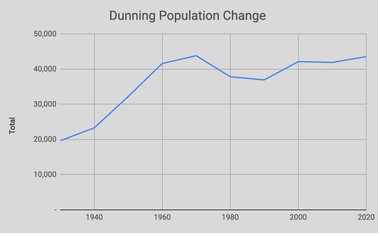
As the institution's footprint consolidated on the western portion of the original grounds, the land to the east opened for residential development. Swedish, German, and Polish immigrant families moved into the area in the 1920s and 1930s, drawn by affordable land, improving road access along Irving Park Road, and the extension of streetcar service. Wilbur Wright Junior College opened in the neighborhood in 1934, adding an educational anchor that gave the area a different kind of institutional identity. The population grew from around 1,300 in 1909 to more than 4,000 by the 1920s, and continued to climb through the postwar bungalow boom.
In 1970, Chicago State Hospital closed and merged its operations with the newly built Chicago-Read Mental Health Center, a modern state-run facility that still occupies the western portion of the original grounds along Oak Park Avenue. The transition from a nineteenth-century asylum to a twenty-first-century community mental health facility was long and imperfect, but it represents a genuine shift in how the city approaches care for residents in psychiatric crisis. The campus also contains the Dunning-Read Conservation Area, a remnant of the original natural landscape that community volunteers have maintained for decades and that the Chicago Park District is now helping to preserve.
Eli's Cheesecake and the Art of Reinvention
Among the more improbable facts about Dunning is that it is home to Eli's Cheesecake World, the 62,000-square-foot bakery and cafe at 6701 West Forest Preserve Drive that has been producing what many Chicagoans consider the definitive Chicago dessert since 1996. The company traces its origins to Eli Schulman, a West Side-born restaurateur who spent years experimenting in the kitchen of his Gold Coast steakhouse, Eli's The Place for Steak, before settling on a recipe in the late 1970s: cream cheese, sour cream, eggs, sugar, and vanilla baked hot and fast without a water bath on a shortbread cookie crust rather than the standard graham cracker base, producing a golden-brown caramelized exterior over a rich, creamy interior.
The style became known as Chicago-style cheesecake, a deliberate contrast to New York-style. When Eli's debuted the cheesecake at the first Taste of Chicago in 1980, the response was immediate enough to convince the family to spin it off as its own company. Frank Sinatra was a devoted customer at the steakhouse and gave Eli Schulman a Cartier watch as a thank-you; Marc Schulman, Eli's son and the company's current steward, wears that watch every day. Presidential inaugurations from Bill Clinton through Barack Obama have featured Eli's cheesecakes, including a 2,000-pound cake for Clinton's first ceremony in 1993. The bakery today produces the cakes in more than 200 flavors and ships them across the country from the facility in Dunning, a neighborhood whose most prominent historical association was once a place of misery and neglect.
The distance between what Dunning was in 1889 and what it contains in 2025 is considerable. The two things coexist without canceling each other out. The memorial park sits three miles from the cheesecake factory. Both are part of the same neighborhood.
Dunning Today
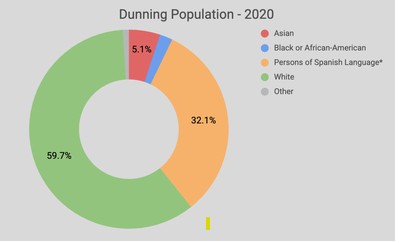
Dunning today is a stable, working-class Northwest Side neighborhood with a population around 42,000, heavily concentrated in single-family bungalows and modest two-flats that have been well-maintained across generations. The community is predominantly white at roughly 68 percent, with a growing Polish-American community concentrated in the Big Oaks section near Harlem Avenue and a Hispanic population of about 24 percent. City workers, police officers, and firefighters make up a significant share of residents, maintaining the same civic employee character that has defined the neighborhood since its mid-century bungalow buildout.
Wilbur Wright College, now part of the City Colleges of Chicago system, anchors the community's eastern section with a campus notable for its striking Bertrand Goldberg-designed pyramid structure, a soaring concrete form from the architect best known for Marina City. The college runs workforce training, GED programs, and transfer pathways that serve the surrounding community and include a longstanding partnership with Eli's Cheesecake, which has provided employment and on-site education programs to its workers through Wilbur Wright since the early 1990s.
The Illinois Veterans Home on Oak Park Avenue, a state-run care facility that broke ground in 2014 and finally received its first residents in early 2022 after years of delays, gives Dunning a new institutional identity to sit alongside the old one. The facility serves veterans from across Illinois in a building designed with a campus feel rather than a clinical one, another quiet indicator of how ideas about care and institutional responsibility have shifted since Cook County first opened the Poor Farm on the remote northwest prairie in 1854.
The bungalows are full. The cheesecakes are baking. Three acres of memorial park mark a burial ground that stretches in every direction beneath the surrounding blocks. Dunning has always held more than it shows.
Trivia Answer
When construction workers broke ground near Irving Park Road and Narragansett Avenue in 1989, they disturbed the Cook County Potter's Field, the burial ground associated with the Cook County Poor Farm and Insane Asylum that operated on the Dunning grounds from 1854 through the early twentieth century. Approximately 38,000 to more than 50,000 people are believed to be buried across the former cemetery, though no comprehensive map of the graves was ever made and the precise number cannot be determined. Those buried included asylum patients and poorhouse residents who died in county care, unknown and unclaimed dead from across Cook County, victims of the 1871 Chicago Fire whose identities were never established, orphaned infants, Civil War veterans, and individuals like serial killer Johann Hoch whose remains were refused by private cemeteries after his execution. A portion of the cemetery lies beneath Wilbur Wright College, a strip mall on Irving Park Road, and former residential construction sites. The Read Dunning Memorial Park, established in 2002 on a three-acre site at Belle Plaine and Neenah Avenues, honors the memory of those buried there. Additional remains have been discovered during road and construction work as recently as 2018.
Stay connected with news and updates!
Join our mailing list to receive the latest news and updates from our team.
Don't worry, your information will not be shared.
We hate SPAM. We will never sell your information, for any reason.
