
Clearing: The Southwest Side Neighborhood That Helped Win a War
Mar 11, 2026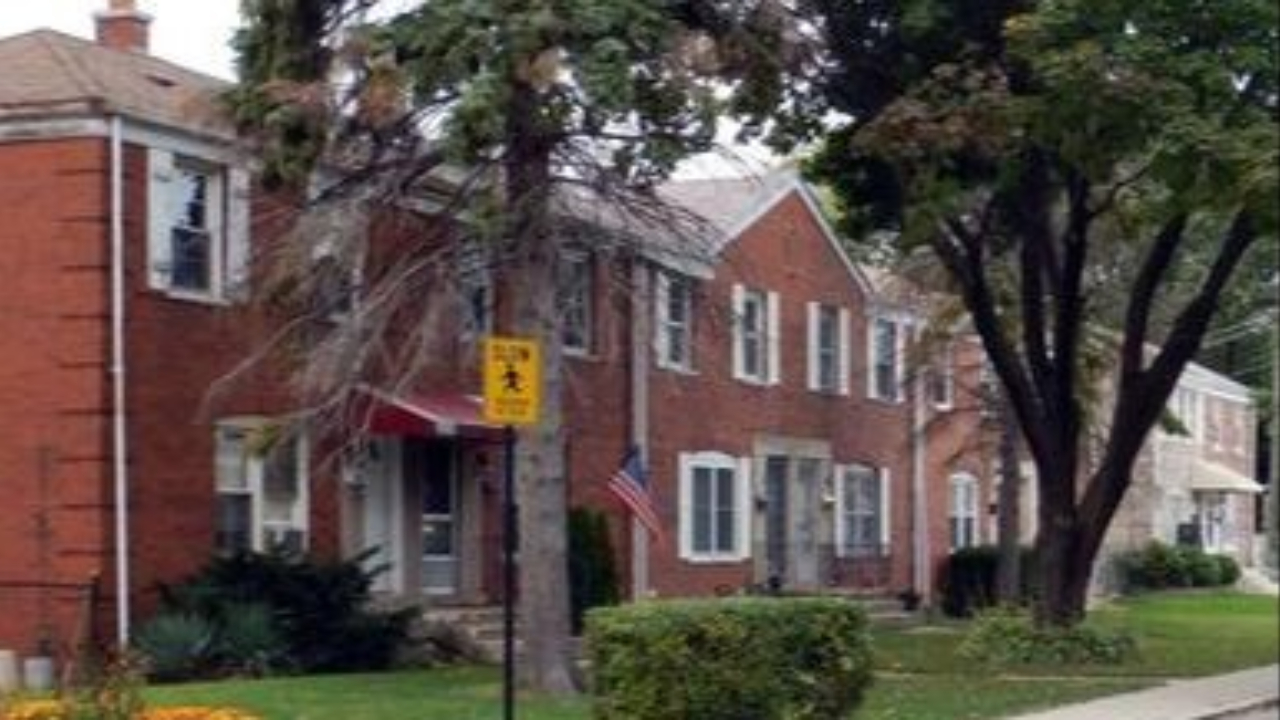
Clearing sits on Chicago's far Southwest Side, approximately ten miles from the Loop. It is bounded by 59th Street to the north, 65th Street to the south, Harlem Avenue to the west, and railroad tracks just east of Cicero Avenue to the east. The southern half of Chicago Midway International Airport falls within the neighborhood's boundaries, a geographic fact that has shaped Clearing's identity, economy, and character for over a century.
Clearing by the Numbers
Trivia Question
A planned community within Clearing was built during World War II to house workers at a nearby defense plant. Those workers helped assemble engines for one of the most important bombers of the war. What was the name of that bomber and what is the neighborhood called today?
Early Land and the Origin of a Name
Before Chicago arrived, the land that would become Clearing was flat prairie claimed by Dutch and German farmers who arrived in the mid-nineteenth century. The area's most prominent early landowner was John "Long John" Wentworth, a six-foot-six former mayor of Chicago and U.S. Senator who amassed roughly 4,700 acres of Southwest Side land in the 1850s and 1860s. He built a country estate at what is now 55th and Harlem, bred cattle and horses on his holdings, and rode the train out from the city nearly every day to tend to his farm.
After Wentworth died in 1888, his family leased the land to Dutch truck farmers, and the area remained largely agricultural into the early twentieth century. There was little to distinguish it from the surrounding prairie, a hardware store opened in 1909, and a handful of scattered homesteads dotted the landscape.
The neighborhood's name has a practical origin. It derives from the practice of "clearing" — that is, delivering or forwarding — farm goods through the railroad yards and the nearby airport. A failed 1888 railroad switching yard project proposed by businessman A.B. Stickney was also to have been called "Clearing," and though the yard never materialized, the name stuck to the land.
Incorporation, Industry, and the Coming of Midway
In 1912, the scattered residents of Clearing voted to incorporate as an official village within Stickney Township. Three years later, the Chicago Transfer and Clearing Company linked a freight car switching hub to eighteen separate industries in the area, generating enough momentum to push Clearing into annexation by the City of Chicago in 1915.
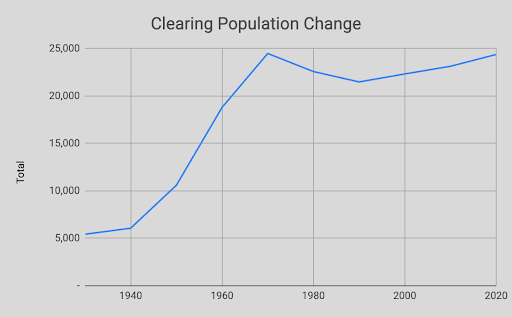
The opening of Chicago Municipal Airport (later renamed Midway Airport) in 1927 accelerated growth considerably. The airport brought jobs, logistics activity, and a steady demand for nearby housing and services. By 1930 the neighborhood's population had reached 5,434, a modest but meaningful base that would multiply dramatically over the following two decades.
During the 1930s and 1940s, more than 300 industrial companies established operations in the Clearing Industrial District, drawn by the neighborhood's rail access, proximity to the airport, and available land. The area became one of the more productive manufacturing zones on the Southwest Side, employing thousands of workers from Clearing and surrounding neighborhoods.
Chrysler Village: A Wartime Neighborhood Within a Neighborhood
The most historically distinctive corner of Clearing is Chrysler Village, a planned community on the neighborhood's eastern edge that stands as one of Chicago's most significant contributions to the World War II home front.
In 1942, the federal government announced plans to construct a massive Chrysler Defense Plant adjacent to Clearing and Chicago Municipal Airport. The plant, a $100 million facility stretching 6.3 million square feet began producing engines for the B-29 Superfortress bomber the following year. The B-29 was the most sophisticated long-range bomber the United States had ever built, and it played a decisive role in the Pacific theater, including the missions that ended the war.
To house the plant's estimated 30,000 workers, private developers Joseph E. Merrion and F.J. Walsh built Chrysler Village in 1943. The 64-acre development between 63rd and 65th Streets contains roughly 700 housing units: single-family homes, duplexes, and multi-unit row houses arranged along winding, curvilinear streets centered on Lawler Park. The layout was a deliberate departure from Chicago's rigid grid, designed to create a sense of community and suburban calm within the city.
Chrysler Village is more than a wartime footnote. Historians credit it as an important prototype for the postwar suburban developments including the famous Levittown communities that would reshape American housing after 1945. In 2014, Chrysler Village was added to the National Register of Historic Places, recognizing its architectural and historical significance.
The O'Hare Effect and Mid-Century Transition
For a generation after the war, Clearing hummed along as a prosperous working-class community. The Chrysler Defense Plant became the Ford Motor Company's aircraft engine division, continuing to produce engines this time for B-52 bombers through the early Cold War years. The plant was eventually converted into Ford City Mall, which opened in 1965 and remains a retail anchor on Cicero Avenue just outside the neighborhood's boundary.
The opening of O'Hare International Airport in 1955 marked a turning point. As O'Hare expanded into a major international hub, Midway lost much of its commercial traffic. Airlines, freight companies, and airport-adjacent businesses migrated north. Workers followed. The economic engine that had powered Clearing for three decades began to sputter.
The subsequent decades brought demographic change. As longtime European-immigrant families relocated to the suburbs, new residents, first young couples seeking affordable homeownership, then, beginning in the late 1980s, Mexican-American families — moved into the neighborhood. The transition followed a pattern familiar across Chicago's Southwest Side: a working-class community that had been nearly homogenous shifted steadily toward majority-Latino.
Clearing Today
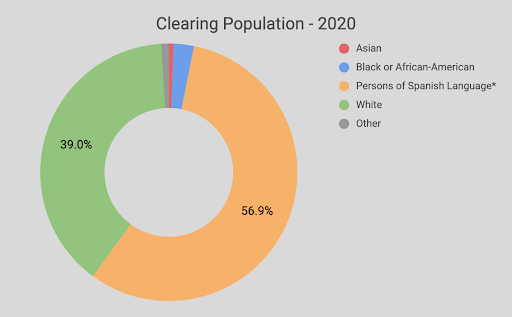
Today, Clearing is a stable, predominantly residential community with a demographic profile that is roughly half white and half Latino, making it one of the more mixed neighborhoods on the Southwest Side. The working-class homeownership ethic that defined the neighborhood's earlier generations persists many blocks show the care of long-term owners who have tended the same brick bungalows for decades.
Midway Airport's resurgence has helped stabilize the neighborhood. After years of reduced service, Midway rebounded as a major domestic hub, particularly for low-cost carriers. The airport is the neighborhood's largest employer and its most prominent geographic feature, with flight paths that make the skies over Clearing among the more active in the city.
Lawler Park and Hale Park serve as the neighborhood's primary green spaces, each with fieldhouses, athletic fields, and programming that draws families year-round. The Clear-Ridge Historical Society, based at the Clearing branch of the Chicago Public Library, actively preserves the neighborhood's history from the Long John Wentworth era through the Chrysler Village years and beyond.
Clearing's story is one of working people and wartime purpose, of farmland turned factory floor turned family neighborhood. It is quieter than its history might suggest, and easier to pass through than to truly see. But beneath its modest exterior is a place that helped build the bombers that won a war and then built a community around what was left when the war was over.
Trivia Answer
The bomber was the B-29 Superfortress, the long-range heavy bomber that proved decisive in the Pacific theater of World War II. The defense workers who assembled its engines lived in Chrysler Village, a 64-acre planned community built in 1943 between 63rd and 65th Streets in Clearing. After the war, the Chrysler Defense Plant became Ford City Mall. Chrysler Village was added to the National Register of Historic Places in 2014.
Stay connected with news and updates!
Join our mailing list to receive the latest news and updates from our team.
Don't worry, your information will not be shared.
We hate SPAM. We will never sell your information, for any reason.
