
Before They Called It Rap, They Called It Truth
Jun 11, 2026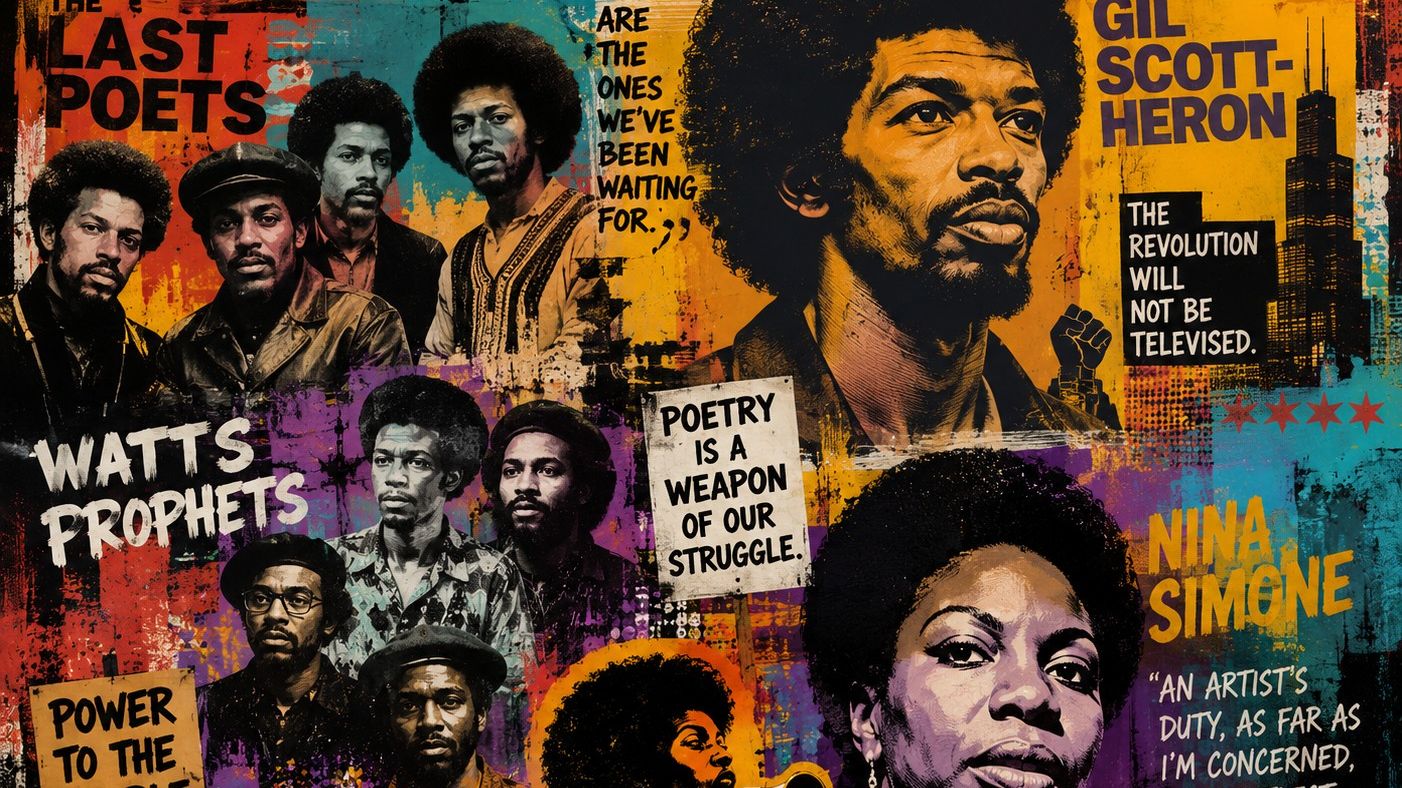
The Last Poets, Gil Scott-Heron, the Watts Prophets, Nina Simone, and the Revolutionary Roots of Hip Hop
What if the most important music in the history of Black America was never played on the radio? What if the blueprint for hip hop — the rhythms, the anger, the poetry, the refusal to stay quiet — was already written before anyone called it rap?
That is exactly what happened. Before Kendrick Lamar won a Pulitzer Prize, before Public Enemy shook the country, before Grandmaster Flash put the streets into verse — four forces were already doing the work. The Last Poets. Gil Scott-Heron. The Watts Prophets. Nina Simone. They did not wait for permission. They did not soften the message. They looked at what was happening to Black people in America and they said it plain, said it loud, and said it over a beat.
This is the story of the fathers — and the mother — of hip hop. And it starts not in a recording studio, but at a memorial for a slain leader.
Born at a Memorial: The Last Poets
On May 19, 1968 — the birthday of Malcolm X — three young Black men stood in a Harlem park and read poetry. David Nelson, Gylan Kain, and Abiodun Oyewole had no label, no manager, and no guarantee that anyone would listen. What they had was fire.
They called themselves the Last Poets, a name drawn from the words of South African revolutionary poet Keorapetse Kgositsile, who believed he was living in the last era of poetry before guns would have to do the talking. The name carried weight. So did everything that came out of their mouths.
"What we wanted to do was to be disciples of Malcolm — using poetry to illuminate the same values that he planted in our heads, like self-determination and Black Nationalism." — Abiodun Oyewole
The Last Poets were not performing for applause. They were performing for survival — the survival of a community under siege. The civil rights movement had just lost Dr. King. The streets were burning. The Black Panthers were organizing. Black America was furious, grieving, and hungry for a voice that did not flinch.
The Last Poets gave them that. They blended spoken word with African percussion — congas, bongos, hand drums — and delivered lines that cut straight to the bone. Their 1970 debut album arrived with tracks that named the rot in American society directly. They were not interested in metaphor when the truth was urgent enough. Poems like "Niggers Are Scared of Revolution" forced Black audiences to look inward as much as outward — to ask themselves whether they were ready to do what freedom actually required.
Music critic Jason Ankeny put it plainly: "With their politically charged raps, taut rhythms, and dedication to raising African-American consciousness, the Last Poets almost single-handedly laid the groundwork for the emergence of hip-hop." Britain's NME agreed, writing that serious voices like the Last Poets "paved the way for the many socially committed Black emcees a decade later."
They were not rappers. They were griots. They were prophets. And they were the blueprint.
From Watts With Fire: The Watts Prophets
Three thousand miles away from Harlem, in the scarred streets of Watts, California, another revolution was finding its voice.
The 1965 Watts Riots had torn through South Los Angeles like a storm — six days of uprising born from decades of police brutality, poverty, and a city that looked the other way. In the aftermath, screenwriter Budd Schulberg established the Watts Writers Workshop, a creative space designed to give the community an outlet. What emerged from that workshop changed music history.
Richard Dedeaux, Father Amde Hamilton, and Otis O'Solomon — three poets with something urgent to say — found each other in that workshop around 1967 and formed the Watts Prophets. Like the Last Poets, they set their spoken-word poetry against jazz and percussion backings. Like the Last Poets, they performed in the streets, in prisons, at community fundraisers — wherever people needed to hear the truth spoken out loud.
But the Watts Prophets carried the specific weight of West Coast Black experience. They had watched their neighborhood burn and watched the system that set it on fire face no accountability. Their work was incendiary by design. Father Amde Hamilton said it directly: "The Watts Prophets are not entertainers. We are revolutionaries."
"We are all poets. The Watts Prophets are not entertainers. We are revolutionaries." — Father Amde Hamilton
In 1969 and 1971, they released two albums that drew from the same spirit as the Last Poets — raw, political, unapologetic. But their 1971 album Rappin' Black in a White World holds a special distinction in music history: many scholars consider it the first recording to use the word "rap" to describe a performance featuring rhyming spoken word over music. That album preceded "Rapper's Delight" — widely credited as hip hop's commercial breakthrough — by nearly a decade.
The Watts Prophets also paid a price for their truth-telling. The radical, incendiary tone of their work drew unfavorable attention from the government. In 1975, the home of the Watts Writers Project was destroyed in a fire — after it had been infiltrated by an FBI informant. The disruption that followed kept them from the national recognition they deserved.
But the music survived. And so did the legacy. They were the West Coast conscience of a movement that stretched from Harlem to Los Angeles, proving that the demand for Black liberation was not a regional story — it was a national one..
The Godfather Speaks: Gil Scott-Heron
Around the same time the Last Poets and Watts Prophets were taking to stages and streets, a young man named Gil Scott-Heron was sharpening his pen at Lincoln University in Pennsylvania. Born in Chicago, raised in Tennessee and New York City, Scott-Heron had poetry in his blood and politics on his mind. When he released his debut live album Small Talk at 125th & Lenox in 1970, the world was not ready — but it needed to be.
That album contained "The Revolution Will Not Be Televised," a spoken-word piece delivered over jazz instrumentation that would become one of the most important protest compositions of the twentieth century. Scott-Heron's delivery was sharp, rhythmic, and furious. He dismantled consumer culture and media complacency in real time, calling out the way television was putting Black communities to sleep while the world burned around them.
"The revolution will not be brought to you by Xerox in 4 parts without commercial interruptions." — Gil Scott-Heron
What Scott-Heron did was unprecedented. He fused the jazz tradition with the urgency of the streets, the precision of poetry with the power of music. He described himself as a "bluesologist" — someone studying the roots of the blues — and that description captures exactly what he was doing: excavating the soul of Black America and putting it into words that no one could ignore.
His 1971 album Pieces of a Man deepened the work. Tracks like "The Bottle" documented addiction and urban poverty with the compassion of Richard Wright and the groove of Marvin Gaye. He followed it with Winter in America in 1974, a meditation on what Black America had lost and what it was still fighting for. Every album was a document, a testimony, a call to action.
Posthumously, the recognition caught up with him. Scott-Heron received a Grammy Lifetime Achievement Award in 2012 and was inducted into the Rock and Roll Hall of Fame in 2021 as an Early Influence Award recipient. Kendrick Lamar has cited Pieces of a Man as a direct inspiration. Common, Talib Kweli, Nas, Lupe Fiasco, Kanye West, and 2Pac all drew from his well.
He was not just the Godfather of Rap — a title he famously resisted. He was the conscience of a movement.
She Was Already There: Nina Simone
Before any of them picked up a microphone, Nina Simone sat down at a piano and decided she was done being quiet.
Simone had been denied admission to the Curtis Institute of Music in Philadelphia — a decision widely believed to be rooted in racism — despite being one of the most gifted classical pianists of her generation. She turned that rejection into something the world would never forget. She became Nina Simone. And when the civil rights era shook the country to its foundation, she did not step back. She stepped up.
In 1963, she wrote "Mississippi Goddam" in response to two devastating blows: the assassination of civil rights activist Medgar Evers and the bombing of the 16th Street Baptist Church in Birmingham, Alabama, which killed four young Black girls. She said the song "burst out" of her in fury and grief. And it sounded like it. Performed at Carnegie Hall, it was biting, satirical, and completely uncompromising — she mocked the idea of patience and gradualism with lines that named exactly who was responsible and exactly what they had done.
"At first I tried to make myself a gun. I gathered some materials. But the only way I could express what I felt was through music." — Nina Simone on writing 'Mississippi Goddam'
Simone rejected the passive, polite protest music of the era. She called out the country by name. She named its violence. She demanded — not requested — equality. And she paid for it. She was watched by authorities, censored by broadcasters, and sometimes pushed to the margins of an industry that wanted her talent without her politics. She kept going anyway.
Her song "To Be Young, Gifted and Black," inspired by her friend playwright Lorraine Hansberry, became a rallying cry for a generation and a declaration of Black identity that would echo through decades of music. From Lauryn Hill to Alicia Keys, from Beyoncé to Rapsody, the artists who followed her carry her fingerprints.
In the lineage from Simone to the Last Poets and the Watts Prophets and Scott-Heron to hip hop, she is the mother of the tradition. The one who proved, before any of them, that Black music could be a weapon of truth — and that using it that way would cost you something — and that you should do it anyway.
The Bridge: From the Streets to the Speakers
The 1970s were fertile ground. The Last Poets were performing. The Watts Prophets were recording. Gil Scott-Heron was releasing album after album. Nina Simone had already lit the fuse. And in the South Bronx, something new was taking shape — block parties, turntables, DJs looping breakbeats, and young people starting to rhyme over the top of it all.
Hip hop was being born, and it was drinking from the same well.
The connection was not accidental. Political hip hop — the branch of rap that looked hard at power and refused to look away — grew directly from the seeds planted by these pioneers. The form evolved, the beats changed, but the mission stayed the same: speak the truth that the powerful do not want spoken.
In 1982, Grandmaster Flash and the Furious Five released "The Message," and hip hop would never be the same. The song documented life in the inner city with a rawness that shocked mainstream America. Chuck D of Public Enemy — who would later call "The Message" the most important hip-hop song ever made — recognized exactly what Grandmaster Flash had done: he had picked up the baton and run with it.
"We should always make note that these efforts were done before: Last Poets, Watts Prophets, Gil Scott-Heron, Nina Simone." — Chuck D
Then came Public Enemy. Formed in 1985, Chuck D and Flavor Flav built a sonic and political machine unlike anything hip hop had produced. Their 1988 album It Takes a Nation of Millions to Hold Us Back was the first hip hop album to top the Village Voice's Pazz & Jop critics' poll. And when Spike Lee came looking for a theme song for Do the Right Thing in 1989, Public Enemy delivered "Fight the Power" — an anthem that drew a direct line from the fire of the civil rights era to the streets of Brooklyn.
The lineage was clear. From Simone's piano and defiance, to the Last Poets' percussion and prophecy, to the Watts Prophets' West Coast fury, to Scott-Heron's poetic rage, to Grandmaster Flash's street reportage, to Public Enemy's organized resistance — each generation was building on what came before, turning up the volume, and reaching new audiences with the same essential message: something is wrong in this country, and Black people are paying the price.
The Tradition Continues: The Present-Day Truth-Tellers
The revolutionary spirit planted in the 1960s is still alive. It has simply found new vessels.
Kendrick Lamar is the most celebrated rapper of his generation — Pulitzer Prize winner, multiple Grammy champion, Super Bowl headliner. But more than the accolades, Lamar is a truth-teller in the tradition of his forebears. His 2015 album To Pimp a Butterfly contained a jazz-centric musical base and spoken-word sections that recalled the Last Poets directly. It examined Black identity, systemic racism, and self-destruction with the kind of unflinching honesty that Scott-Heron practiced in the early 1970s. At the 2025 Super Bowl halftime show, Lamar invoked Scott-Heron's spirit, connecting the moment to a fifty-year lineage of resistance.
- Cole, Common, Lupe Fiasco, Talib Kweli, KRS-One, Mos Def — all of them carry the thread. Each one, in their own way, has looked at the world and refused to pretend it was fine.
And then there is Bad Bunny. The Puerto Rican superstar is one of the most listened-to artists on the planet, and he has never once used that platform to stay safe. He has called out corrupt politicians by name, addressed the displacement of Puerto Rican communities, spotlighted femicide and violence against trans women, and used his music to document the ongoing colonial reality of the island. His 2025 album DeBÍ TiRAR MáS FOToS was his most explicitly political yet — examining gentrification, displacement, and identity with the kind of specificity that honors the tradition Simone, the Last Poets, the Watts Prophets, and Scott-Heron established.
Bad Bunny does not rap in English. He does not need to. The tradition of truth-telling in music crosses every language, every border. What connects him to Nina Simone is not the melody — it is the refusal. The refusal to be silent. The refusal to let power go unnamed. The refusal to make comfortable music for an uncomfortable world.
We live in a moment when truth-telling is dangerous again. When calling out corruption can cost you your career, your freedom, or your life. When the machinery of distraction — social media, streaming culture, constant noise — makes it easier than ever to look away.
Nina Simone sat at a piano in 1963 and wrote a song while the country was still deciding whether Black children deserved to live. The Last Poets stood in a park in 1968 and spoke the names of the things that were killing their community. The Watts Prophets built a workshop out of the ashes of a riot and turned grief into art that the government feared enough to try to destroy. Gil Scott-Heron warned us that if we sat in front of the television long enough, we would forget to revolt.
They were right then. They are right now.
Every rapper who has ever picked up a mic and said something real — something that made somebody uncomfortable, something that named a name, something that gave language to a suffering that had no words before — is standing on the foundation these four built.
Hip hop did not come from nowhere. It came from grief and fury and love. It came from people who believed that the truth, spoken clearly and loudly enough, could change something. It came from poets who understood that the revolution might not be televised — but it would be rapped.
"The revolution will not be right back after a message about a white tornado." — Gil Scott-Heron. It will be in the music. It always has been.
Stay connected with news and updates!
Join our mailing list to receive the latest news and updates from our team.
Don't worry, your information will not be shared.
We hate SPAM. We will never sell your information, for any reason.
