
Auburn Gresham: A South Side Neighborhood Built on Bungalows, Faith, and Resilience
Apr 15, 2026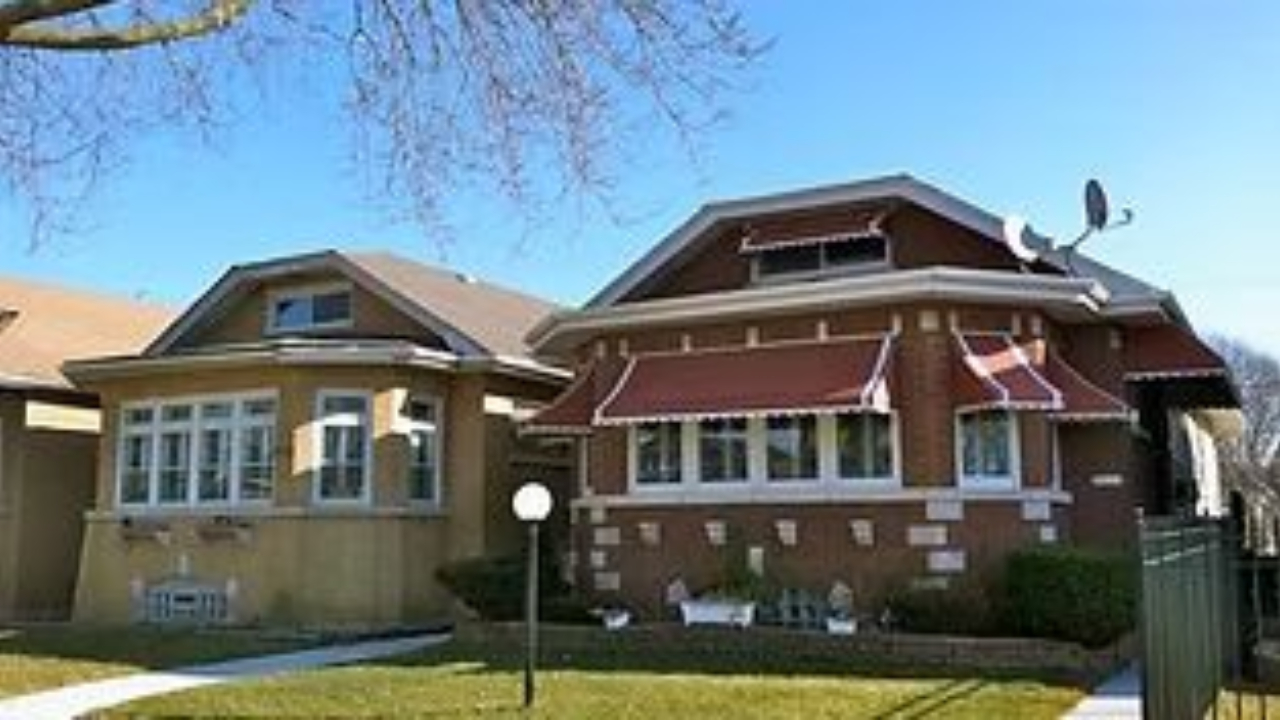
Auburn Gresham sits on Chicago's far South Side, roughly nine miles from the Loop. It is bounded by 71st Street to the north, 87th Street to the south, Halsted Street to the east, and the Union Pacific railroad tracks to the west. Within those borders lies one of the city's most storied and underappreciated neighborhoods. Auburn Gresham, a place of handsome brick bungalows and limestone-edged lagoons, of Catholic parishes that once organized the lives of tens of thousands of Irish and German families, and of the Black middle-class community that moved in when those families departed and has been working to rebuild the neighborhood ever since.
Auburn Gresham by the Numbers
Trivia Question
One of the most celebrated and influential American writers of the twentieth century was born at 7812 South Emerald Avenue in Auburn Gresham in 1928. His novels and short stories, many of them exploring themes of identity, reality, and what it means to be human, have been adapted into some of Hollywood's most enduring science fiction films. Who was he?
From Swamp Prairie to Streetcar Suburb
The land that became Auburn Gresham started as low, flat, swampy ground at the southeastern edge of the old Town of Lake. The same township that gave rise to many of Chicago's South and Southwest Side neighborhoods before annexation in 1889. German and Dutch truck farmers were among the first European settlers, working the land in the mid-nineteenth century alongside the Irish railroad workers who followed the new rail lines south. Neither group found the terrain hospitable for much beyond farming and transit. The neighborhood remained resolutely rural.
The 1893 World's Columbian Exposition changed the calculus for much of Chicago's South Side. The fair drew 27 million visitors to Jackson Park and prompted the city to dramatically extend its streetcar infrastructure southward. New lines pushed down Halsted, Racine, and Ashland all the way to 87th Street. The 79th Street line stretched east to the lakefront. Suddenly, land that had been inconveniently remote became commuter-friendly, and developers moved quickly to market it to the families fleeing the older, more congested neighborhoods of Bridgeport, Canaryville, and Back of the Yards.
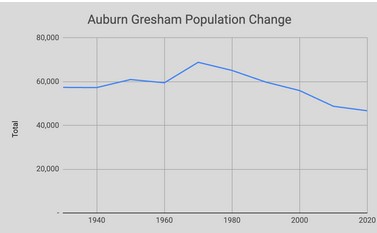
City workers, police officers, firefighters, railroad laborers, and stockyard employees were particularly drawn to Auburn Gresham. The neighborhood offered the space and quiet of the city's edge without sacrificing transit access. The population was around 19,000 in 1920. By 1930 it had nearly tripled to more than 57,000, driven by a decade of intense residential construction that left an architectural legacy still visible on every block today.
The Bungalow Belt and a National Historic District
Auburn Gresham is bungalow country in one of its finest expressions. Between 1918 and 1932, thirty-two different architects designed and built 264 Chicago-style bungalows in what is now the Auburn Gresham Bungalow Historic District; one-and-a-half-story brick homes with broad overhanging eaves, wide front porches, and generous lot sizes that made homeownership feel attainable for working-class families who had never owned property before.
The design was deliberately uniform enough to be affordable but varied enough to feel personal. Brickwork patterns, window arrangements, and decorative details distinguish one home from the next even as the overall massing and scale hold the streetscape together in a way that feels cohesive rather than monotonous. Chicago Magazine called the bungalow belt a form of urban planning that no one planned. A working-class utopia assembled block by block by individual families making individual decisions that somehow added up to something coherent.
The district was added to the National Register of Historic Places in October 2012, becoming Chicago's tenth Bungalow Historic District. Beyond the recognition itself, the designation brought a practical benefit: homeowners who undertake renovations equal to 25 percent of their property's market value qualify for an eight-year property tax freeze under an Illinois program tied to National Register listing. In a neighborhood where homeownership rates remain high and many residents have held their properties for decades, that kind of incentive carries real weight.
Five Parishes and the Irish Catholic South Side
For the first half of the twentieth century, Auburn Gresham was organized around its Catholic parishes as much as its streets. Five major parishes served the community — St. Sabina, St. Leo, St. Carthage, St. Ethelreda, and St. Adrian — each anchoring a cluster of families, schools, and social networks that defined daily life more precisely than any ward boundary or zip code.
The neighborhood had a strong Irish identity, with roughly 21 percent of the population claiming Irish ancestry by the 1930s. German Americans, Swedish Americans, Polish Americans, and other European groups filled out the rest, but the Irish Catholic stamp was the one that gave Auburn Gresham its cultural signature. The South Side Irish Parade, one of Chicago's most beloved St. Patrick's Day traditions, originated in Auburn Gresham stepping off from 79th Street before eventually relocating to the neighboring Beverly neighborhood as the community's Irish population shifted westward.
The intersection of Halsted and 79th Street became one of the South Side's busiest commercial crossroads, a major streetcar transfer point that generated foot traffic, retail activity, and the kind of concentrated neighborhood energy that marks a genuine urban center. Auburn Park — a five-acre green space threaded with lagoons, hand-hewn granite retaining walls, and stone bridges — served as the neighborhood's pastoral counterpoint, a place where the density of bungalow blocks gave way to water and shade.
Blockbusting, White Flight, and the Struggle to Stay
The transformation of Auburn Gresham from an overwhelmingly white neighborhood to a predominantly Black one happened over roughly a decade and was shaped by forces that played out in neighborhoods across Chicago and the urban North. As African-American families — long confined to the overcrowded Black Belt by restrictive housing covenants gained new legal standing following the Supreme Court's 1948 ruling in Shelley v. Kraemer, they began moving outward in search of better housing. Auburn Gresham, with its solid brick bungalows and good transit access, was an attractive destination.
The community's response was not uniform. In 1959, local churches and civic organizations formed the Organization of Southwest Communities (OSC) with the explicit goal of managing the transition without violence or precipitous decline. The OSC worked to deter real estate agents from blockbusting (the practice of deliberately stoking racial fear to drive rapid home sales at below-market prices )and encouraged residents to maintain their properties and resist panic selling. In its first years, the organization had genuine success. The integration proceeded more peaceably in Auburn Gresham than in many comparable neighborhoods.
But the larger economic forces proved too powerful to fully contain. By the end of the 1960s, rising crime, blockbusting pressure, and the pull of newer suburban developments had accelerated white departure far beyond what the OSC's managed-integration model could absorb. The neighborhood that had been nearly 100 percent white in 1960 was 69 percent Black by the 1970 census. Businesses followed their customers to the suburbs. Investment dried up. The commercial corridor on 79th Street, once one of the South Side's most active retail strips, began its long decline.
St. Sabina and Father Pfleger
Of all the institutions that have shaped Auburn Gresham's modern identity, none has been more consequential or more visible than St. Sabina Catholic Church, located at 1210 West 78th Place. Founded in 1916 as a storefront congregation on South Racine Avenue, St. Sabina grew into one of the five major parishes serving Auburn Gresham's early white Catholic population. When the neighborhood transitioned in the 1960s, St. Sabina made a different choice than many of its counterparts: it stayed, and it opened its doors.
Father Michael Pfleger arrived as pastor in 1981, becoming at 25 the youngest full pastor in the Chicago Archdiocese. The church he inherited was struggling, and he was told it would likely close within three years. It did not close. Over the following four decades, Pfleger (a white priest in a predominately Black community) transformed St. Sabina into one of Chicago's most active community institutions — not simply a church but a social service provider, a housing developer, an anti-violence organizer, and a platform for advocacy on gun control, poverty, and racial justice. His weekly summer Peace Walks, in which church members march the neighborhood streets, have become a fixture of Auburn Gresham's civic life. The ARK of St. Sabina, the church's youth development nonprofit, provides education, mentoring, and programming for young people in Auburn Gresham and neighboring Englewood.
Pfleger's tenure has not been without controversy. His outspoken political activism has drawn criticism from within the Archdiocese and beyond, and he faced a serious personal crisis in 2021 when he was placed on administrative leave during an investigation into abuse allegations — allegations from which he was ultimately cleared. He returned to St. Sabina in 2022 and has continued his work. Whatever one makes of the man, the institution he has built in Auburn Gresham is among the most durable examples of a church functioning as a genuine anchor for a neighborhood in need.
Disinvestment, Resilience, and the Work of Rebuilding
The decades following white flight brought persistent disinvestment to Auburn Gresham. Grocery stores closed or never opened. National retail chains that had lined 79th Street pulled out. Liquor stores and currency exchanges filled the gaps. The mortgage crisis of 2008 hit the neighborhood hard, adding foreclosures to a housing market already under pressure from decades of redlining and contract buying that had stripped equity from many families who thought they were building wealth.
The Greater Auburn-Gresham Development Corporation (GAGDC), which has operated in the neighborhood for decades, has worked steadily against those trends — attracting new housing development, supporting commercial tenants on 79th Street, and connecting residents to economic opportunity. In 2020, the organization was awarded a $10 million Chicago Prize from the Pritzker Traubert Foundation, the largest community development prize in the city's history, in recognition of its plans for a Healthy Lifestyle Hub at 79th and Halsted — a development combining affordable housing, community health facilities, green technology, and retail in a building designed to catalyze investment along the corridor.
Auburn Gresham also received designation as an INVEST South/West corridor under Mayor Lightfoot's initiative, bringing city resources to bear on commercial and residential development in a neighborhood that had long been overlooked. A new Metra station at 79th Street — decades in the making — broke ground in 2024 and will give the neighborhood a second commuter rail stop in addition to the existing Gresham station at 87th and Vincennes.
Auburn Gresham Today
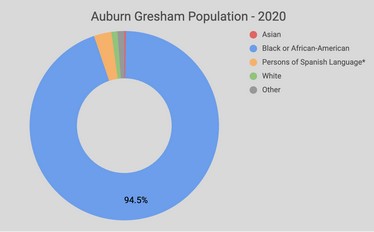
Auburn Gresham today is a neighborhood carrying a heavy history and doing serious work to reshape its future. Its population is roughly 93 percent African American — largely middle-class homeowners, city workers, and long-term residents who have stayed through decades of disinvestment and are now watching new investment slowly return. The bungalows that went up in the 1920s are still standing, still occupied, still anchoring blocks that hold their character even when the commercial strips around them have struggled.
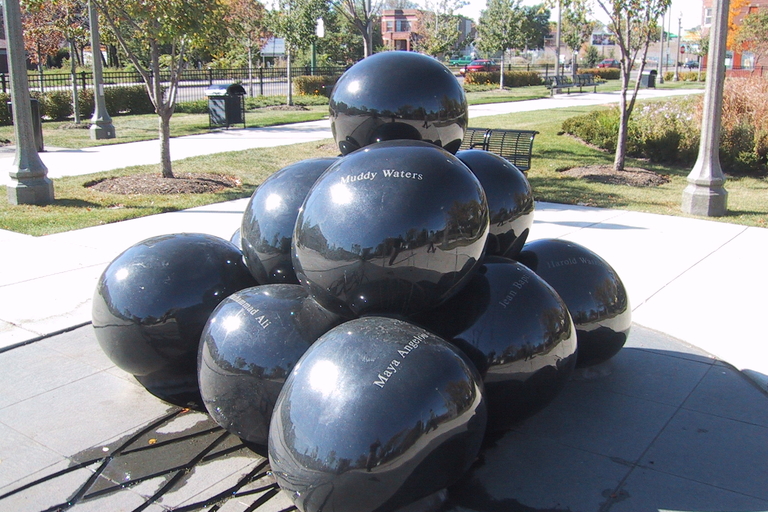
Auburn Park, with its lagoons and stone bridges and fishing ponds, remains one of the South Side's most quietly beautiful green spaces. Renaissance Park, nearby, features a sculptural fountain designed by artist Jerzy Kenar: a pyramid of black granite spheres inscribed with the names of significant African-American figures — Martin Luther King Jr., Rosa Parks, Harold Washington, Maya Angelou. The fountain sends water cascading down the granite in what the artist described as a spring of positive change.
The neighborhood has also produced people who carry its stories elsewhere. A Tuskegee Airman named John "Jack" Lyle who shot down an enemy aircraft in World War II, then came home to find work washing windows because the country wasn't ready to honor what he'd done, spent his later years here, sailing on Lake Michigan and inventing things in his basement workshop until he was nearly a hundred years old. A woman named Minyon Moore, who grew up in the neighborhood, went on to become White House Political Director under President Clinton and the coordinator of the 2024 Democratic National Convention. And a boy born on South Emerald Avenue in 1928 grew up to write science fiction novels that are still in print, still taught in universities, and still asking the questions that matter most.
Auburn Gresham's story is Chicago's story, compressed: the optimism of the bungalow boom, the violence of racial transition, the long work of rebuilding after disinvestment, and the stubborn insistence of a community that refuses to be written off. The lagoons at Auburn Park have been there longer than most of the neighborhood's residents have been alive. They will likely outlast whatever comes next.
Trivia Answer
The writer born at 7812 South Emerald Avenue in Auburn Gresham in 1928 was Philip K. Dick (1928–1982). One of the most visionary and prolific science fiction authors of the twentieth century, Dick wrote novels and stories exploring identity, consciousness, surveillance, and the nature of reality — themes that feel urgently contemporary decades after his death. His works are the basis for numerous Hollywood films, including Blade Runner (adapted from Do Androids Dream of Electric Sheep?), Total Recall (We Can Remember It for You Wholesale), Minority Report, A Scanner Darkly, and The Adjustment Bureau. Dick spent little of his adult life in Chicago, but his birthplace on the South Side places him firmly in Auburn Gresham's history.
Stay connected with news and updates!
Join our mailing list to receive the latest news and updates from our team.
Don't worry, your information will not be shared.
We hate SPAM. We will never sell your information, for any reason.
