
Ashburn: From Ash Heaps and Airfields to Chicago's Best-Kept Secret
Apr 08, 2026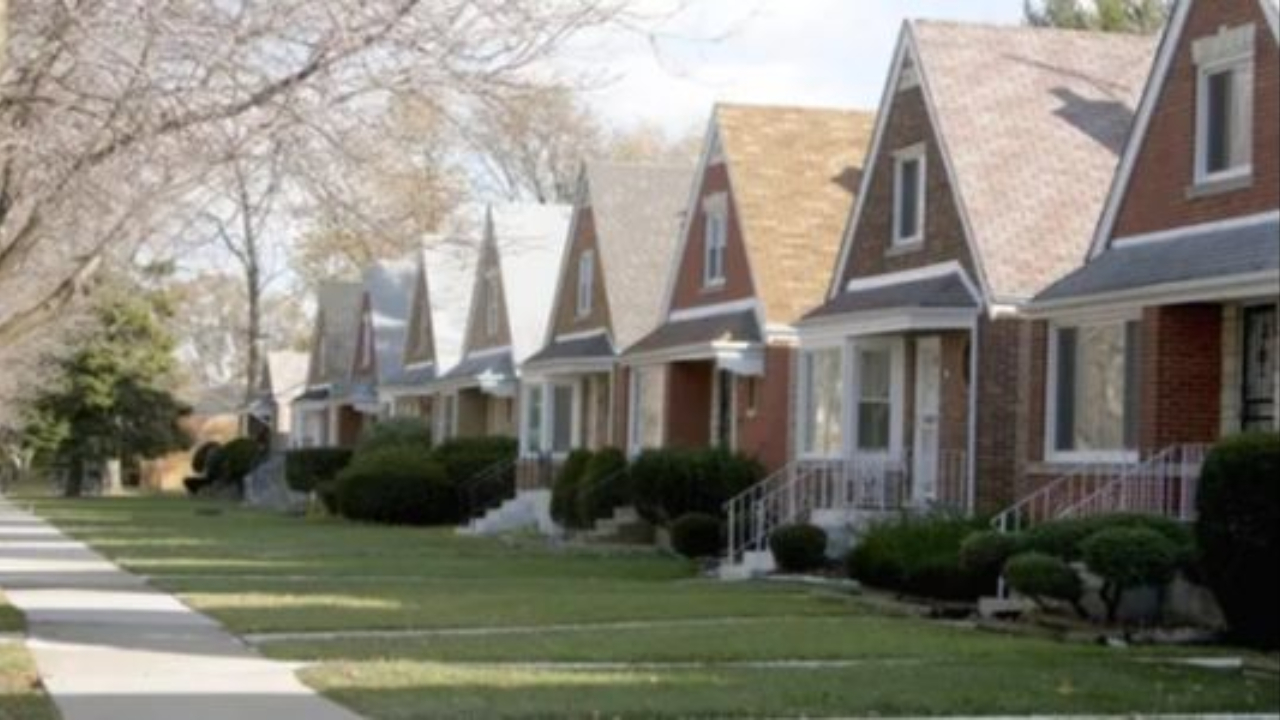
Ashburn sits on Chicago's far Southwest Side, about ten miles from the Loop. It is bounded by 72nd Street to the north, 87th Street to the south, Western Avenue to the east, and Cicero Avenue to the west. Nearly five square miles of bungalows, two-flats, and tree-lined residential blocks that feel more like a suburb than a city neighborhood. Ashburn borders the municipalities of Evergreen Park and Oak Lawn to the south and west, and that suburban quality is more than impressive. It was, for much of the twentieth century, the end of the line, the place where the city ran out of city.
Trivia Question
Ashburn Flying Field, which opened in 1916 at 83rd Street and Cicero Avenue, was Chicago's first registered airport. In its early years, a young man who would go on to achieve one of the most celebrated feats in aviation history reportedly spent time at Ashburn Field learning the craft of flying. Who was he, and what did he later accomplish?
Ashburn by the Numbers
Ash Heaps, Annexation, and a Slow Start
The name Ashburn is not poetic. It derives from a practical and unglamorous reality: the land that would become the neighborhood was used as a dumping site for ashes from Chicago's coal-fired furnaces and fireplaces. By 1908, the area had accumulated enough of an identity and enough ash to be formally named for the practice. Before that, it had been absorbed into the city as part of the Town of Lake annexation in 1889, but annexation brought little development to a tract of land still largely defined by marshiness and an inconvenient distance from downtown.
The first formal subdivision, called Clarkdale after its developer, was platted near 83rd Street and Central Park Avenue in 1893, alongside the newly arrived Chicago and Grand Trunk Railway. In the half-century that followed, fewer than 20 homes were built on that plat. The early residents were Dutch, Swedish, and Irish that made up a small, scattered community occupying what was essentially a flat, wet prairie at the edge of the city's reach. Ash heaps were visible in the fields south of Ford City but north of 79th Street well into the postwar era, before Bogan High School was built and residential development finally swallowed the last open ground.
Ashburn Flying Field: Chicago's First Airport
The event that first put Ashburn on the map had nothing to do with housing or industry. In November 1916, Ashburn Flying Field opened at 83rd Street and Cicero Avenue, making it Chicago's first registered airport. The airfield occupied a marshy but usable tract on the neighborhood's western edge, and it quickly drew the aviators, mechanics, and aviation enthusiasts who were then making Chicago into one of the country's early centers of flight.
When the United States entered World War I, Ashburn Flying Field was converted into a training camp for the U.S. Army Signal Corps. The airfield buzzed with biplanes and military recruits, and the neighborhood's population climbed briefly to around 1,363 — still a small number by any measure, but a notable spike for a community that had barely existed the decade before. After the war, the field transitioned to civilian aviation and airmail contracts, becoming home to the E.M. Laird Airplane Company. Emil "Matty" Laird, a Chicago native and pioneering aircraft designer, built and raced planes at Ashburn Field throughout the 1920s, producing some of the most competitive racing aircraft of the era.
Among the many young aviation enthusiasts who passed through Ashburn Field in its early years was a young man from the Midwest who had developed an obsession with flying and was quietly acquiring the skills that would eventually carry him across the Atlantic Ocean. Ashburn Field closed in 1939, its marshy ground never quite ideal for the increasingly demanding requirements of modern aviation. By then, another airfield had already superseded it, Chicago Air Park, which had opened just north of Ashburn in 1923 for airmail service, and which would eventually grow into Chicago Midway International Airport.
The Postwar Boom: From Ash Fields to Bungalow Belt
The transformation of Ashburn from a sparsely populated fringe into one of Chicago's most densely settled residential neighborhoods happened with remarkable speed and was driven by a convergence of forces that arrived almost simultaneously in the late 1940s and early 1950s.
The postwar economic boom gave returning veterans access to federally backed mortgages through the GI Bill. The baby boom filled those homes with children. The industrial expansion anchored by the nearby Ford City complex ( the massive former Dodge Chicago plant at 76th and Cicero) provided blue-collar employment within a short commute. And the ash heaps that had long made Ashburn feel like the wrong side of the city line were finally graded over and forgotten as developers raced to build on the last large tracts of open land on the Southwest Side.
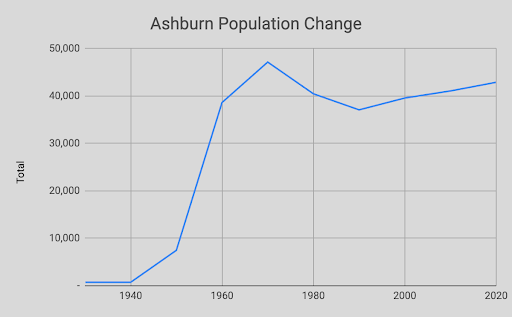
More than 2,400 new homes were constructed in the 1940s and 1950s. The population, which had hovered below 1,000 before the war, surged toward 47,000 by 1970. The housing stock that went up in those two decades defines the neighborhood today: single-family brick bungalows and ranch houses, solidly built and well-maintained, with small yards front and back and a strong ethic of homeownership that has outlasted every demographic shift the neighborhood has since experienced.
Many of the families who moved in were city workers, Chicago police officers, firefighters, teachers, and municipal employees who were required to live within city limits and chose Ashburn because it offered the most suburban experience available inside the city boundary. The neighborhood's proximity to the western suburbs made it feel like a reasonable compromise: city address, suburban feel. That reputation has persisted across generations.
St. Denis, St. Bede, and the Irish Catholic Geography
For the first four decades after the postwar buildout, Ashburn was predominantly Irish-Catholic in a way that was less a demographic fact than an organizing principle. The neighborhood was not simply a place where Irish-Catholic families lived, it was a place structured around Irish-Catholic institutions. In a city where parish boundaries often mattered more than ward lines, Ashburn was divided not by streets but by churches.
Greater Ashburn contained three distinct parish territories that functioned almost like sub-neighborhoods. The westernmost section, known as Scottsdale, fell under St. Bede the Venerable Parish. The central section went by Ashburn proper and organized itself around St. Denis Parish, whose grammar school in the 1950s enrolled more than 2,000 children, many in classrooms of forty students or more, and some in double shifts during the White Sox's 1959 World Series run, when overflow classes were held in the school basement. The easternmost section, known as Wrightwood, was the territory of St. Thomas More Parish.
This parish geography was not merely spiritual. It determined where children went to school, where families socialized, which summer carnivals drew which crowds, and, to a significant degree, where the boundaries of trust and belonging were drawn. Ashburn was a neighborhood of long-term residents — surveys in the early 2000s found that a third of residents had lived there five years or more — and many of those long-timers traced their roots to families that had moved in during the postwar boom and never left.
Desegregation, Resistance, and a Neighborhood Tested
The most turbulent chapter in Ashburn's recent history arrived in the summer of 1977, when the Chicago Board of Education proposed a busing plan to relieve overcrowding in predominantly Black schools on the South Side by transferring students to underutilized schools in the Bogan area — which included Ashburn, Scottsdale, and surrounding neighborhoods.
The response from a significant portion of the white community was fierce and, at its worst, violent. The Bogan Community Council organized a torchlight parade through commercial streets the Sunday before the second week of school, drawing roughly a thousand people who chanted racist taunts and carried effigies of school officials. Eleven people were arrested. Black children arriving at Stevenson Elementary were terrorized by adults and teenagers in the streets. The events drew national media attention and placed Ashburn at the center of one of Chicago's most damaging conflicts over school desegregation.
The busing program ultimately involved relatively small numbers — a permissive transfer plan for a handful of students, not a wholesale reassignment. But the reaction revealed the depth of resistance in the community to racial integration at any scale. White parents had been successfully blocking student transfer plans since 1963, and the 1977 protests were a continuation of that history rather than an aberration from it.
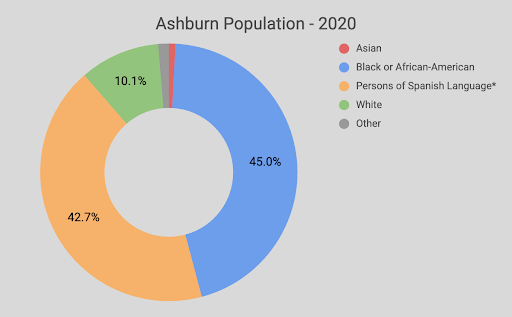
What followed over the next two decades was the demographic transition that resistance had been trying to prevent. African-American middle-class families — many of them the same city workers who had defined the neighborhood's identity, now from different backgrounds — began moving into Ashburn in the 1980s. White flight accelerated through the 1990s as the neighborhood shifted from overwhelmingly white to racially mixed. By 2000, Black residents comprised more than 40 percent of the population. Today, Ashburn is roughly 43 percent Black and 46 percent Latino, making it one of the more genuinely diverse community areas in Chicago — and, according to a 2017 WBEZ analysis, the only Chicago neighborhood with a dominant middle-class Black population that was still adding Black residents between 2000 and 2010, a period when Black Chicagoans were leaving the city in significant numbers.
Vito & Nick's and the Taste That Stays
Any account of Ashburn that omits Vito & Nick's Pizzeria is incomplete. The restaurant at 8433 South Pulaski Road has been operating in the neighborhood since 1965, when Nick Barraco moved the family business from its previous location to the current spot. But the story behind it goes back further: to 1920, when Nick's father Vito opened a speakeasy on the Near West Side; to 1945, when Nick came home from the war and joined the family operation; and to 1946, when his mother Mary developed the cracker-thin crust pizza recipe that would eventually make the family famous.
Vito & Nick's serves tavern-style pizza — ultra-thin, cut into squares, baked until the crust achieves the crunch of a well-made cracker. It is, by the reckoning of many Chicagoans who grew up on the Southwest Side, the platonic ideal of a Chicago pizza: not the deep-dish that visitors come expecting, but the thin crust that actual Chicagoans eat on a Friday night with an Old Style on tap and the Bears on television. The restaurant does not deliver. It has never delivered. Nick Barraco's standing order, issued in 1965 and honored to this day was that if you want a truly great pizza, you come in for it.
Three generations of the Barraco family have run the place. Rose George, Nick's daughter, grew up in the apartment above the restaurant and still lives there. The carpeted walls and the little Pilsner glasses of Old Style and the regulars who have been coming for fifty years are still there too. Chicago Magazine has called the thin crust sausage pizza iconic. Dave Portnoy of Barstool Sports called it something that goes on a list of things you have to eat. The neighborhood has changed enormously around it. Vito & Nick's has not.
Ashburn Today
Ashburn today is a neighborhood in the ongoing work of integration — not as a political project but as a daily reality. Its housing stock remains extraordinarily stable, with homeownership rates well above 86 percent, far exceeding the citywide average. The bungalows built for Irish-Catholic city workers in 1952 are now owned by Black and Latino families with similar profiles: police officers, firefighters, teachers, and municipal employees who want a safe block, a decent school, and a yard. The ethic of homeownership and community investment that defined the neighborhood in one era has carried forward into the next.
The Greater Ashburn Development Association, formed in 2016 to replace its predecessor organization, works to attract businesses, support residents, and counter the commercial disinvestment that followed the white departures of the 1980s and 1990s. The neighborhood received national attention in 2017 when it won the Good Neighbor Award from Nextdoor — the only predominantly African-American community in Chicago to receive the recognition — for its online community organizing and mutual aid.
St. Rita of Cascia High School continues to draw students from across the Southwest Side. Bogan High School, the institution around which the 1977 battles were fought, still serves the community. Durkin Park, a 21-acre green space near the neighborhood's eastern edge, offers athletic fields, a swimming pool, and a fieldhouse that anchors community programming year-round.
The ash heaps are long gone. The airfield where biplanes once lifted off the marshy grass at 83rd and Cicero is now a residential block indistinguishable from every other residential block in the neighborhood. The neighborhood that got its name from what people discarded here became, against the odds and over considerable resistance, a place that people chose — and in many cases, refused to leave.
Trivia Answer
The young aviator who spent time at Ashburn Flying Field was Charles Lindbergh. Before his historic 1927 solo nonstop transatlantic flight from New York to Paris — the first ever completed — Lindbergh was a young Midwesterner working to master the craft of flying. Chicago's Ashburn Field, with its community of aviation pioneers and aircraft builders, was among the early airfields where he refined his skills. His later nonstop solo crossing of the Atlantic in the Spirit of St. Louis, covering 3,600 miles in 33.5 hours, made him one of the most celebrated figures of the twentieth century.
Stay connected with news and updates!
Join our mailing list to receive the latest news and updates from our team.
Don't worry, your information will not be shared.
We hate SPAM. We will never sell your information, for any reason.
