
Archer Heights: The Road That Made a Neighborhood
Mar 25, 2026
Archer Heights occupies a compact wedge of Chicago's Southwest Side, roughly seven miles from the Loop. It is bounded by the Stevenson Expressway (Interstate 55) to the north, the CTA Orange Line tracks to the south, the Corwith rail yard to the east, and railroad tracks near Knox Avenue to the west. Archer Avenue (one of the oldest roads in Illinois) cutting diagonally through the neighborhood from the northeast to the southwest is both its main artery and its defining feature. In a city built on a rigid grid, that diagonal tells you something important: this road was here long before Chicago was.
Trivia Question
Archer Avenue and by extension, Archer Heights, takes its name from Colonel William Beatty Archer, a nineteenth-century civil engineer and canal commissioner. But Archer left a mark on American history that goes well beyond Chicago's Southwest Side. What notable political act is Colonel Archer credited with that connected him to one of the most consequential figures in American history?
Archer Heights by the Numbers
A Road Older Than the City
Before European settlers arrived, the path that would become Archer Avenue was a well-worn Native American trail linking the Chicago River portage to the Des Plaines River valley and points southwest. It was one of the primary overland routes through a landscape otherwise dominated by wetlands and prairie — a reliable high ground through territory that, in wet seasons, was difficult or impossible to cross elsewhere.
When Illinois set out to build the Illinois and Michigan Canal in the 1830s the project that would eventually make Chicago the commercial hub of the continent. The state appointed Colonel William Beatty Archer as one of its first canal commissioners. Archer helped oversee the canal's construction and, crucially, pushed for the road that ran alongside it. That road took his name. It still carries it today.
The canal opened in 1848, linking the Great Lakes to the Illinois and Mississippi Rivers and unleashing a torrent of commerce through Chicago. The road beside it, Archer Avenue carried goods, workers, and settlers in the same direction. Three railroads encircled the area by the 1880s, and Chicago annexed the surrounding land in 1889. But annexation alone wasn't enough to spark settlement. The land remained soggy prairie and sparsely occupied farmland well into the early 1900s. Infrastructure could bring people to an area, but it couldn't drain a swamp.
Streetcars and the First Wave of Settlement
The catalyst for Archer Heights' transformation wasn't a railroad or a factory, it was the streetcar. Horse-drawn trolleys along Archer Avenue appeared in the 1890s, and electric streetcars followed in the early 1900s, suddenly making the Southwest Side accessible to workers whose jobs were elsewhere in the city. For immigrant families crowding into denser neighborhoods closer to downtown, Archer Heights offered something invaluable: affordable land with room to breathe, and a reasonable commute.
Real estate developers moved into the southern sections of Archer Heights around 1900, platting modest residential lots and marketing them to the working class. The northern half of the neighborhood remained largely in the grip of the railroads. The Corwith yard and other freight infrastructure dominated that terrain and would continue to do so for generations. But the southern blocks began to fill in, block by block, with the modest frame houses and early brick two-flats that predated the postwar bungalow boom.
Chicago annexed the neighborhood fully by 1889 and again in subsequent expansions, but it was the slow accumulation of transit access, drainage improvements, and immigrant demand that actually built the community. By 1920, Archer Heights had a recognizable residential character concentrated around its southern half, anchored by Archer Avenue's commercial strip.
Polonia on the Southwest Side
The 1920s and 1930s were the decades that gave Archer Heights its defining character, and that character was overwhelmingly Polish. As Polish immigrants climbed the economic ladder in Chicago, many moved outward along Archer Avenue from older settlements in Bridgeport and McKinley Park, pushing southwest into Archer Heights in search of newer housing and more space. They were joined by Czech, Italian, and Russian Jewish families, but Poles set the cultural tone.
Two Catholic parishes became the neighborhood's institutional anchors. St. Bruno's was established in 1925, and St. Richard's followed in 1938. In a community where parish boundaries often defined daily life more precisely than any political map, these churches organized everything from school enrollment to social events to community organizing. For decades, the answer to "where are you from?" on the Southwest Side was as likely to be your parish as your street address.
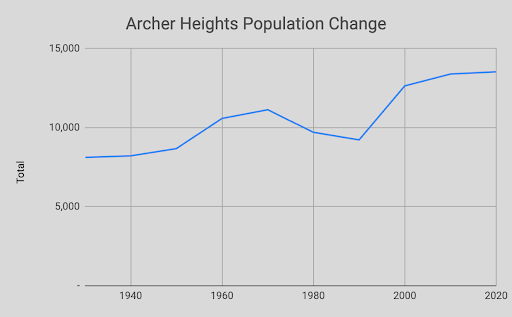
The Great Depression slowed growth but did not devastate Archer Heights the way it hit neighborhoods more dependent on a single industry. The mix of rail employment, proximity to Midway Airport, and the steady manufacturing output of nearby industrial districts. The Crawford and Kenwood corridors to the north and east kept enough of the neighborhood employed to weather the worst years. The population stood at roughly 8,100 in 1930 and barely budged through the decade, but it held.
After World War II, Archer Heights experienced the same bungalow-building surge that transformed much of the Southwest Side. Block after block of single-story brick bungalows and raised ranches filled in the remaining lots. The neighborhood reached its peak population of about 11,000 in 1970. By then, the Polish Highlanders Alliance of North America, a fraternal organization representing the górale, or mountaineer, culture of southern Poland had established its headquarters here, giving the neighborhood a cultural institution that drew visitors from the broader Polish diaspora across the region.
Bobak's, Kielbasa, and the Texture of a Neighborhood
No institution better captured the Polish character of mid-century Archer Heights than Bobak's Sausage Company. Frank Bobak, a first-generation Polish-American, founded the business in 1967 and relocated it to a sprawling complex at 5275 South Archer Avenue in 1989. At its height, Bobak's was one of the most celebrated Polish delis in the Midwest, a 50,000-square-foot retail store and restaurant with a 150-foot deli counter offering fourteen varieties of smoked Polish sausage, imported goods from Eastern Europe, and baked bread that customers described as smelling authentically of the old country.
Its reputation extended well beyond the neighborhood. The Food Network named it one of America's top delis. In 1979, when Pope John Paul II visited Chicago, he specifically requested Bobak's sausage and deli meats. The store became a destination — a pilgrimage site of sorts for Polish-Americans across the Chicago area who came as much for the experience as for the kielbasa.
Bobak's closed its Archer Avenue retail store in 2015, a casualty of both internal family disputes over the company's ownership and the broader demographic shift underway in the neighborhood. The building on Archer is now occupied by El Cubano Wholesale Meats — a change that tells the neighborhood's story in a single sentence.
The Demographic Turn
Archer Heights remained overwhelmingly white and predominantly Polish well into the 1980s. As recently as 1990, the community area was 96 percent white, with roughly 27 percent of residents foreign-born and a strong Polish cohort. Then, in the space of roughly a decade, one of the most dramatic demographic shifts on the Southwest Side reshaped the neighborhood entirely.
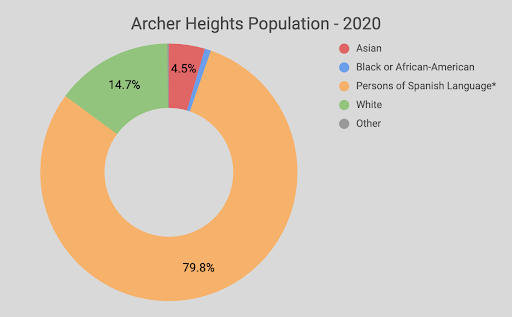
Beginning in the 1990s, Mexican-American families began moving into Archer Heights in large numbers, drawn by the same forces that had attracted Polish immigrants generations earlier: affordable housing, a safe residential environment, and a manageable distance from jobs across the Southwest Side. They bought homes from Polish families departing for the suburbs, enrolled their children in the same parish schools, and began opening businesses along Archer Avenue that reflected their own food traditions and culture. By 2000, Hispanics were the majority. Today they comprise roughly 80 percent of the neighborhood's population.
The transition has been more cultural evolution than rupture. The bungalows are the same. The parish institutions (St. Bruno and St. Richard) still anchor daily life, now serving predominantly Spanish-speaking congregations. The Archer Heights Civic Association, founded in 1938 and the oldest continuously active neighborhood civic organization in Southwest Chicago, has carried forward its mission of homeowner advocacy and community stability across the ethnic transition. The organization's longevity is itself a statement about the neighborhood's character: whatever the language spoken on the block, the underlying ethic of working-class homeownership has endured.
Archer Heights Today
Today, Archer Avenue remains the neighborhood's spine, a diagonal commercial corridor lined with taquerias, panaderías, auto shops, and the kind of family-run businesses that rarely appear on best-of lists but keep a neighborhood functional. Szalas Restaurant, one of the last Polish dining institutions still operating in the area, holds its ground alongside Mexican restaurants that have made their own reputations on the strip. The Polish Highlanders banquet hall still stands. The Szykowsky Funeral Home sits catty-corner from Garcia Tax Service.
Archer Park, a 13-acre green space managed by the Chicago Park District, serves as the neighborhood's social commons. It offers baseball and softball fields, tennis courts, a fieldhouse with a gym and fitness center, and a water playground that draws families in summer. Free outdoor movie nights in warmer months draw multigenerational crowds, the kind of low-key neighborhood institution that doesn't require a marketing campaign because it already has an audience.
The CTA Orange Line, which opened in 1993, gave Archer Heights a direct transit connection to the Loop via the Pulaski station at 51st and Pulaski, a link that the neighborhood had lacked for most of its history when Southwest Siders depended entirely on express buses along the Stevenson. The airport noise from Midway, just to the south, is a permanent backdrop, and the Archer Heights Civic Association remains active in noise mitigation advocacy on behalf of residents.
Trivia Answer
Colonel William Beatty Archer (1793–1870) nominated Abraham Lincoln for vice president at the 1856 Republican National Convention. Lincoln did not receive the nomination that year. John C. Frémont was the party's presidential nominee and William Dayton was selected as his running mate but Archer's nomination of Lincoln was an early signal of the Illinois lawyer's rising national profile. Four years later, Lincoln won the presidency. Archer, meanwhile, left his name on the canal road he helped build, the street that runs through the Southwest Side, and the neighborhood that grew up around it.
Stay connected with news and updates!
Join our mailing list to receive the latest news and updates from our team.
Don't worry, your information will not be shared.
We hate SPAM. We will never sell your information, for any reason.
